Committee asks for data as impact‑fee revenue and building permits fall
November 20, 2025 | Flagstaff City, Coconino County, Arizona
This article was created by AI summarizing key points discussed. AI makes mistakes, so for full details and context, please refer to the video of the full meeting. Please report any errors so we can fix them. Report an error »
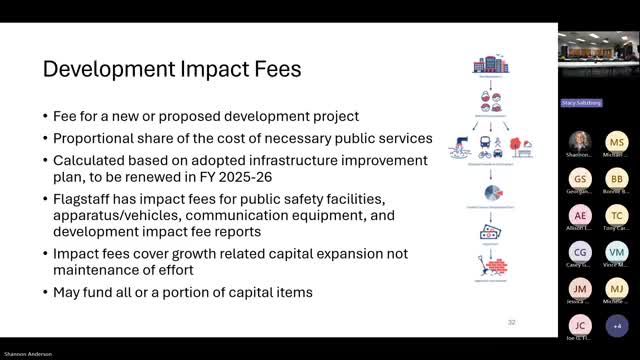
Committee members asked the management service director and finance staff to quantify the fiscal effect of a multi‑year decline in building permits and to clarify how development impact fees are collected and used.
An unidentified committee member cited city website figures and said that since 2020 Flagstaff’s building permits have generally fallen each year, with a 41% drop reported for 2024 compared with state and national increases. The member asked staff to calculate "the cost to the city for not keeping up with building permits" — that is, the revenue the city did not realize because development slowed.
Rick responded that staff can prepare the requested historical permit and revenue data and noted development impact fees are recorded in restricted funds and must be used for growth‑related capital projects consistent with an infrastructure improvement plan. He emphasized impact fees cannot be used for ongoing operations or routine maintenance and cannot be applied to replace existing equipment intended for operations (for example, replacing a current fire engine is not an eligible use if it is maintenance rather than growth‑related).
During the discussion an unnamed speaker reported that police and fire development impact fees for fiscal year 2025 totaled just over $1,200,000 and that the city had accumulated roughly $4,500,000 in those restricted accounts at the end of FY25. Rick confirmed the accounts are interest‑bearing and restricted, and said impact fee revenues are typically budgeted for eligible capital through the annual budget process; he added the city is required to spend collected impact fees within ten years of collection or return them per applicable statute.
Committee members requested staff return with more detailed data on permit trends, the revenue shortfall implied by reduced permitting, and a breakdown of how impact‑fee balances are planned to be used.
An unidentified committee member cited city website figures and said that since 2020 Flagstaff’s building permits have generally fallen each year, with a 41% drop reported for 2024 compared with state and national increases. The member asked staff to calculate "the cost to the city for not keeping up with building permits" — that is, the revenue the city did not realize because development slowed.
Rick responded that staff can prepare the requested historical permit and revenue data and noted development impact fees are recorded in restricted funds and must be used for growth‑related capital projects consistent with an infrastructure improvement plan. He emphasized impact fees cannot be used for ongoing operations or routine maintenance and cannot be applied to replace existing equipment intended for operations (for example, replacing a current fire engine is not an eligible use if it is maintenance rather than growth‑related).
During the discussion an unnamed speaker reported that police and fire development impact fees for fiscal year 2025 totaled just over $1,200,000 and that the city had accumulated roughly $4,500,000 in those restricted accounts at the end of FY25. Rick confirmed the accounts are interest‑bearing and restricted, and said impact fee revenues are typically budgeted for eligible capital through the annual budget process; he added the city is required to spend collected impact fees within ten years of collection or return them per applicable statute.
Committee members requested staff return with more detailed data on permit trends, the revenue shortfall implied by reduced permitting, and a breakdown of how impact‑fee balances are planned to be used.
Don't Miss a Word: See the Full Meeting!
Go beyond summaries. Unlock every video, transcript, and key insight with a Founder Membership.
✓
Get instant access to full meeting videos
✓
Search and clip any phrase from complete transcripts
✓
Receive AI-powered summaries & custom alerts
✓
Enjoy lifetime, unrestricted access to government data
30-day money-back guarantee
