Louisiana commission begins count of convictions from non‑unanimous juries
November 20, 2025 | 2025 Legislature LA, Louisiana
This article was created by AI summarizing key points discussed. AI makes mistakes, so for full details and context, please refer to the video of the full meeting. Please report any errors so we can fix them. Report an error »
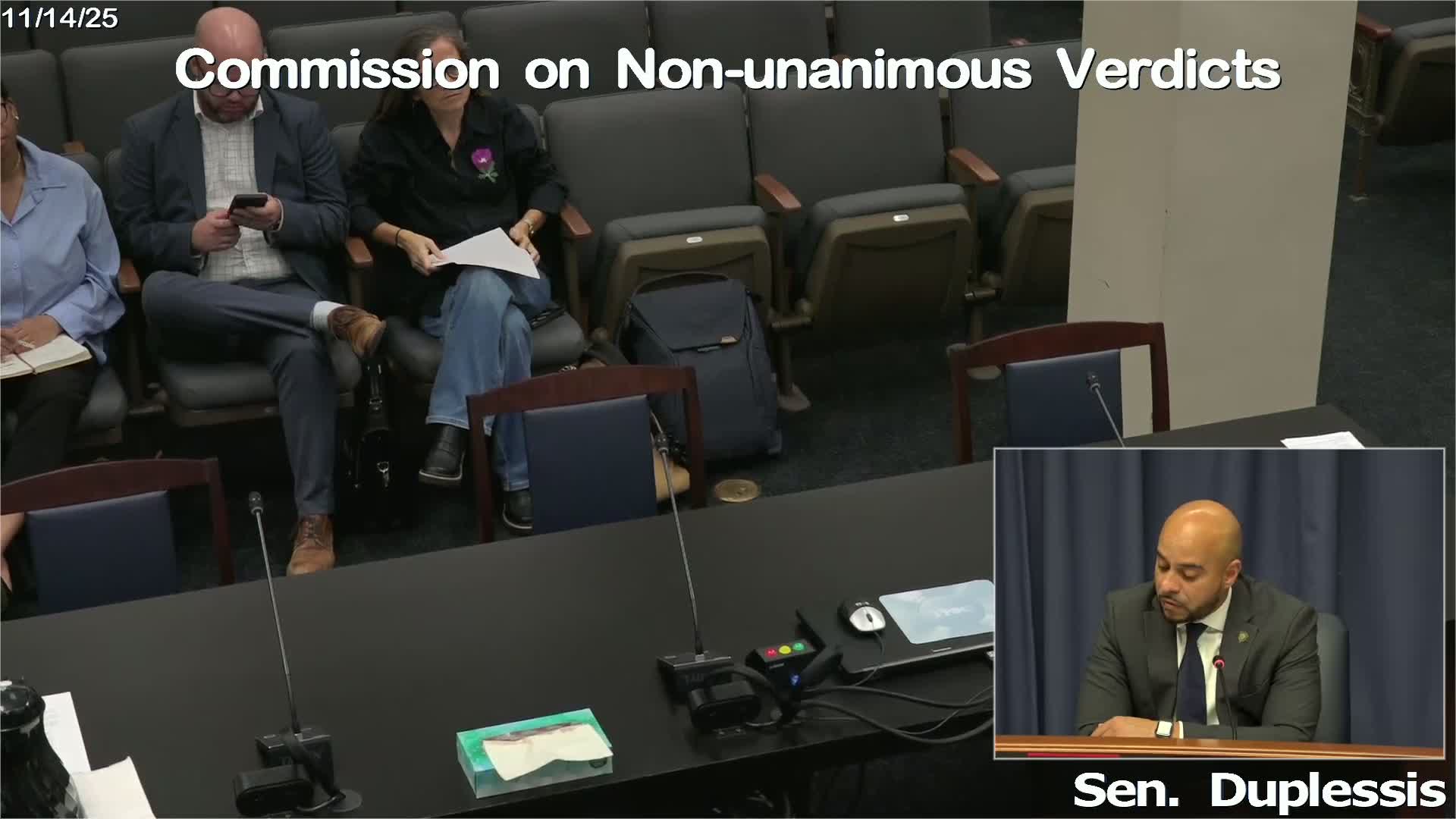
The Commission on Non‑Unanimous Verdicts opened its first meeting to begin implementing Senate Resolution 183, which directs the panel to establish methods for collecting court records, legal filings and jury polling slips and to accept case submissions from incarcerated people who believe they were convicted by a non‑unanimous jury.
The chair said the commission’s initial task is to determine the size of the problem before debating whether relief should be applied retroactively. Claude Michael Como, a staff attorney at the Promise of Justice Initiative, described a proposed application form that would collect prisoners’ names, DOC numbers, conviction dates, parish of conviction and supporting proof — examples he listed included minute entries, transcripts, appellate opinions and jury polling slips. "We have this application form that people that are incarcerated can fill out," Como said, describing outreach already begun to clients and sub‑counsel.
Zach Daniels, executive director of the Louisiana District Attorneys Association, outlined a multi‑stage, manual vetting process that has so far produced roughly 890 cases for further review. "So far, we've identified about, 890 or so cases that we need to continue to vet," Daniels said, noting that the number likely reflects jurisdictions that filed post‑conviction petitions and that additional cases may exist where no petitions were filed. He said the DAs plan to supplement Westlaw searches with case files from individual clerks of court, a step he described as time‑consuming and largely manual.
Retired Judge John Connery said juror polling and minute entries often reveal whether polling was performed and would make verification straightforward where they exist, but he cautioned polling is not uniformly practiced across the state. "I know that we always did, so it would be easy to find," Connery said. "I take it that's not a universal practice throughout the state, so the committee really would have a difficult time establishing who was convicted by non‑unanimous verdicts if there's no polling done at the time."
Sarah Gonzalo of the Promise of Justice Initiative testified about the group’s 2020 effort that located and filed for more than 1,000 people. Gonzalo said many people believe they were convicted by non‑unanimous juries but lack documentary proof; she estimated the current verifiable count is about 1,100. "We were able to find and file for over 1000 people all over Louisiana," Gonzalo said. "Many times, the judge asked, do you want the jury pulled? And both the DA and the attorneys said no. Those people are out of luck."
Commission members agreed the panel’s work should rely on verifiable records and proposed pairing the DA association’s list with PJI’s files to reach a shared, evidence‑based universe of cases. Participants discussed possible roles for the Department of Corrections and clerks of court in locating minute entries, jury polling slips and other materials. The commission also discussed confidentiality and the ethical limits on sharing client lists versus publicly filed pleadings; PJI said it would consult its office about providing pleadings or working with waivers.
The chair said the commission intends to reconvene after members have had time to compare datasets and recommended offline coordination by email to schedule the next meeting. The chair moved to adjourn; Judge Connery seconded, there was no objection, and the meeting ended.
The chair said the commission’s initial task is to determine the size of the problem before debating whether relief should be applied retroactively. Claude Michael Como, a staff attorney at the Promise of Justice Initiative, described a proposed application form that would collect prisoners’ names, DOC numbers, conviction dates, parish of conviction and supporting proof — examples he listed included minute entries, transcripts, appellate opinions and jury polling slips. "We have this application form that people that are incarcerated can fill out," Como said, describing outreach already begun to clients and sub‑counsel.
Zach Daniels, executive director of the Louisiana District Attorneys Association, outlined a multi‑stage, manual vetting process that has so far produced roughly 890 cases for further review. "So far, we've identified about, 890 or so cases that we need to continue to vet," Daniels said, noting that the number likely reflects jurisdictions that filed post‑conviction petitions and that additional cases may exist where no petitions were filed. He said the DAs plan to supplement Westlaw searches with case files from individual clerks of court, a step he described as time‑consuming and largely manual.
Retired Judge John Connery said juror polling and minute entries often reveal whether polling was performed and would make verification straightforward where they exist, but he cautioned polling is not uniformly practiced across the state. "I know that we always did, so it would be easy to find," Connery said. "I take it that's not a universal practice throughout the state, so the committee really would have a difficult time establishing who was convicted by non‑unanimous verdicts if there's no polling done at the time."
Sarah Gonzalo of the Promise of Justice Initiative testified about the group’s 2020 effort that located and filed for more than 1,000 people. Gonzalo said many people believe they were convicted by non‑unanimous juries but lack documentary proof; she estimated the current verifiable count is about 1,100. "We were able to find and file for over 1000 people all over Louisiana," Gonzalo said. "Many times, the judge asked, do you want the jury pulled? And both the DA and the attorneys said no. Those people are out of luck."
Commission members agreed the panel’s work should rely on verifiable records and proposed pairing the DA association’s list with PJI’s files to reach a shared, evidence‑based universe of cases. Participants discussed possible roles for the Department of Corrections and clerks of court in locating minute entries, jury polling slips and other materials. The commission also discussed confidentiality and the ethical limits on sharing client lists versus publicly filed pleadings; PJI said it would consult its office about providing pleadings or working with waivers.
The chair said the commission intends to reconvene after members have had time to compare datasets and recommended offline coordination by email to schedule the next meeting. The chair moved to adjourn; Judge Connery seconded, there was no objection, and the meeting ended.
Don't Miss a Word: See the Full Meeting!
Go beyond summaries. Unlock every video, transcript, and key insight with a Founder Membership.
✓
Get instant access to full meeting videos
✓
Search and clip any phrase from complete transcripts
✓
Receive AI-powered summaries & custom alerts
✓
Enjoy lifetime, unrestricted access to government data
30-day money-back guarantee
