Legislative study examines local options to fund sidewalks across Washington
November 20, 2025 | Legislative Sessions, Washington
This article was created by AI summarizing key points discussed. AI makes mistakes, so for full details and context, please refer to the video of the full meeting. Please report any errors so we can fix them. Report an error »
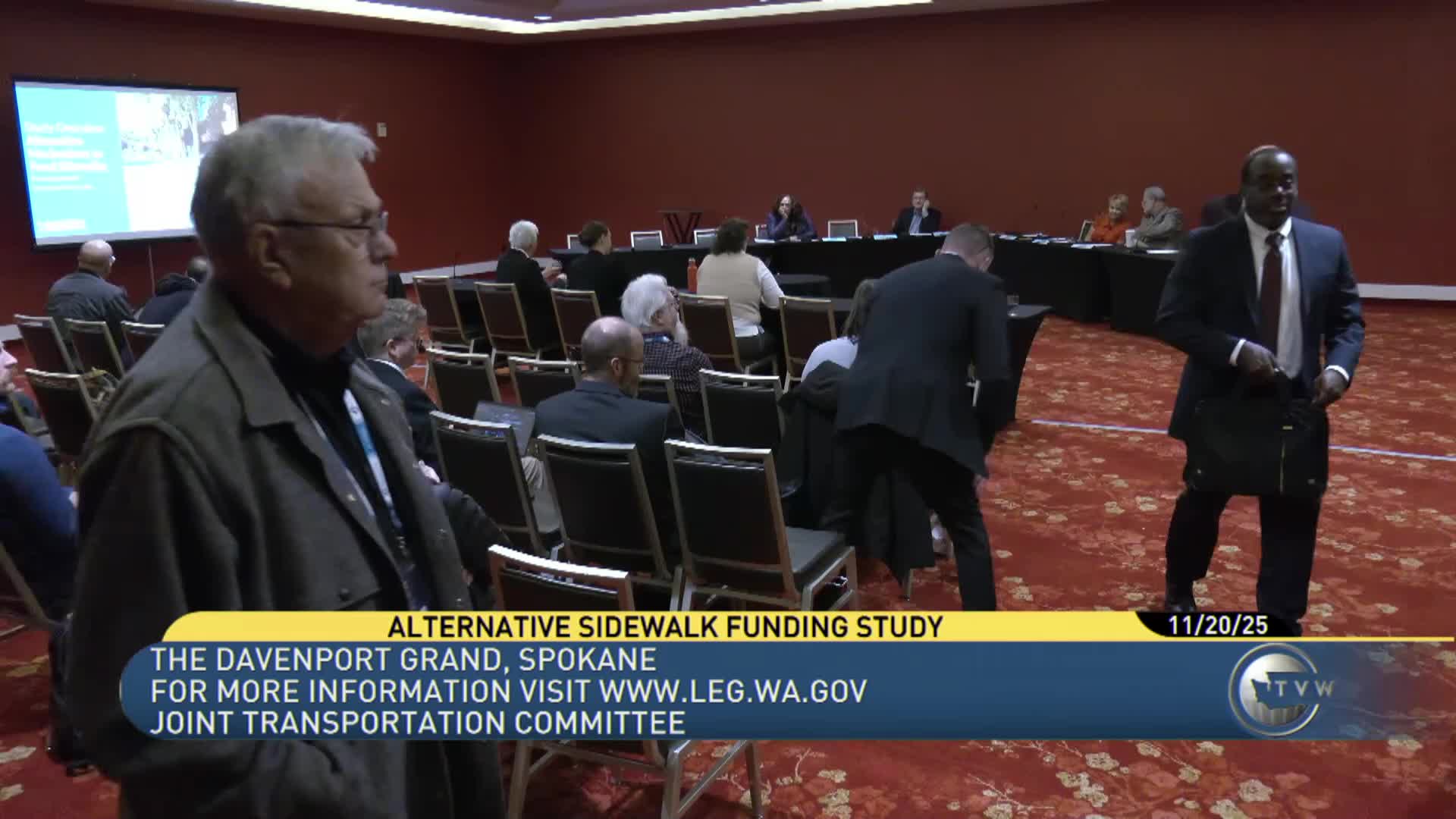
The Joint Transportation Committee heard an initial briefing on a Joint Transportation Committee study that will evaluate alternative local funding mechanisms for sidewalk construction and maintenance across Washington.
Rachel Dean, nonpartisan JTC project manager, said the study—appropriated in the prior biennial budget—will recommend mechanisms local governments could use voluntarily. Consultants from Brooke Consulting explained a three‑phase approach: information gathering (a statewide survey of cities and counties and interviews), evaluation (modeling candidate mechanisms across sample jurisdictions, plus legal analysis), and reporting.
Consultants noted Washington lacks a dedicated statewide sidewalk funding source and described common existing tools — competitive grants, Transportation Benefit Districts, local levies — and examples from other states. "A sidewalk fee is kind of the closest thing that we could find to a dedicated source of funding," Tracy Burrows of the consultant team said, citing Denver, Ithaca and Syracuse as municipalities that bill a sidewalk fee via utility bills; such fees in other cities can average about $150 per parcel per year.
Presenters said the study will test how mechanisms function in jurisdictions of varying sizes and geographies, and will examine legal constraints in Washington—such as uniformity requirements for property taxation—that limit some options like parcel taxes. A preliminary draft report is scheduled for Dec. 15, followed by a "Sidewalks 101" primer by year end and a final report in mid‑June of next year.
Committee members asked whether a new mechanism would replace current funding or be additive; consultants said the study intends to expand local options, not mandate adoption, and jurisdictions would choose whether to implement recommendations.
Rachel Dean, nonpartisan JTC project manager, said the study—appropriated in the prior biennial budget—will recommend mechanisms local governments could use voluntarily. Consultants from Brooke Consulting explained a three‑phase approach: information gathering (a statewide survey of cities and counties and interviews), evaluation (modeling candidate mechanisms across sample jurisdictions, plus legal analysis), and reporting.
Consultants noted Washington lacks a dedicated statewide sidewalk funding source and described common existing tools — competitive grants, Transportation Benefit Districts, local levies — and examples from other states. "A sidewalk fee is kind of the closest thing that we could find to a dedicated source of funding," Tracy Burrows of the consultant team said, citing Denver, Ithaca and Syracuse as municipalities that bill a sidewalk fee via utility bills; such fees in other cities can average about $150 per parcel per year.
Presenters said the study will test how mechanisms function in jurisdictions of varying sizes and geographies, and will examine legal constraints in Washington—such as uniformity requirements for property taxation—that limit some options like parcel taxes. A preliminary draft report is scheduled for Dec. 15, followed by a "Sidewalks 101" primer by year end and a final report in mid‑June of next year.
Committee members asked whether a new mechanism would replace current funding or be additive; consultants said the study intends to expand local options, not mandate adoption, and jurisdictions would choose whether to implement recommendations.
View the Full Meeting & All Its Details
This article offers just a summary. Unlock complete video, transcripts, and insights as a Founder Member.
✓
Watch full, unedited meeting videos
✓
Search every word spoken in unlimited transcripts
✓
AI summaries & real-time alerts (all government levels)
✓
Permanent access to expanding government content
30-day money-back guarantee
