Energy omnibus shifts siting disputes to state regulator; Kane County debates data‑center energy and water impacts
November 19, 2025 | Kane County, Illinois
This article was created by AI summarizing key points discussed. AI makes mistakes, so for full details and context, please refer to the video of the full meeting. Please report any errors so we can fix them. Report an error »
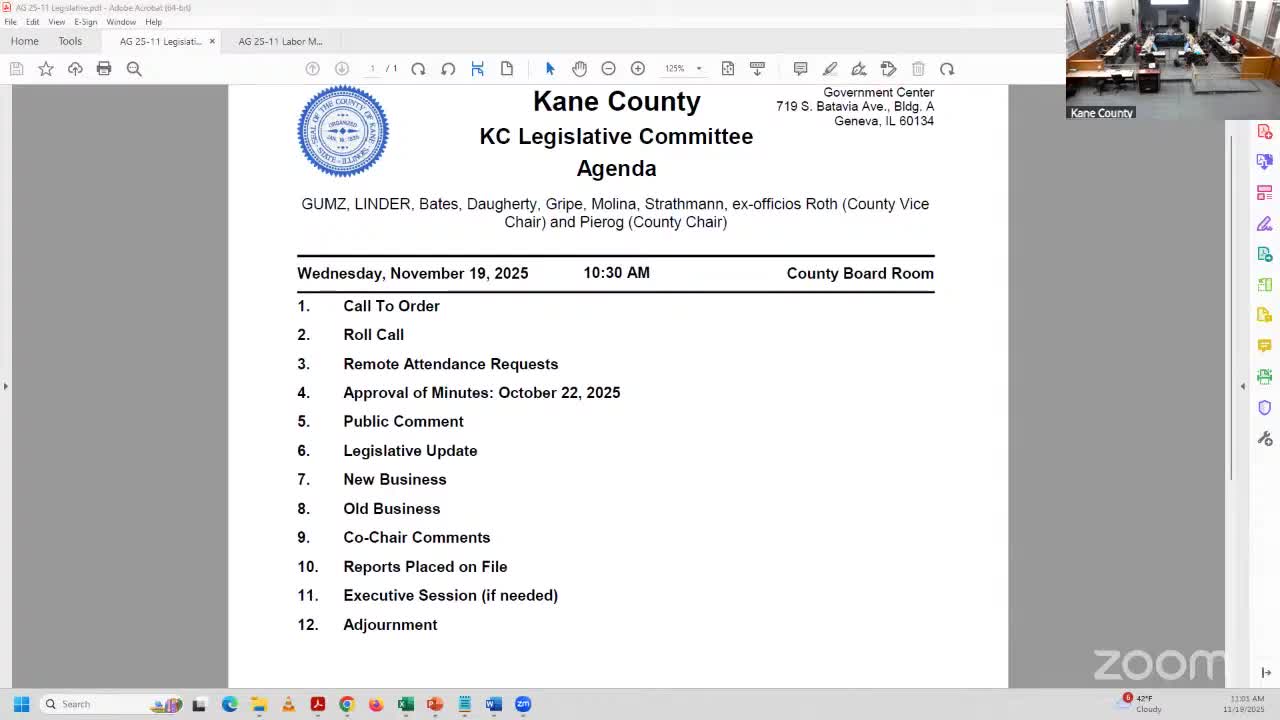
James Sherwood told the legislative committee that the energy omnibus passed late in veto session and is expected to be signed by Governor Pritzker. He said the bill shifts some authority to the Illinois Commerce Commission (ICC) through an integrated resource planning process and creates state support for battery storage and expanded energy‑efficiency goals.
"The thought is that the Illinois Commerce Commission...can react quickly," Sherwood said, describing the bill's move of certain planning authority to the ICC. He also warned the committee that the ICC's adjudicatory role may favor projects that add generation, noting that the bill limits how far local governments can use zoning or other measures to block renewable projects and that disputes between developers and local units of government may now be resolved by the ICC.
Committee members raised concerns that those provisions would erode local control. One member said the county must "speak with one voice when it comes to matters dealing with the legislature," and several urged clearer messaging through the county's lobbyists.
Members then turned to the growing number of proposals for hyperscale data centers. The committee discussed the centers' large electricity demands and water‑use implications. Sherwood said a spring proposal that would have required very large new loads (including data centers) to install on‑site renewables was removed from the final package; a remaining provision would require cleaner technology for backup diesel generators.
Committee members asked staff to collect data on local interest in unincorporated areas, to invite experts on closed‑loop cooling and water reuse, and to analyze local infrastructure constraints. Members also debated economic tradeoffs: one county official noted that while data centers bring property and utility tax revenue, they often produce relatively few long‑term local jobs compared with the amount of electricity and water they consume. The committee agreed to schedule a deeper, staff‑led discussion on data‑center siting, infrastructure and mitigation strategies in a future meeting.
The article does not attempt to predict ICC decisions; it reports committee members' concerns and the actions they requested of county staff.
"The thought is that the Illinois Commerce Commission...can react quickly," Sherwood said, describing the bill's move of certain planning authority to the ICC. He also warned the committee that the ICC's adjudicatory role may favor projects that add generation, noting that the bill limits how far local governments can use zoning or other measures to block renewable projects and that disputes between developers and local units of government may now be resolved by the ICC.
Committee members raised concerns that those provisions would erode local control. One member said the county must "speak with one voice when it comes to matters dealing with the legislature," and several urged clearer messaging through the county's lobbyists.
Members then turned to the growing number of proposals for hyperscale data centers. The committee discussed the centers' large electricity demands and water‑use implications. Sherwood said a spring proposal that would have required very large new loads (including data centers) to install on‑site renewables was removed from the final package; a remaining provision would require cleaner technology for backup diesel generators.
Committee members asked staff to collect data on local interest in unincorporated areas, to invite experts on closed‑loop cooling and water reuse, and to analyze local infrastructure constraints. Members also debated economic tradeoffs: one county official noted that while data centers bring property and utility tax revenue, they often produce relatively few long‑term local jobs compared with the amount of electricity and water they consume. The committee agreed to schedule a deeper, staff‑led discussion on data‑center siting, infrastructure and mitigation strategies in a future meeting.
The article does not attempt to predict ICC decisions; it reports committee members' concerns and the actions they requested of county staff.
View the Full Meeting & All Its Details
This article offers just a summary. Unlock complete video, transcripts, and insights as a Founder Member.
✓
Watch full, unedited meeting videos
✓
Search every word spoken in unlimited transcripts
✓
AI summaries & real-time alerts (all government levels)
✓
Permanent access to expanding government content
30-day money-back guarantee
