Todd County commissioners authorize signing of USDA wildlife work initiation document
November 19, 2025 | Todd County, Minnesota
This article was created by AI summarizing key points discussed. AI makes mistakes, so for full details and context, please refer to the video of the full meeting. Please report any errors so we can fix them. Report an error »
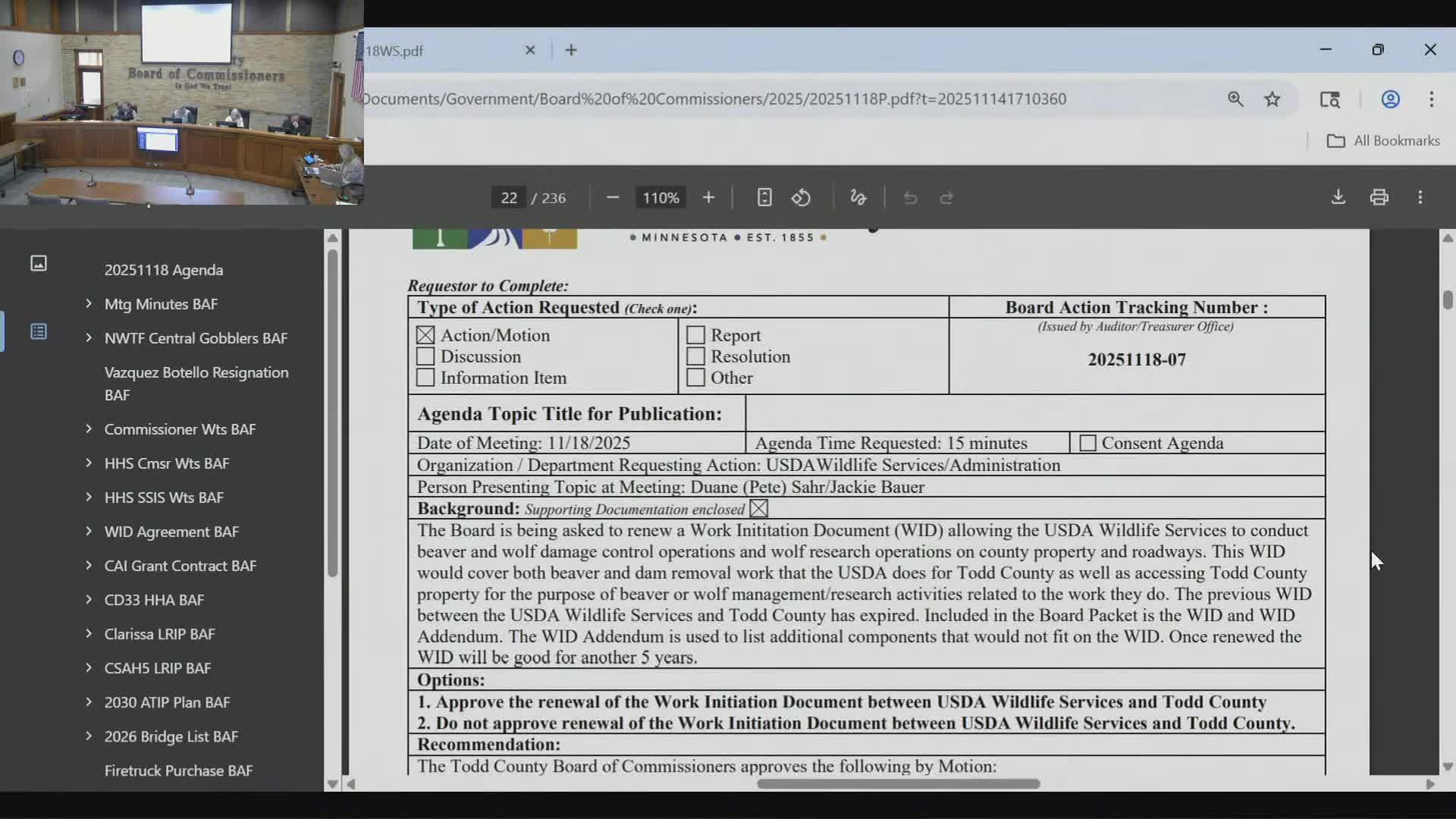
Todd County commissioners voted Nov. 18 to authorize signing a Work Initiation Document (WID) with USDA Wildlife Services that will allow the agency to operate on public and private property in the county for predator and beaver work.
USDA staff Dakota Bird, district supervisor, and Pete Saar, assistant district supervisor and wildlife biologist, described the WID as a standard permission form reviewed by the Office of General Counsel that covers potential activities such as trapping, relocation and, when necessary, chemical immobilization for research or removal of animals. They said earlier agreements with Todd County had lapsed (a WID in place in 2008 expired in 2013) and that the agency is again seeking county-level agreements across a set of Minnesota counties.
Commissioners asked clarifying questions about target species and methods. Bird and Saar said the WID lists gray wolf, beaver and other species; they noted that coyotes are often incidentally captured when managing wolves and that USDA considers coyotes a target species in many farm situations. They also said some WID language references toxicants used in western states but that not every component applies to every county or incident and that components can be revoked by either party.
Commissioner Newman noted the gray wolf remains listed under federal protections and asked whether delisting would change the local work. USDA staff replied that delisting would not eliminate the need for local response; Minnesota DNR would manage wolves but USDA services historically continued to operate for depredation response, and state-certified private trappers were used as part of past programs.
After discussion, Commissioner Nasca moved to authorize signing the WID and Commissioner Denny seconded. The board approved the motion by voice vote. Staff said the document and an addendum would be signed after the meeting so USDA could resume coordinated responses in Todd County.
The board’s authorization does not itself create a separate financial agreement; USDA staff said any cost-sharing arrangements would be handled through distinct cooperative service agreements when required.
USDA staff Dakota Bird, district supervisor, and Pete Saar, assistant district supervisor and wildlife biologist, described the WID as a standard permission form reviewed by the Office of General Counsel that covers potential activities such as trapping, relocation and, when necessary, chemical immobilization for research or removal of animals. They said earlier agreements with Todd County had lapsed (a WID in place in 2008 expired in 2013) and that the agency is again seeking county-level agreements across a set of Minnesota counties.
Commissioners asked clarifying questions about target species and methods. Bird and Saar said the WID lists gray wolf, beaver and other species; they noted that coyotes are often incidentally captured when managing wolves and that USDA considers coyotes a target species in many farm situations. They also said some WID language references toxicants used in western states but that not every component applies to every county or incident and that components can be revoked by either party.
Commissioner Newman noted the gray wolf remains listed under federal protections and asked whether delisting would change the local work. USDA staff replied that delisting would not eliminate the need for local response; Minnesota DNR would manage wolves but USDA services historically continued to operate for depredation response, and state-certified private trappers were used as part of past programs.
After discussion, Commissioner Nasca moved to authorize signing the WID and Commissioner Denny seconded. The board approved the motion by voice vote. Staff said the document and an addendum would be signed after the meeting so USDA could resume coordinated responses in Todd County.
The board’s authorization does not itself create a separate financial agreement; USDA staff said any cost-sharing arrangements would be handled through distinct cooperative service agreements when required.
Don't Miss a Word: See the Full Meeting!
Go beyond summaries. Unlock every video, transcript, and key insight with a Founder Membership.
✓
Get instant access to full meeting videos
✓
Search and clip any phrase from complete transcripts
✓
Receive AI-powered summaries & custom alerts
✓
Enjoy lifetime, unrestricted access to government data
30-day money-back guarantee
