Board of Regents unveils workforce‑alignment dashboard, says most majors break even quickly
November 14, 2025 | Regents, State Board of, Executive, Iowa
This article was created by AI summarizing key points discussed. AI makes mistakes, so for full details and context, please refer to the video of the full meeting. Please report any errors so we can fix them. Report an error »
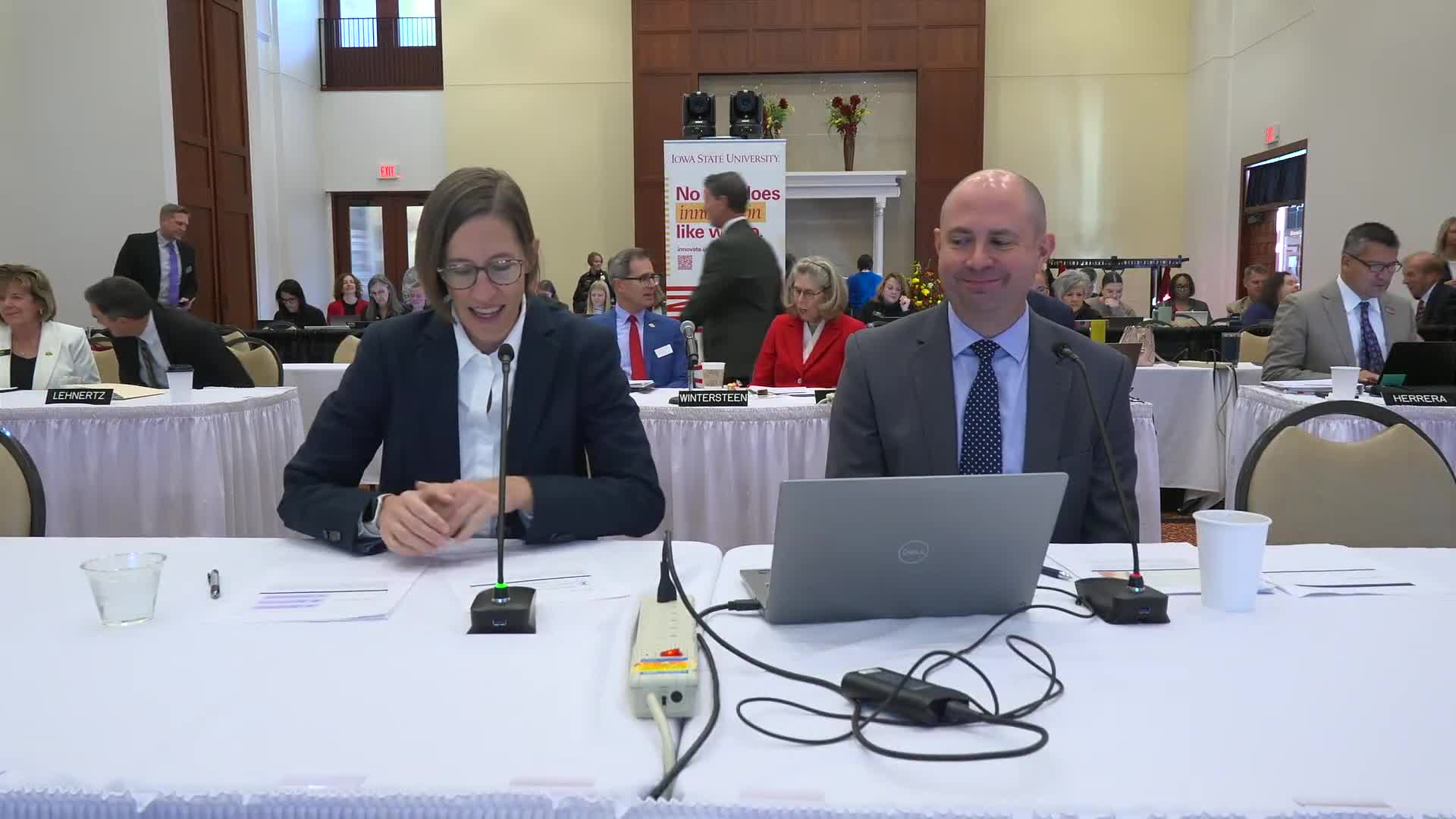
Rachel Boone, board chief academic officer, and Jason Pontius, associate chief academic officer, presented the Board of Regents with a workforce alignment review and an interactive dashboard designed to connect degree programs to labor‑market outcomes.
"We wanted this to be the same data that anybody else can access," Pontius said, describing a methodology that uses a SIP→SOC crosswalk (standard program identifiers to Standard Occupational Classification) and public sources such as U.S. Census wage records, Bureau of Labor Statistics projections and Iowa Workforce Development statistics.
The presentation emphasized transparency and repeatability: the team used publicly available datasets and adopted established return‑on‑investment thresholds modeled on work from the University of Texas system and the Georgetown Center’s approaches. Under the conservative assumptions used in the board materials (a 10‑year financing assumption and a higher debt scenario), the presenters reported that 75 majors break even within three years. Using median debt assumptions, presenters said, as many as 98 percent of students would break even within three years.
The dashboard allows filtering by university and program, and it brings together multiple indicators: net price, time to degree, median earnings at 1/5/10 years, projected job openings and industry placement. Pontius and Boone described workarounds for data gaps where direct major→occupation links do not exist and noted several places the team applied "common sense" crosswalk adjustments; they said those edits are documented and shareable.
Presenters and regents flagged limitations. Pontius noted that unemployment‑insurance wage data show industry but not occupation in many cases (an accountant working at a retailer and a pharmacist at a retail pharmacy can both appear in a "retail" industry bucket), and Boone said adding occupation codes to wage records would strengthen the analysis, a change some other states are implementing. Both presenters recommended pursuing enhanced wage records and other supplemental datasets to reduce ambiguity.
The board received a set of recommendations: make break‑even/ROI tools more visible to students, advisors and the public; embed key dashboard elements into existing board dashboards; develop supplemental data to fill gaps; consider a "social and community impact" index for programs (to capture public‑value programs with lower wage outcomes); and integrate enrollment thresholds into the board’s annual program review process.
Regents asked for practical next steps. Several members suggested the February program‑review meeting as an opportunity for universities to present initial responses and timelines for any program changes informed by the dashboard. Boone said the work is iterative and invited the board to identify which dashboard elements would be most useful at the board level.
The board’s discussion closed with broad agreement to continue refining the tools, pursue improved occupation coding in wage records, and surface the dashboard indicators where students and policymakers can readily see them.
"We wanted this to be the same data that anybody else can access," Pontius said, describing a methodology that uses a SIP→SOC crosswalk (standard program identifiers to Standard Occupational Classification) and public sources such as U.S. Census wage records, Bureau of Labor Statistics projections and Iowa Workforce Development statistics.
The presentation emphasized transparency and repeatability: the team used publicly available datasets and adopted established return‑on‑investment thresholds modeled on work from the University of Texas system and the Georgetown Center’s approaches. Under the conservative assumptions used in the board materials (a 10‑year financing assumption and a higher debt scenario), the presenters reported that 75 majors break even within three years. Using median debt assumptions, presenters said, as many as 98 percent of students would break even within three years.
The dashboard allows filtering by university and program, and it brings together multiple indicators: net price, time to degree, median earnings at 1/5/10 years, projected job openings and industry placement. Pontius and Boone described workarounds for data gaps where direct major→occupation links do not exist and noted several places the team applied "common sense" crosswalk adjustments; they said those edits are documented and shareable.
Presenters and regents flagged limitations. Pontius noted that unemployment‑insurance wage data show industry but not occupation in many cases (an accountant working at a retailer and a pharmacist at a retail pharmacy can both appear in a "retail" industry bucket), and Boone said adding occupation codes to wage records would strengthen the analysis, a change some other states are implementing. Both presenters recommended pursuing enhanced wage records and other supplemental datasets to reduce ambiguity.
The board received a set of recommendations: make break‑even/ROI tools more visible to students, advisors and the public; embed key dashboard elements into existing board dashboards; develop supplemental data to fill gaps; consider a "social and community impact" index for programs (to capture public‑value programs with lower wage outcomes); and integrate enrollment thresholds into the board’s annual program review process.
Regents asked for practical next steps. Several members suggested the February program‑review meeting as an opportunity for universities to present initial responses and timelines for any program changes informed by the dashboard. Boone said the work is iterative and invited the board to identify which dashboard elements would be most useful at the board level.
The board’s discussion closed with broad agreement to continue refining the tools, pursue improved occupation coding in wage records, and surface the dashboard indicators where students and policymakers can readily see them.
View the Full Meeting & All Its Details
This article offers just a summary. Unlock complete video, transcripts, and insights as a Founder Member.
✓
Watch full, unedited meeting videos
✓
Search every word spoken in unlimited transcripts
✓
AI summaries & real-time alerts (all government levels)
✓
Permanent access to expanding government content
30-day money-back guarantee
