Birmingham Planning Board hears four firms pitch rewrite of zoning code tied to 2040 plan
November 13, 2025 | Birmingham City, Oakland County, Michigan
This article was created by AI summarizing key points discussed. AI makes mistakes, so for full details and context, please refer to the video of the full meeting. Please report any errors so we can fix them. Report an error »
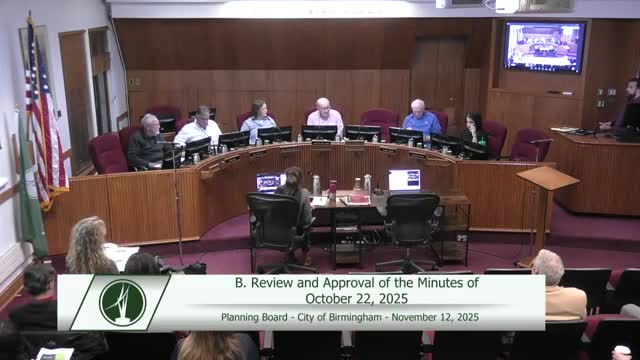
The Birmingham Planning Board on Nov. 12 heard 15-minute presentations from four consultant teams competing to write or modernize the city's zoning ordinance to implement Birmingham's 2040 plan.
Brett Keith, owner and CEO of Kennedy Keith Collaborative and Encode Plus, told the board his team would build on the existing ordinance and deliver an online, searchable code integrated with GIS. "We will create a zoning ordinance update that is uniquely Birmingham," Keith said, adding that Encode Plus offers pop-up definitions, development calculators and a linked map so users can type an address and see applicable regulations. He said the city already pays recurring platform fees and that staff could manage many future edits without re-hiring the firm.
John Hauseal of Hauseal Levine emphasized visualization and calibration between form-based downtown standards and conventional neighborhood rules. "Form drives character," Hauseal said, arguing that 3-D models and parcel-level GIS analysis help residents see how infill or missing-middle housing would look before changes are finalized. Carrie Papelbaum, the firm's proposed project manager, outlined a phased schedule: reconnaissance and a diagnostic report, modular drafting, then adoption and support.
Jill Bame, partner at Giffels Webster, presented a locally based team and stressed accessible language and education for both staff and residents. Giffels is proposing "clear zoning" spreads — two-page district summaries with a use table on one side and a graphic summary on the other — plus interactive mapping and a public-engagement program run with subconsultant Public Sector Consultants.
John Jackson of McKenna highlighted the firm's prior work with Birmingham and proposed a three-phase process: discovery/diagnostic, design/drafting and testing/adoption. McKenna said it routinely tests final drafts against recent development cases and recommends a 6-to-12-month post-adoption review to correct graphics or implementation problems.
Board members focused questions on four recurring issues: (1) deliverable format and usability — whether the final code will be a printable document, an interactive online tool, or both; (2) ongoing costs and who must be paid for future edits; (3) public engagement strategies to reach residents who do not normally attend planning meetings; and (4) how firms would preserve neighborhood character while implementing the 2040 plan's goals. Firms responded with examples of surveys, open houses, targeted focus groups, and visual-preference exercises; several proposed flowcharts and simplified tables to reduce the current code's complexity.
The board approved a routine motion to adopt the Oct. 22 meeting minutes at the start of the session. No final selection was made. Chair and staff said the Planning Board will aim to forward a single recommendation to the City Commission after staff checks and additional input; the board set its next meeting for Dec. 10 with the expectation of making that recommendation then.
The Planning Board made no binding procurement decision at the Nov. 12 meeting; the City Commission will make the final hire based on the board's recommendation and the city's procurement process.
What to watch next: the Planning Board's Dec. 10 packet, staff reference checks and any supplemental materials firms provide between now and the meeting.
Brett Keith, owner and CEO of Kennedy Keith Collaborative and Encode Plus, told the board his team would build on the existing ordinance and deliver an online, searchable code integrated with GIS. "We will create a zoning ordinance update that is uniquely Birmingham," Keith said, adding that Encode Plus offers pop-up definitions, development calculators and a linked map so users can type an address and see applicable regulations. He said the city already pays recurring platform fees and that staff could manage many future edits without re-hiring the firm.
John Hauseal of Hauseal Levine emphasized visualization and calibration between form-based downtown standards and conventional neighborhood rules. "Form drives character," Hauseal said, arguing that 3-D models and parcel-level GIS analysis help residents see how infill or missing-middle housing would look before changes are finalized. Carrie Papelbaum, the firm's proposed project manager, outlined a phased schedule: reconnaissance and a diagnostic report, modular drafting, then adoption and support.
Jill Bame, partner at Giffels Webster, presented a locally based team and stressed accessible language and education for both staff and residents. Giffels is proposing "clear zoning" spreads — two-page district summaries with a use table on one side and a graphic summary on the other — plus interactive mapping and a public-engagement program run with subconsultant Public Sector Consultants.
John Jackson of McKenna highlighted the firm's prior work with Birmingham and proposed a three-phase process: discovery/diagnostic, design/drafting and testing/adoption. McKenna said it routinely tests final drafts against recent development cases and recommends a 6-to-12-month post-adoption review to correct graphics or implementation problems.
Board members focused questions on four recurring issues: (1) deliverable format and usability — whether the final code will be a printable document, an interactive online tool, or both; (2) ongoing costs and who must be paid for future edits; (3) public engagement strategies to reach residents who do not normally attend planning meetings; and (4) how firms would preserve neighborhood character while implementing the 2040 plan's goals. Firms responded with examples of surveys, open houses, targeted focus groups, and visual-preference exercises; several proposed flowcharts and simplified tables to reduce the current code's complexity.
The board approved a routine motion to adopt the Oct. 22 meeting minutes at the start of the session. No final selection was made. Chair and staff said the Planning Board will aim to forward a single recommendation to the City Commission after staff checks and additional input; the board set its next meeting for Dec. 10 with the expectation of making that recommendation then.
The Planning Board made no binding procurement decision at the Nov. 12 meeting; the City Commission will make the final hire based on the board's recommendation and the city's procurement process.
What to watch next: the Planning Board's Dec. 10 packet, staff reference checks and any supplemental materials firms provide between now and the meeting.
Don't Miss a Word: See the Full Meeting!
Go beyond summaries. Unlock every video, transcript, and key insight with a Founder Membership.
✓
Get instant access to full meeting videos
✓
Search and clip any phrase from complete transcripts
✓
Receive AI-powered summaries & custom alerts
✓
Enjoy lifetime, unrestricted access to government data
30-day money-back guarantee
