RTD says FastTracks faces roughly $1.2 billion shortfall; Adams County commissioners press for end‑line prioritization
November 13, 2025 | Adams County, Colorado
This article was created by AI summarizing key points discussed. AI makes mistakes, so for full details and context, please refer to the video of the full meeting. Please report any errors so we can fix them. Report an error »
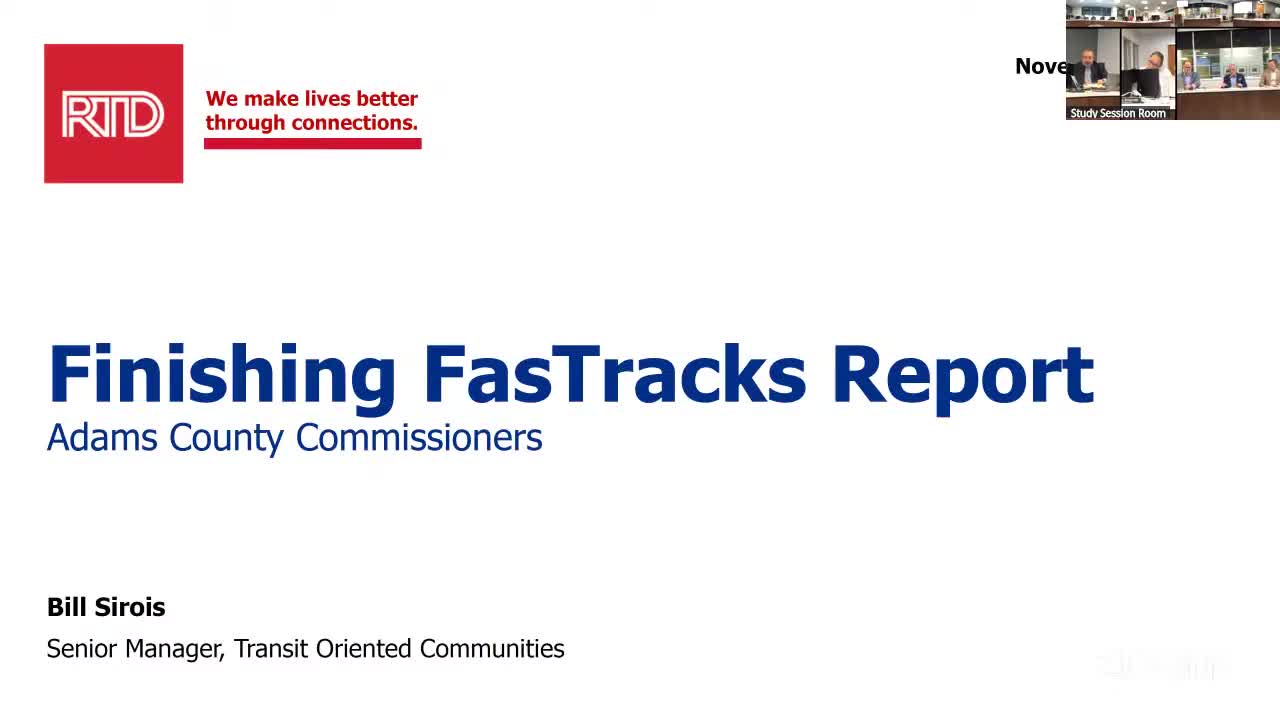
Regional Transportation District officials told the Adams County Board of Commissioners that updated estimates to finish the FastTracks light‑rail program—using 2024 cost assumptions—put corridor capital needs at about $1.6 billion and annual operations around $23 million, leaving an estimated $1.2 billion shortfall even after assumed state contributions.
The presentation, delivered by Bill Saroy, RTD senior manager for transit communities, said the FastTracks program is about 75% complete but that many remaining corridors are only 15–30% designed and that rising construction inflation and asset‑renewal needs increase costs. "We are still at about 60% of the ridership that we're at in 2019," Saroy said, summarizing lower rail ridership and its impact on revenue assumptions.
Why it matters: the shortfall and design gaps threaten the timeline for completing projects that county leaders have long sought, notably the North Metro end line. The report was prepared in response to legislative directions tied to SB 24‑230 and an update under SB 25‑161; both bills ask RTD to prioritize certain corridors and examine debt capacity and outreach needs.
RTD outlined potential revenue sources it had considered: a five‑year FastTracks internal savings account forecast (figures discussed by RTD staff), about $30 million regionally remaining in the state multimodal options fund (MMOF) for 2030–2032, and new clean‑transit revenues from oil‑and‑gas fees projected at roughly $90 million per year starting in 2026, with 20% of that pot identified for rail statewide (about $18 million a year under current assumptions). RTD also noted past federal capital investment grants (about $1.4 billion previously awarded to FastTracks) but said remaining projects may not meet current FTA eligibility criteria. CRISI and BUILD grants were discussed as opportunistic but uncertain sources.
Commissioners pressed RTD on specifics. One commissioner raised the packet’s debt tables and asked for an itemized list of COPs and other obligations; Saroy said staff would provide the information and pointed to the board materials (the November 10 packet was referenced) for details. Another commissioner expressed frustration that, after decades of local contributions, the North Metro area appears at risk of losing priority. "How in the hell can I go to the taxpayer and say that we're now at front of the line, and guess what? All those folks who already got their line ... are now gonna have theirs renewed and refreshed, and you're still gonna be stuck with nothing," the commissioner said.
RTD emphasized legal and procedural limits: Chris Quinn, RTD project manager, explained the legislation directs RTD to prioritize the Northwest and North Metro end line if funds are awarded, but the Clean Transit Enterprise and other state bodies ultimately govern the grant process and distribution. "The legislation directs RTD to prioritize these two projects," Quinn said, "but there is nothing in there that says the state has to prioritize those two projects."
What commissioners asked for next: county leaders requested two short‑term actions from staff—(1) a workshop with RTD, CDOT and Adams County staff (including RTD service‑development staff) to map out how CDOT’s proposed projects and RTD service changes would interact, and (2) a separate session with RTD, CDOT and the Clean Transit Enterprise chair to clarify how new state revenue streams will be distributed and to press for prioritization of the North Metro end line. RTD confirmed the report’s public comment period closes Friday and said it will submit a final report to the legislature before Thanksgiving.
What we know and what remains uncertain: RTD presented several numerical estimates (capital ~$1.6 billion; operating ~$23 million annually; projected 3,600 daily boardings for four corridors in a 20‑year horizon; a roughly $1.2 billion funding gap). Several state funding sources and formulas were discussed, but RTD and commissioners agreed the precise distribution mechanics—particularly how the Clean Transit Enterprise will allocate the new funds—remain unresolved. County officials asked RTD and CDOT to move quickly to provide debt schedules and to convene the workshops so elected officials can set expectations with constituents.
Next steps: RTD will incorporate public comments and finalize the report to the legislature; Adams County staff will coordinate the two requested meetings with RTD, CDOT and the enterprise to pursue prioritization and mitigate local impacts.
The presentation, delivered by Bill Saroy, RTD senior manager for transit communities, said the FastTracks program is about 75% complete but that many remaining corridors are only 15–30% designed and that rising construction inflation and asset‑renewal needs increase costs. "We are still at about 60% of the ridership that we're at in 2019," Saroy said, summarizing lower rail ridership and its impact on revenue assumptions.
Why it matters: the shortfall and design gaps threaten the timeline for completing projects that county leaders have long sought, notably the North Metro end line. The report was prepared in response to legislative directions tied to SB 24‑230 and an update under SB 25‑161; both bills ask RTD to prioritize certain corridors and examine debt capacity and outreach needs.
RTD outlined potential revenue sources it had considered: a five‑year FastTracks internal savings account forecast (figures discussed by RTD staff), about $30 million regionally remaining in the state multimodal options fund (MMOF) for 2030–2032, and new clean‑transit revenues from oil‑and‑gas fees projected at roughly $90 million per year starting in 2026, with 20% of that pot identified for rail statewide (about $18 million a year under current assumptions). RTD also noted past federal capital investment grants (about $1.4 billion previously awarded to FastTracks) but said remaining projects may not meet current FTA eligibility criteria. CRISI and BUILD grants were discussed as opportunistic but uncertain sources.
Commissioners pressed RTD on specifics. One commissioner raised the packet’s debt tables and asked for an itemized list of COPs and other obligations; Saroy said staff would provide the information and pointed to the board materials (the November 10 packet was referenced) for details. Another commissioner expressed frustration that, after decades of local contributions, the North Metro area appears at risk of losing priority. "How in the hell can I go to the taxpayer and say that we're now at front of the line, and guess what? All those folks who already got their line ... are now gonna have theirs renewed and refreshed, and you're still gonna be stuck with nothing," the commissioner said.
RTD emphasized legal and procedural limits: Chris Quinn, RTD project manager, explained the legislation directs RTD to prioritize the Northwest and North Metro end line if funds are awarded, but the Clean Transit Enterprise and other state bodies ultimately govern the grant process and distribution. "The legislation directs RTD to prioritize these two projects," Quinn said, "but there is nothing in there that says the state has to prioritize those two projects."
What commissioners asked for next: county leaders requested two short‑term actions from staff—(1) a workshop with RTD, CDOT and Adams County staff (including RTD service‑development staff) to map out how CDOT’s proposed projects and RTD service changes would interact, and (2) a separate session with RTD, CDOT and the Clean Transit Enterprise chair to clarify how new state revenue streams will be distributed and to press for prioritization of the North Metro end line. RTD confirmed the report’s public comment period closes Friday and said it will submit a final report to the legislature before Thanksgiving.
What we know and what remains uncertain: RTD presented several numerical estimates (capital ~$1.6 billion; operating ~$23 million annually; projected 3,600 daily boardings for four corridors in a 20‑year horizon; a roughly $1.2 billion funding gap). Several state funding sources and formulas were discussed, but RTD and commissioners agreed the precise distribution mechanics—particularly how the Clean Transit Enterprise will allocate the new funds—remain unresolved. County officials asked RTD and CDOT to move quickly to provide debt schedules and to convene the workshops so elected officials can set expectations with constituents.
Next steps: RTD will incorporate public comments and finalize the report to the legislature; Adams County staff will coordinate the two requested meetings with RTD, CDOT and the enterprise to pursue prioritization and mitigate local impacts.
View the Full Meeting & All Its Details
This article offers just a summary. Unlock complete video, transcripts, and insights as a Founder Member.
✓
Watch full, unedited meeting videos
✓
Search every word spoken in unlimited transcripts
✓
AI summaries & real-time alerts (all government levels)
✓
Permanent access to expanding government content
30-day money-back guarantee
