City staff outline Critical Areas Ordinance update: wetlands, aquifer protection, 200-foot Spokane River riparian buffer and floodplain rules
November 13, 2025 | Spokane, Spokane County, Washington
This article was created by AI summarizing key points discussed. AI makes mistakes, so for full details and context, please refer to the video of the full meeting. Please report any errors so we can fix them. Report an error »
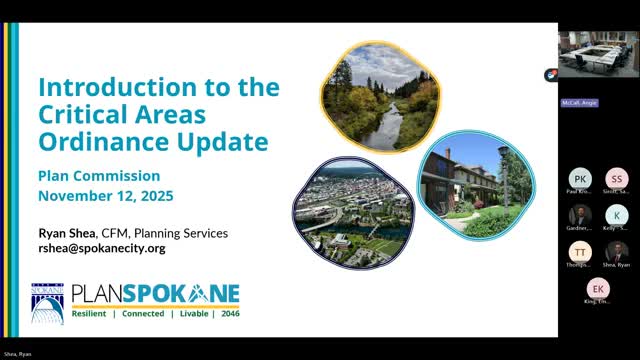
Ryan Shea, planner in Planning Services, presented a multi-topic update to the city's Critical Areas Ordinance (CAO). Shea emphasized that the CAO is regulatory code implementing the comprehensive plan rather than a long-range plan: "Critical areas ordinance is code. It's not a plan. It's the implementation of our comp plan in a way," he said.
Shea reviewed major elements proposed for update or clarification:
- Wetlands: Spokane uses a four-class rating system (Class I IV) with buffers scaled to wetland class. If a development affects a wetland or its buffer, mitigation or rehabilitation and permitting are required. Spokane County currently does not have a wetland bank; staff said they are working to establish one.
- Critical aquifer recharge areas: Because Spokane relies on a sole-source aquifer, the CAO restricts high-polluting uses and requires controls for storage tanks and certain materials in high-sensitivity capture zones to protect groundwater.
- Fish and wildlife habitat: The code currently includes a 200-foot riparian buffer from ordinary high water on both sides of the Spokane River with strong limits on vegetation removal and development near nesting and spawning areas; larger projects may require habitat management plans.
- Frequently flooded areas: The CAO aligns with FEMA regulations; the city has chosen a freeboard of +2 feet above base flood elevation and enforces elevation, anchoring and no-net-fill standards in floodways. Shea noted repeated examples where substantial remodels or redevelopment in floodplain areas must be brought into conformance.
- Geologically hazardous areas: The update clarifies requirements for steep slopes, geotechnical reports and limits on vegetation removal to reduce landslide and erosion risk.
Shea said preliminary project goals include conforming to state requirements, increasing code usability by consolidating duplicated language across chapters, and completing a draft for internal and agency review by the end of the year with stakeholder outreach and refinement in mid-to-late 2026 ahead of a planned adoption process later in 2026.
Next steps: staff will produce a consolidated CAO draft for internal review by year-end, pursue stakeholder outreach in 2026 (roughly Q3), and work with the commission on workshops and adoption steps.
Shea reviewed major elements proposed for update or clarification:
- Wetlands: Spokane uses a four-class rating system (Class I IV) with buffers scaled to wetland class. If a development affects a wetland or its buffer, mitigation or rehabilitation and permitting are required. Spokane County currently does not have a wetland bank; staff said they are working to establish one.
- Critical aquifer recharge areas: Because Spokane relies on a sole-source aquifer, the CAO restricts high-polluting uses and requires controls for storage tanks and certain materials in high-sensitivity capture zones to protect groundwater.
- Fish and wildlife habitat: The code currently includes a 200-foot riparian buffer from ordinary high water on both sides of the Spokane River with strong limits on vegetation removal and development near nesting and spawning areas; larger projects may require habitat management plans.
- Frequently flooded areas: The CAO aligns with FEMA regulations; the city has chosen a freeboard of +2 feet above base flood elevation and enforces elevation, anchoring and no-net-fill standards in floodways. Shea noted repeated examples where substantial remodels or redevelopment in floodplain areas must be brought into conformance.
- Geologically hazardous areas: The update clarifies requirements for steep slopes, geotechnical reports and limits on vegetation removal to reduce landslide and erosion risk.
Shea said preliminary project goals include conforming to state requirements, increasing code usability by consolidating duplicated language across chapters, and completing a draft for internal and agency review by the end of the year with stakeholder outreach and refinement in mid-to-late 2026 ahead of a planned adoption process later in 2026.
Next steps: staff will produce a consolidated CAO draft for internal review by year-end, pursue stakeholder outreach in 2026 (roughly Q3), and work with the commission on workshops and adoption steps.
View the Full Meeting & All Its Details
This article offers just a summary. Unlock complete video, transcripts, and insights as a Founder Member.
✓
Watch full, unedited meeting videos
✓
Search every word spoken in unlimited transcripts
✓
AI summaries & real-time alerts (all government levels)
✓
Permanent access to expanding government content
30-day money-back guarantee
