Work study: staff outlines text amendments on outdoor storage, animals, wireless facilities, downtown parking and murals
November 12, 2025 | Queen Creek, Maricopa County, Arizona
This article was created by AI summarizing key points discussed. AI makes mistakes, so for full details and context, please refer to the video of the full meeting. Please report any errors so we can fix them. Report an error »
The Queen Creek Planning & Zoning Commission held a work‑study session in which staff outlined multiple draft text amendments intended to clarify code provisions and respond to recurring community issues.
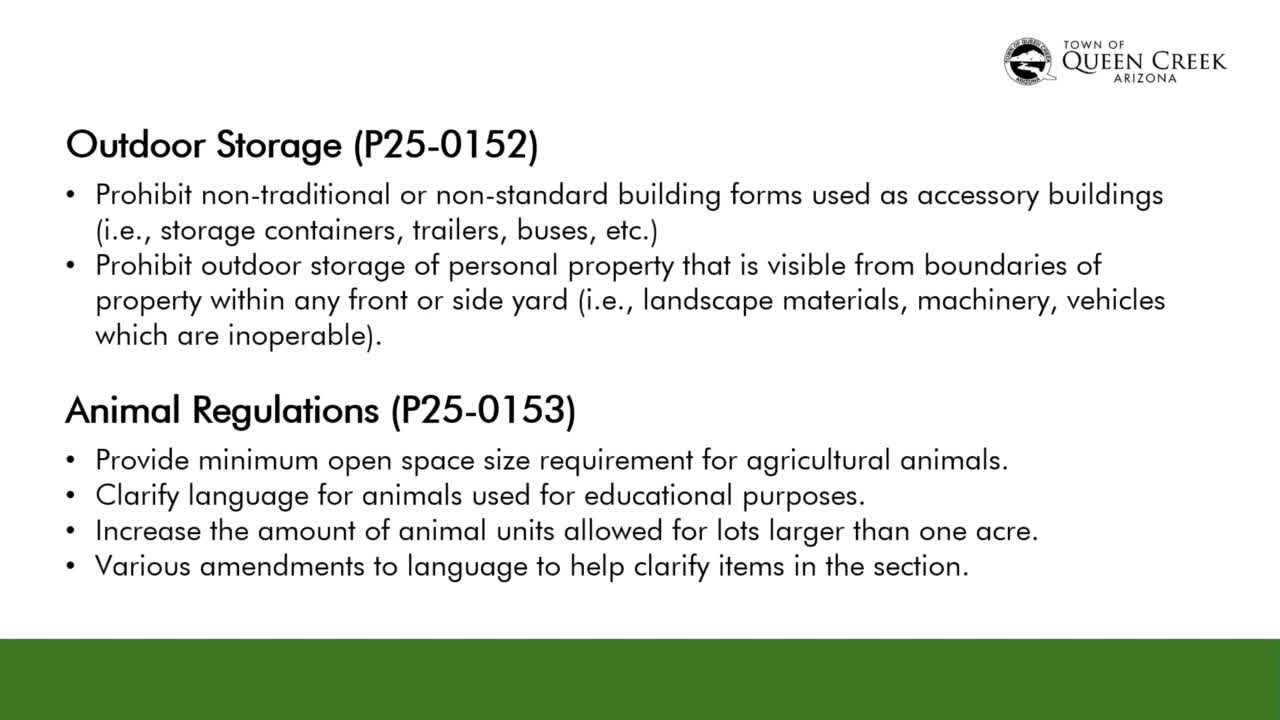
Les Johnson, principal planner, said staff prepared amendments after receiving resident complaints and following state‑mandated code updates. On outdoor storage, staff described repeated complaints about nonstandard storage forms (shipping containers, buses, boats) and large accumulations of items visible from streets or adjacent properties; the draft language would prohibit long‑term use of such nonstandard structures and limit visible outdoor storage while allowing short‑term construction storage. "Sometimes those aren't in backyard, sometimes they're in highly visible locations," Johnson said, explaining the complaints.
On animal regulations, staff proposed minimum pen‑size requirements per animal unit, a tighter definition of "educational purposes" (the only existing exception that can allow swine), and a modest increase in allowed animal units on lots larger than 1 acre so the code aligns with recent conditional use practice.
On wireless communications, staff proposed allowing stealth antennas integrated into buildings and certain small‑cell installations (including private‑property small cells) to undergo administrative review rather than a conditional use permit, and to make the commission, rather than council, the final decision body for many conditional use wireless applications unless appealed.
For the downtown core, staff proposed a narrow exception east of Ellsworth for properties under 5,000 sq ft (about 16–18 lots) to relieve on‑site parking minimums, aimed at retaining small‑scale character and preventing substantial building modification; commissioners questioned ADA access and longer‑term parking impacts and asked staff to return with further analysis.
Staff also proposed a definition for murals so they are treated distinctly from signage and not governed by the sign code. Johnson said staff will continue to refine language and bring the amendments back for formal consideration next month. He said enforcement for outdoor storage is primarily complaint‑driven and that code compliance emphasizes education and notices before citations.
No final votes were taken; staff will return with refined draft language and supporting materials, including the results of a downtown parking demand study being conducted with consultants.
Les Johnson, principal planner, said staff prepared amendments after receiving resident complaints and following state‑mandated code updates. On outdoor storage, staff described repeated complaints about nonstandard storage forms (shipping containers, buses, boats) and large accumulations of items visible from streets or adjacent properties; the draft language would prohibit long‑term use of such nonstandard structures and limit visible outdoor storage while allowing short‑term construction storage. "Sometimes those aren't in backyard, sometimes they're in highly visible locations," Johnson said, explaining the complaints.
On animal regulations, staff proposed minimum pen‑size requirements per animal unit, a tighter definition of "educational purposes" (the only existing exception that can allow swine), and a modest increase in allowed animal units on lots larger than 1 acre so the code aligns with recent conditional use practice.
On wireless communications, staff proposed allowing stealth antennas integrated into buildings and certain small‑cell installations (including private‑property small cells) to undergo administrative review rather than a conditional use permit, and to make the commission, rather than council, the final decision body for many conditional use wireless applications unless appealed.
For the downtown core, staff proposed a narrow exception east of Ellsworth for properties under 5,000 sq ft (about 16–18 lots) to relieve on‑site parking minimums, aimed at retaining small‑scale character and preventing substantial building modification; commissioners questioned ADA access and longer‑term parking impacts and asked staff to return with further analysis.
Staff also proposed a definition for murals so they are treated distinctly from signage and not governed by the sign code. Johnson said staff will continue to refine language and bring the amendments back for formal consideration next month. He said enforcement for outdoor storage is primarily complaint‑driven and that code compliance emphasizes education and notices before citations.
No final votes were taken; staff will return with refined draft language and supporting materials, including the results of a downtown parking demand study being conducted with consultants.
View the Full Meeting & All Its Details
This article offers just a summary. Unlock complete video, transcripts, and insights as a Founder Member.
✓
Watch full, unedited meeting videos
✓
Search every word spoken in unlimited transcripts
✓
AI summaries & real-time alerts (all government levels)
✓
Permanent access to expanding government content
30-day money-back guarantee
