Prince George’s County task force approves data-center report after strong community opposition and debate over zoning
November 12, 2025 | Prince George's County, Maryland
This article was created by AI summarizing key points discussed. AI makes mistakes, so for full details and context, please refer to the video of the full meeting. Please report any errors so we can fix them. Report an error »
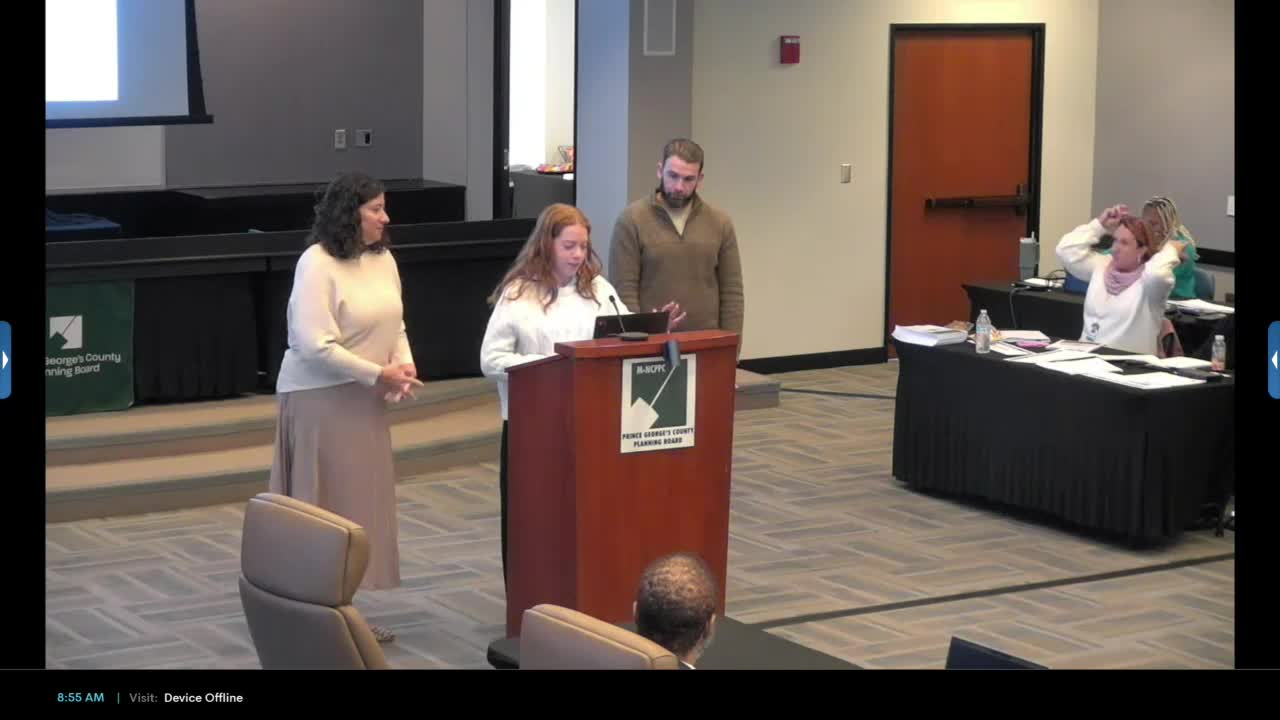
The Qualified Data Center Task Force voted to approve its final report recommending that Prince George’s County require special-exception or planned-development review for so-called qualified data centers, after members and staff described intensive public opposition and debated technical, environmental and workforce issues.
James Hunt, deputy planning director for Prince George’s County, told the task force the consultant team had gathered extensive public input and organized task force comments by a green/yellow/red system that shows which suggestions were incorporated, which require further analysis and which need task force direction. "We have our consultant team, the Gensler consultant group," Hunt said while introducing the draft study and the staff response to comments.
The draft report summarizes four public meetings and a large community meeting in Landover on Oct. 25. Hadar, a Gensler consultant presenting the community meeting results, said the Oct. 25 event ran 10 a.m. to 12 p.m. with "over 450 attendees" and that the most frequent comment was that "participants ... do not want data centers in Prince George's County at all," with water and energy concerns the next-highest themes. Staff later clarified written-input totals: the meeting generated thousands of inputs (staff cited 1,186 comments in one count and corrected the total to 1,565 for the appendices), which will be included in the final record.
The report recommends removing "permitted by right" status for qualified data centers in affected zones and instead routing such proposals either through a special-exception review or a zoning-map amendment via a planned-development (PD) process. Anthony Jones, the county attorney and co-chair, outlined the procedural difference: under the special-exception process, staff conducts an analysis, the planning board transmits the record to the zoning hearing examiner for a public hearing, and the district council makes the final determination; the PD route likewise provides public notice, community meetings, planning board review and council determination.
Policy items flagged for county-council consideration include advocating to the State of Maryland for a high energy-use surcharge, discouraging speculative data-center siting by incentivizing planned developments, and adding infrastructure-specific requirements at the zoning stage (for example, system-analysis submissions from power and water utilities). Staff said the report will refer to the Washington Suburban Sanitary Commission (WSSC) by its full name in the final document.
Task force members and invited stakeholders also pressed staff on mitigation and enforcement details. Members asked staff to consider eliminating code exceptions that allow unmitigated generator noise and to evaluate requiring third-party acoustic engineering reviews during design and post-occupancy enforcement. On community benefits, members asked the report to identify example CBA (community benefit agreement) provisions, targets for local hiring with family-sustaining wages, and clawbacks for incentives that are not met; staff said those matters will need further stakeholder analysis and likely legislative action by the County Council.
Speakers representing labor and economic interests emphasized both caution and opportunity. A representative of IBW Local 26 urged the county to use local training centers to fill construction and maintenance jobs, describing data centers as "a tremendous source of highly skilled, good jobs" and noting continuing retrofit and maintenance work. Other speakers emphasized research showing broader fiscal benefits at build-out in comparable counties but cautioned that power availability and siting criteria will determine what sites can realistically be developed.
The task force approved the report by voice vote. Stacy Hartwell recorded a "no" vote; Alexis Lewis of the Maryland Office of People's Counsel announced an abstention and Crystal Carpenter also registered an abstention in the chat. Staff reiterated that the task force intends to transmit the report and its appendices to the County Council (the report is due to the council by Nov. 30; staff said they expect to provide a version by Nov. 24) and to pursue a council presentation in January.
Next steps: staff will incorporate the task force comments (color-coded spreadsheet and appendices), correct naming and factual items such as WSSC references, add the meeting materials and PowerPoint presentations to the appendices, and coordinate a County Council presentation. The County Council and, where applicable, state agencies will determine whether to pursue legislative changes such as a surcharge or the detailed statutory mechanisms to carry out the recommendations.
James Hunt, deputy planning director for Prince George’s County, told the task force the consultant team had gathered extensive public input and organized task force comments by a green/yellow/red system that shows which suggestions were incorporated, which require further analysis and which need task force direction. "We have our consultant team, the Gensler consultant group," Hunt said while introducing the draft study and the staff response to comments.
The draft report summarizes four public meetings and a large community meeting in Landover on Oct. 25. Hadar, a Gensler consultant presenting the community meeting results, said the Oct. 25 event ran 10 a.m. to 12 p.m. with "over 450 attendees" and that the most frequent comment was that "participants ... do not want data centers in Prince George's County at all," with water and energy concerns the next-highest themes. Staff later clarified written-input totals: the meeting generated thousands of inputs (staff cited 1,186 comments in one count and corrected the total to 1,565 for the appendices), which will be included in the final record.
The report recommends removing "permitted by right" status for qualified data centers in affected zones and instead routing such proposals either through a special-exception review or a zoning-map amendment via a planned-development (PD) process. Anthony Jones, the county attorney and co-chair, outlined the procedural difference: under the special-exception process, staff conducts an analysis, the planning board transmits the record to the zoning hearing examiner for a public hearing, and the district council makes the final determination; the PD route likewise provides public notice, community meetings, planning board review and council determination.
Policy items flagged for county-council consideration include advocating to the State of Maryland for a high energy-use surcharge, discouraging speculative data-center siting by incentivizing planned developments, and adding infrastructure-specific requirements at the zoning stage (for example, system-analysis submissions from power and water utilities). Staff said the report will refer to the Washington Suburban Sanitary Commission (WSSC) by its full name in the final document.
Task force members and invited stakeholders also pressed staff on mitigation and enforcement details. Members asked staff to consider eliminating code exceptions that allow unmitigated generator noise and to evaluate requiring third-party acoustic engineering reviews during design and post-occupancy enforcement. On community benefits, members asked the report to identify example CBA (community benefit agreement) provisions, targets for local hiring with family-sustaining wages, and clawbacks for incentives that are not met; staff said those matters will need further stakeholder analysis and likely legislative action by the County Council.
Speakers representing labor and economic interests emphasized both caution and opportunity. A representative of IBW Local 26 urged the county to use local training centers to fill construction and maintenance jobs, describing data centers as "a tremendous source of highly skilled, good jobs" and noting continuing retrofit and maintenance work. Other speakers emphasized research showing broader fiscal benefits at build-out in comparable counties but cautioned that power availability and siting criteria will determine what sites can realistically be developed.
The task force approved the report by voice vote. Stacy Hartwell recorded a "no" vote; Alexis Lewis of the Maryland Office of People's Counsel announced an abstention and Crystal Carpenter also registered an abstention in the chat. Staff reiterated that the task force intends to transmit the report and its appendices to the County Council (the report is due to the council by Nov. 30; staff said they expect to provide a version by Nov. 24) and to pursue a council presentation in January.
Next steps: staff will incorporate the task force comments (color-coded spreadsheet and appendices), correct naming and factual items such as WSSC references, add the meeting materials and PowerPoint presentations to the appendices, and coordinate a County Council presentation. The County Council and, where applicable, state agencies will determine whether to pursue legislative changes such as a surcharge or the detailed statutory mechanisms to carry out the recommendations.
Don't Miss a Word: See the Full Meeting!
Go beyond summaries. Unlock every video, transcript, and key insight with a Founder Membership.
✓
Get instant access to full meeting videos
✓
Search and clip any phrase from complete transcripts
✓
Receive AI-powered summaries & custom alerts
✓
Enjoy lifetime, unrestricted access to government data
30-day money-back guarantee
