Overland Park police warn of fentanyl powder, kratom‑linked '7O' products; lawmakers eyed
November 12, 2025 | Overland Park, Johnson County, Kansas
This article was created by AI summarizing key points discussed. AI makes mistakes, so for full details and context, please refer to the video of the full meeting. Please report any errors so we can fix them. Report an error »
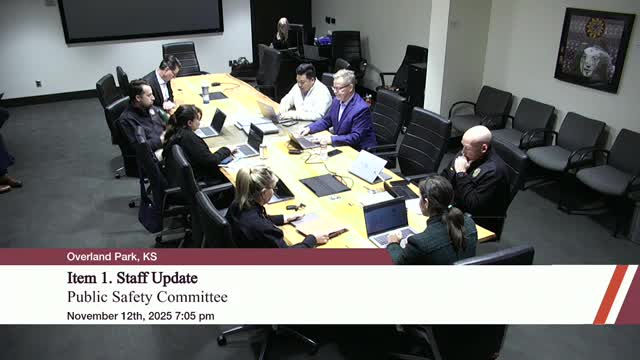
Detective Broom, an Overland Park Police Department detective, told the Public Safety Committee on Nov. 12 that fentanyl in the Kansas City metro has shifted from counterfeit pills to powder and is increasingly found mixed into other street drugs. "Just last month in Kansas there was a bust of about nine pounds of fentanyl," Detective Broom said. "That was about enough to kill 2,000,000 people." He described the seizure as evidence of the potency and public‑health risk of current supply chains.
Captain Twaddle, who leads the Special Investigations Unit (SIU), described the unit’s staffing and approach: one sergeant, one dedicated crime analyst, six in‑house detectives and two DEA task force officers focused on narcotics and co‑occurring crimes such as auto theft and weapons offenses. Twaddle said the unit emphasizes targeting sources of supply and pairs enforcement with prevention and school outreach.
The presentation flagged a growing market for products loosely marketed with kratom — a natural botanical — and a synthetic derivative sometimes called "7O" or "7‑OH" (presenters used the shorthand "7O"). Detective Broom said these products are unregulated, vary widely in potency and are being sold at smoke shops and convenience stores in the region. "These are not made in FDA‑regulated labs," he said, adding that potency can differ dramatically from product to product.
Committee members asked how the city might respond. Staff referenced House Bill 2230, introduced by state Rep. Alan Rivas, which aimed to restrict kratom derivatives in Kansas but did not pass this session. Overland Park staff said they are exploring a municipal ordinance to ban commercial sales of kratom‑related synthetic products at convenience stores and similar retailers, though they emphasized the city is in early discussions and would start with an education effort because the Johnson County district attorney has been reluctant to pursue prosecutions in many cases.
Presenters also discussed other trends: marijuana and THC concentrates remain common (with enforcement complicated by differing state laws and THC formulations); methamphetamine continues to be prevalent in the Midwest and relatively inexpensive compared with cocaine; and cocaine has resurged in some party scenes. Staff noted that some school outreach occurs on an invitation basis (for example, Red Ribbon Week), but there is no citywide curriculum for all districts.
The presentation included data and response context: Overland Park has pursued eight cases under the state's "distribution leading to death or great bodily harm" statute since 2019, including the city's first guilty plea and first jury conviction under that statute, presenters said. Investigations of that type are treated similarly to homicides because of the severity and time required.
The committee heard that Narcan (naloxone) is effective on synthetic opioids like fentanyl and the kratom‑linked 7O in overdose situations, and staff reiterated the Good Samaritan protections in place to encourage people to call for medical help during overdoses.
What happens next: staff said they will continue education with schools and businesses and are exploring enforcement and ordinance options at the municipal level, including coordinating with Johnson County crime lab testing capabilities and the county district attorney as the city evaluates next steps.
Captain Twaddle, who leads the Special Investigations Unit (SIU), described the unit’s staffing and approach: one sergeant, one dedicated crime analyst, six in‑house detectives and two DEA task force officers focused on narcotics and co‑occurring crimes such as auto theft and weapons offenses. Twaddle said the unit emphasizes targeting sources of supply and pairs enforcement with prevention and school outreach.
The presentation flagged a growing market for products loosely marketed with kratom — a natural botanical — and a synthetic derivative sometimes called "7O" or "7‑OH" (presenters used the shorthand "7O"). Detective Broom said these products are unregulated, vary widely in potency and are being sold at smoke shops and convenience stores in the region. "These are not made in FDA‑regulated labs," he said, adding that potency can differ dramatically from product to product.
Committee members asked how the city might respond. Staff referenced House Bill 2230, introduced by state Rep. Alan Rivas, which aimed to restrict kratom derivatives in Kansas but did not pass this session. Overland Park staff said they are exploring a municipal ordinance to ban commercial sales of kratom‑related synthetic products at convenience stores and similar retailers, though they emphasized the city is in early discussions and would start with an education effort because the Johnson County district attorney has been reluctant to pursue prosecutions in many cases.
Presenters also discussed other trends: marijuana and THC concentrates remain common (with enforcement complicated by differing state laws and THC formulations); methamphetamine continues to be prevalent in the Midwest and relatively inexpensive compared with cocaine; and cocaine has resurged in some party scenes. Staff noted that some school outreach occurs on an invitation basis (for example, Red Ribbon Week), but there is no citywide curriculum for all districts.
The presentation included data and response context: Overland Park has pursued eight cases under the state's "distribution leading to death or great bodily harm" statute since 2019, including the city's first guilty plea and first jury conviction under that statute, presenters said. Investigations of that type are treated similarly to homicides because of the severity and time required.
The committee heard that Narcan (naloxone) is effective on synthetic opioids like fentanyl and the kratom‑linked 7O in overdose situations, and staff reiterated the Good Samaritan protections in place to encourage people to call for medical help during overdoses.
What happens next: staff said they will continue education with schools and businesses and are exploring enforcement and ordinance options at the municipal level, including coordinating with Johnson County crime lab testing capabilities and the county district attorney as the city evaluates next steps.
View the Full Meeting & All Its Details
This article offers just a summary. Unlock complete video, transcripts, and insights as a Founder Member.
✓
Watch full, unedited meeting videos
✓
Search every word spoken in unlimited transcripts
✓
AI summaries & real-time alerts (all government levels)
✓
Permanent access to expanding government content
30-day money-back guarantee
