Governance committee debates annual strategic-priority setting and proposed council rule changes; language to be redrafted
November 11, 2025 | Portland, Multnomah County, Oregon
This article was created by AI summarizing key points discussed. AI makes mistakes, so for full details and context, please refer to the video of the full meeting. Please report any errors so we can fix them. Report an error »
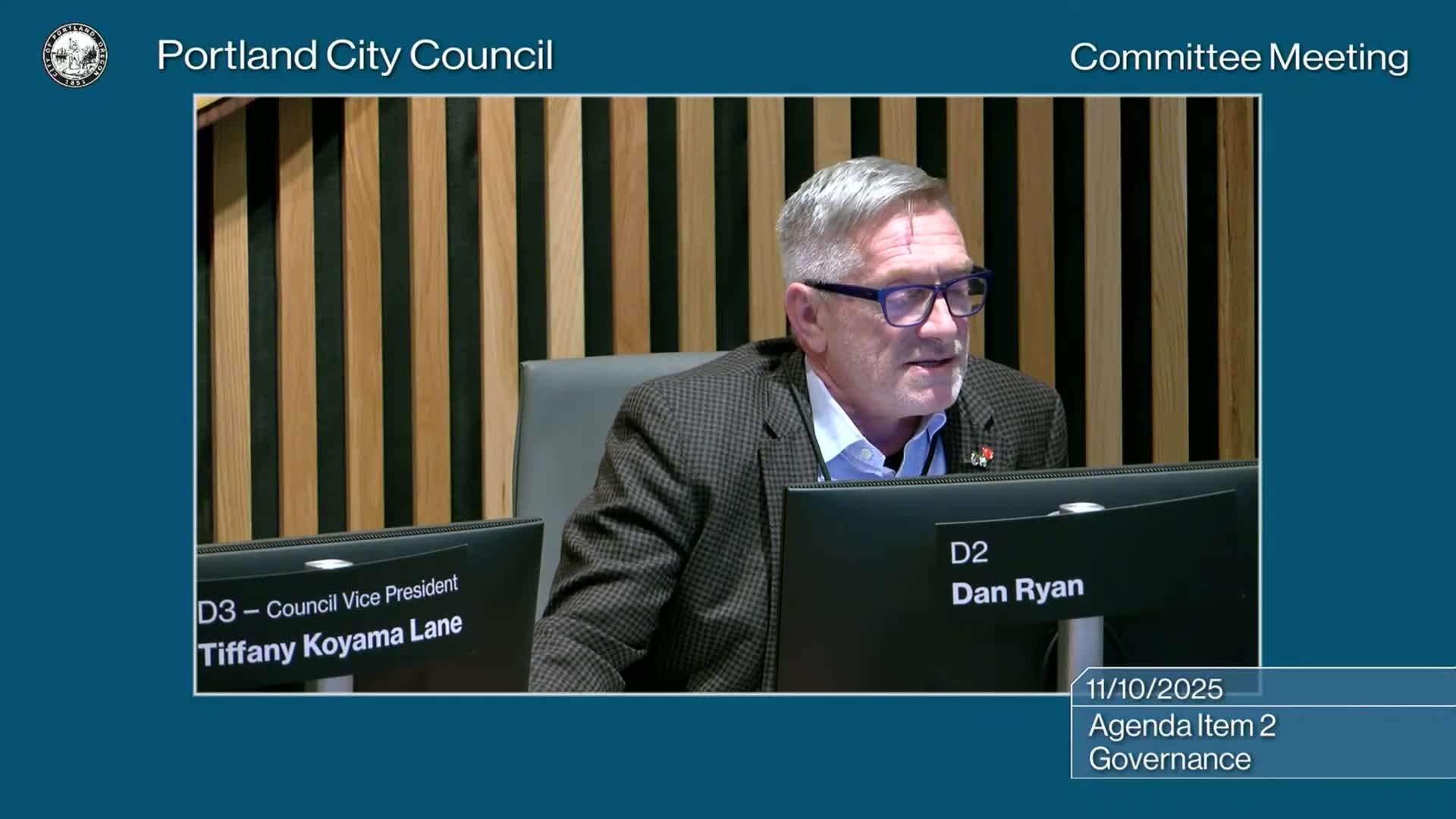
The Portland Governance Committee on Nov. 10 held an extended, workshop-style discussion of a proposed annual strategic-priority setting process and a separate package of potential changes to council rules and committee procedures. Committee members agreed on the value of a structured priority-setting session but split over timing, binding language and procedural safeguards.
Vice Chair Ryan introduced a resolution that would require the council to meet annually (proposed December or January) to identify three to four top priorities, set measurable targets and consider convening a neutral facilitator. Speaker Dean Salazar, a public testifier, urged adoption and said the measure ‘‘is a central architecture we need for accountable and empathetic leadership,’’ adding that a 75% supermajority requirement for final approval would be a ‘‘vital safeguard.’’ Several councilors, however, questioned whether a supermajority or strict binding language would limit the council’s ability to respond to urgent issues.
Councilors debated whether the session should follow the election of a council president and vice president, whether committees should be suspended during the process, and whether the handbook or rules should be permissive guidance rather than binding. Supporters said an external facilitator and readoption of a concise rules handbook every one to two years would create clearer priorities and improve budget alignment; opponents warned that overly rigid procedures could curtail individual councilors’ ability to pursue district-specific work or respond to emergent events.
Separately, the council president presented proposed code edits to chapter 3.02 that would codify committee timelines (chairs must place referred items on committee agendas within 90 days), create an ‘‘inactive/expired’’ status for items not reintroduced within 180 days, clarify that committees issue recommendations (do pass/do adopt), and tighten amendment-filing practices at full council while preserving a 9-of-12 vote release valve for emergency or on-the-floor changes.
Committee members generally welcomed daylighting the proposed rule changes for legal review and asked the council president’s office to return with revised, word‑smithed language. The vice chair’s office was also asked to redraft the strategic-priority resolution to reflect the committee’s feedback on timing, facilitator use, and whether outcomes should be binding or advisory. Both items will be returned to committee for further consideration.
As Council President (speaker 8) noted, the proposal is intended as a governance improvement and is not being voted on in final form today; the document will undergo legal review and be reposted before any formal action.
Vice Chair Ryan introduced a resolution that would require the council to meet annually (proposed December or January) to identify three to four top priorities, set measurable targets and consider convening a neutral facilitator. Speaker Dean Salazar, a public testifier, urged adoption and said the measure ‘‘is a central architecture we need for accountable and empathetic leadership,’’ adding that a 75% supermajority requirement for final approval would be a ‘‘vital safeguard.’’ Several councilors, however, questioned whether a supermajority or strict binding language would limit the council’s ability to respond to urgent issues.
Councilors debated whether the session should follow the election of a council president and vice president, whether committees should be suspended during the process, and whether the handbook or rules should be permissive guidance rather than binding. Supporters said an external facilitator and readoption of a concise rules handbook every one to two years would create clearer priorities and improve budget alignment; opponents warned that overly rigid procedures could curtail individual councilors’ ability to pursue district-specific work or respond to emergent events.
Separately, the council president presented proposed code edits to chapter 3.02 that would codify committee timelines (chairs must place referred items on committee agendas within 90 days), create an ‘‘inactive/expired’’ status for items not reintroduced within 180 days, clarify that committees issue recommendations (do pass/do adopt), and tighten amendment-filing practices at full council while preserving a 9-of-12 vote release valve for emergency or on-the-floor changes.
Committee members generally welcomed daylighting the proposed rule changes for legal review and asked the council president’s office to return with revised, word‑smithed language. The vice chair’s office was also asked to redraft the strategic-priority resolution to reflect the committee’s feedback on timing, facilitator use, and whether outcomes should be binding or advisory. Both items will be returned to committee for further consideration.
As Council President (speaker 8) noted, the proposal is intended as a governance improvement and is not being voted on in final form today; the document will undergo legal review and be reposted before any formal action.
Don't Miss a Word: See the Full Meeting!
Go beyond summaries. Unlock every video, transcript, and key insight with a Founder Membership.
✓
Get instant access to full meeting videos
✓
Search and clip any phrase from complete transcripts
✓
Receive AI-powered summaries & custom alerts
✓
Enjoy lifetime, unrestricted access to government data
30-day money-back guarantee
