Buckeye staff propose phased multi‑year water and sewer rate increases to fund asset reinvestment
November 06, 2025 | Buckeye, Maricopa County, Arizona
This article was created by AI summarizing key points discussed. AI makes mistakes, so for full details and context, please refer to the video of the full meeting. Please report any errors so we can fix them. Report an error »
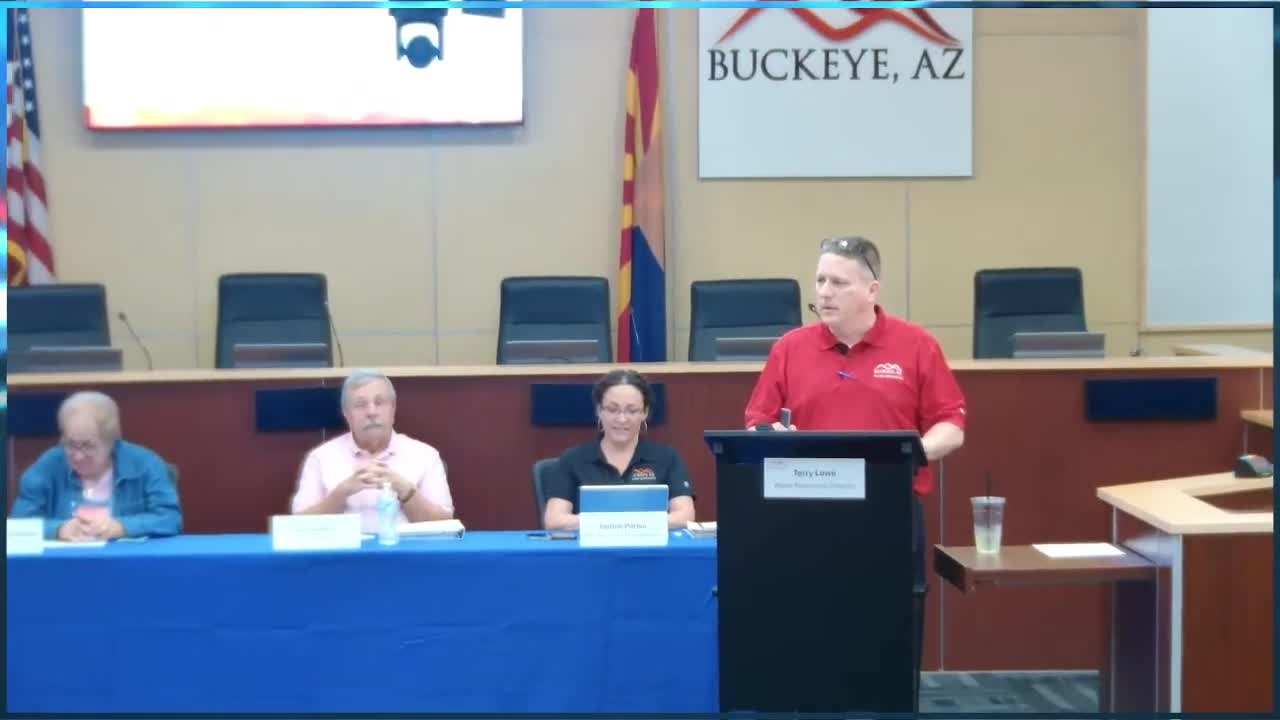
Terry Lowe, City of Buckeye water resources director, told attendees at the second of three public open‑house meetings that the city is proposing a multiyear water and wastewater rate plan aimed at restoring long‑term asset reinvestment and maintaining service levels. "We do not collect any tax revenue," Lowe said, noting the utilities operate as enterprise funds that must recover personnel, supplies, debt service and capital projects through rates alone.
The proposal, developed with the Water Rates Committee (WRC) after seven or eight meetings, would shift the city to a predictable multiyear cycle and adopt several structural changes: streamline base rates by meter size, add a smaller meter category for 3/4‑inch services, eliminate the sewer volumetric charge in favor of a flat sewer rate, and remove a $3.05 flat fee by folding it into the base charge. Lowe described a "gradualism" approach to phase increases over time rather than imposing a single large one, with staff modeling that the utility would reach its targeted reinvestment level by the third rate cycle (roughly years 11–15).
Why it matters: Lowe said asset management — preventive maintenance, rehabilitation and eventual replacement of wells, pump stations, storage tanks and treatment facilities — drives a large portion of rate needs. He told the room the city "currently operates just over a billion dollars worth of assets," and later in the presentation staff used a $790 million figure for water assets in the rate model; Lowe said staff would grow reinvestment from an initial modeled $5.9 million and increase it over time toward a longer‑term target (the presentation used a 2% rule‑of‑thumb for reinvestment). Lowe cautioned the city will not seek the full 2% target immediately but will phase increases so the utility reaches the objective over several rate cycles.
Staff walked through sample bills to show likely customer impacts. A typical 1‑inch residential customer with 6,000 gallons of monthly use currently pays about $57; staff estimated that bill would rise to roughly $62 in 2026 under the proposal, with smaller incremental increases in subsequent years. Commercial customers with larger meters would see larger dollar increases; landscaping and nonpotable (reclaimed) customers were modeled with adjusted tiers to reflect regional norms and HOA billing structures.
Officials compared Buckeye to neighboring West Valley cities and said Buckeye uses more assets per unit of production because the city's wells typically produce less water per site and the system is more geographically distributed. "Each every time you add an asset, you're adding personnel, you're adding electricity," Lowe said, explaining the higher asset footprint behind Buckeye's cost structure.
Staff also addressed finance and process questions. Lowe said the utility's required reserve is two months' operating expenses; staff reported approximately $30 million on hand against about $39 million in planned expenses. Staff plan further outreach materials (bill inserts, social media, an online rate calculator) and a council workshop, with a notice of intent targeted for late January, a 60‑day public comment period in April and potential adoption in May.
During audience Q&A, staff said developers and large users (including data centers) are responsible for capital expansions through impact fees or direct construction; the city does not propose using rate revenues to subsidize private development. Lowe offered to share the city's development agreement with a large data‑center developer to show how capital responsibilities are allocated. He also reiterated that utility revenues do not fund community amenities outside the utility enterprise.
The presentation materials, a calculator and a method to submit comments will be posted on the city's website; staff encouraged attendees to speak with technical staff after the presentation and to submit follow‑up questions via the QR code in the meeting packet.
The proposal, developed with the Water Rates Committee (WRC) after seven or eight meetings, would shift the city to a predictable multiyear cycle and adopt several structural changes: streamline base rates by meter size, add a smaller meter category for 3/4‑inch services, eliminate the sewer volumetric charge in favor of a flat sewer rate, and remove a $3.05 flat fee by folding it into the base charge. Lowe described a "gradualism" approach to phase increases over time rather than imposing a single large one, with staff modeling that the utility would reach its targeted reinvestment level by the third rate cycle (roughly years 11–15).
Why it matters: Lowe said asset management — preventive maintenance, rehabilitation and eventual replacement of wells, pump stations, storage tanks and treatment facilities — drives a large portion of rate needs. He told the room the city "currently operates just over a billion dollars worth of assets," and later in the presentation staff used a $790 million figure for water assets in the rate model; Lowe said staff would grow reinvestment from an initial modeled $5.9 million and increase it over time toward a longer‑term target (the presentation used a 2% rule‑of‑thumb for reinvestment). Lowe cautioned the city will not seek the full 2% target immediately but will phase increases so the utility reaches the objective over several rate cycles.
Staff walked through sample bills to show likely customer impacts. A typical 1‑inch residential customer with 6,000 gallons of monthly use currently pays about $57; staff estimated that bill would rise to roughly $62 in 2026 under the proposal, with smaller incremental increases in subsequent years. Commercial customers with larger meters would see larger dollar increases; landscaping and nonpotable (reclaimed) customers were modeled with adjusted tiers to reflect regional norms and HOA billing structures.
Officials compared Buckeye to neighboring West Valley cities and said Buckeye uses more assets per unit of production because the city's wells typically produce less water per site and the system is more geographically distributed. "Each every time you add an asset, you're adding personnel, you're adding electricity," Lowe said, explaining the higher asset footprint behind Buckeye's cost structure.
Staff also addressed finance and process questions. Lowe said the utility's required reserve is two months' operating expenses; staff reported approximately $30 million on hand against about $39 million in planned expenses. Staff plan further outreach materials (bill inserts, social media, an online rate calculator) and a council workshop, with a notice of intent targeted for late January, a 60‑day public comment period in April and potential adoption in May.
During audience Q&A, staff said developers and large users (including data centers) are responsible for capital expansions through impact fees or direct construction; the city does not propose using rate revenues to subsidize private development. Lowe offered to share the city's development agreement with a large data‑center developer to show how capital responsibilities are allocated. He also reiterated that utility revenues do not fund community amenities outside the utility enterprise.
The presentation materials, a calculator and a method to submit comments will be posted on the city's website; staff encouraged attendees to speak with technical staff after the presentation and to submit follow‑up questions via the QR code in the meeting packet.
Don't Miss a Word: See the Full Meeting!
Go beyond summaries. Unlock every video, transcript, and key insight with a Founder Membership.
✓
Get instant access to full meeting videos
✓
Search and clip any phrase from complete transcripts
✓
Receive AI-powered summaries & custom alerts
✓
Enjoy lifetime, unrestricted access to government data
30-day money-back guarantee
