McKinney planning staff gives overview of 1 McKinney 2040 comprehensive plan and how it guides zoning
November 04, 2025 | McKinney, Collin County, Texas
This article was created by AI summarizing key points discussed. AI makes mistakes, so for full details and context, please refer to the video of the full meeting. Please report any errors so we can fix them. Report an error »
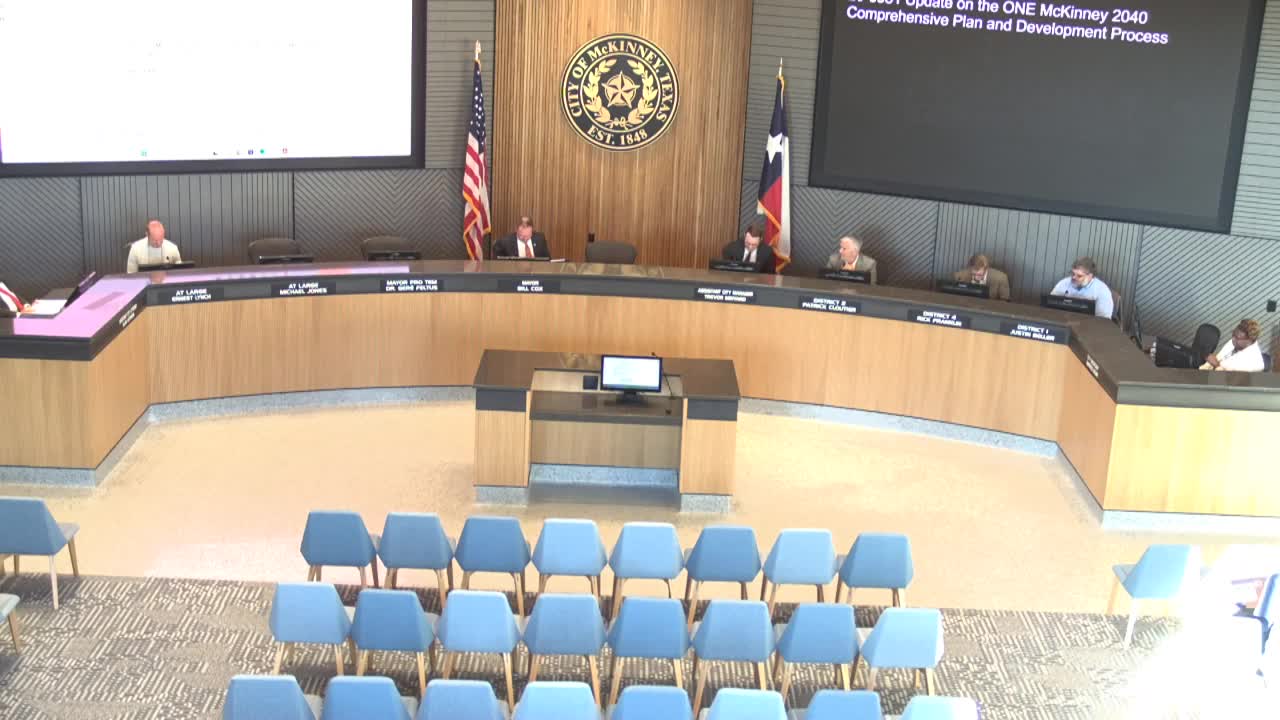
Lucas Raley, director of planning for the City of McKinney, presented the first of a two-part work session on the 1 McKinney 2040 comprehensive plan and the city’s development review process.
Raley said the session was intended as a refresher for recently seated council members and described the plan as a community-driven policy document developed between 2015 and 2018 through stakeholder interviews, summits and charrettes. He said comprehensive plans are typically updated every 10 to 15 years and that staff will likely request budget authority to update the plan within the next one to two years.
Raley outlined the plan’s components — a vision and guiding principles, a preferred scenario (a map that identifies 17 districts across the city), a land use diagram with place types, a future thoroughfare plan, and an implementation matrix. He emphasized that the preferred scenario map is not a zoning map but a growth framework that shows where the city expects and plans for growth. He described the land use diagram as intentionally flexible, with gradients and place-type descriptions that convey the intended character of areas rather than parcel-level permitted uses.
Raley also described a citywide decision-making criteria staff use to evaluate rezoning and land-use requests that do not perfectly align with the land use diagram. He said the Unified Development Code (UDC) was developed from the 2018 comprehensive plan and that staff use both the place types and district diagrams to craft recommendations for zoning requests.
Councilmembers responding during the session said the comp plan is particularly useful for setting neighborhood expectations around infill and noted that rapid growth means the plan must be reviewed and adjusted periodically. Raley closed by saying part two of the work session will translate the plan into practical recommendations and show how staff applies the policy to specific development scenarios.
No formal changes to the comprehensive plan or zoning regulations were made at the meeting; the council recessed for an executive session and later adjourned the work session by voice vote.
Raley said the session was intended as a refresher for recently seated council members and described the plan as a community-driven policy document developed between 2015 and 2018 through stakeholder interviews, summits and charrettes. He said comprehensive plans are typically updated every 10 to 15 years and that staff will likely request budget authority to update the plan within the next one to two years.
Raley outlined the plan’s components — a vision and guiding principles, a preferred scenario (a map that identifies 17 districts across the city), a land use diagram with place types, a future thoroughfare plan, and an implementation matrix. He emphasized that the preferred scenario map is not a zoning map but a growth framework that shows where the city expects and plans for growth. He described the land use diagram as intentionally flexible, with gradients and place-type descriptions that convey the intended character of areas rather than parcel-level permitted uses.
Raley also described a citywide decision-making criteria staff use to evaluate rezoning and land-use requests that do not perfectly align with the land use diagram. He said the Unified Development Code (UDC) was developed from the 2018 comprehensive plan and that staff use both the place types and district diagrams to craft recommendations for zoning requests.
Councilmembers responding during the session said the comp plan is particularly useful for setting neighborhood expectations around infill and noted that rapid growth means the plan must be reviewed and adjusted periodically. Raley closed by saying part two of the work session will translate the plan into practical recommendations and show how staff applies the policy to specific development scenarios.
No formal changes to the comprehensive plan or zoning regulations were made at the meeting; the council recessed for an executive session and later adjourned the work session by voice vote.
View the Full Meeting & All Its Details
This article offers just a summary. Unlock complete video, transcripts, and insights as a Founder Member.
✓
Watch full, unedited meeting videos
✓
Search every word spoken in unlimited transcripts
✓
AI summaries & real-time alerts (all government levels)
✓
Permanent access to expanding government content
30-day money-back guarantee
