Council approves home‑rule development agreement to rebuild Beach Baptist and allow 12 homes
November 04, 2025 | Fort Myers Beach, Lee County, Florida
This article was created by AI summarizing key points discussed. AI makes mistakes, so for full details and context, please refer to the video of the full meeting. Please report any errors so we can fix them. Report an error »
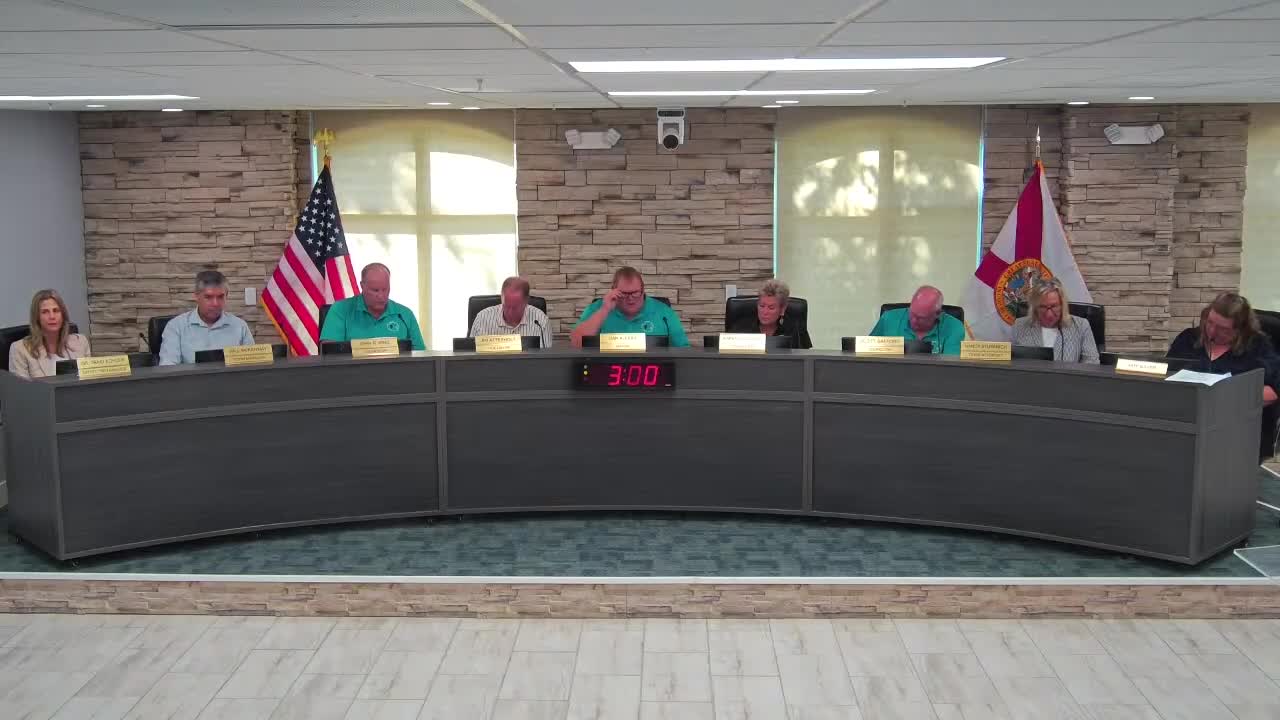
Vice Mayor Aderholt moved and Councilor Safford seconded the approval of Ordinance 25‑17, the second reading and final public hearing on a home‑rule development agreement for 110–138 Connecticut Street owned by First Baptist Church of Fort Myers Inc. The council voted unanimously to adopt the ordinance.
The agreement authorizes redevelopment of two parcels: a 1.1‑acre parcel for a church facility and a roughly 2‑acre parcel to be rezoned and developed with 12 single‑family homes. The applicant told the council it demolished two trailers on the site and paid outstanding water bills prior to the hearing. Staff and the applicant reported they reduced the number of requested deviations from five to three by changing the site plan, including increasing a previously smaller side‑yard separation to 13 feet.
Jennifer Sabin, AICP, the applicant’s land‑use planner, described the site plan changes and landscaping commitments. Under the developer agreement the church parcel will retain its existing zoning, while the residential parcel will be rezoned from IN to RC. Sabin said buffers and native plantings will be provided along the perimeter (five trees per 100 feet and double hedge screening in many locations) and that two small walls would be installed near the dead‑end street to limit vehicle light intrusion. Parking for the homes will be provided beneath the houses with short driveways intended for guest parking; trash and recycling will be handled individually, similar to standard single‑family neighborhoods.
Applicant representative Jonathan Thomas said the project arose after the church’s substantial damage from Hurricane Ian and the developer’s effort to help the congregation regain a functional campus. The development team said the plan is to build the church first, commence residential site work concurrently, and begin construction of homes as market demand permits. Thomas said building permits for the church are largely submitted and anticipated permitting time is roughly three to four months.
The developer agreement includes several use restrictions and commitments. The applicant agreed to prohibit overnight RV parking on both parcels, and to adopt a traffic management plan for the church to address drop‑off and circulation if needed. Staff maintained its recommendation for approval in the updated staff report, noting the proposal is consistent with the town’s comprehensive plan and the land‑development code when implemented under the agreement.
After public comment closed with no speakers, Vice Mayor Aderholt moved to approve Ordinance 25‑17. The motion was seconded by Councilor Safford and carried 5–0 (Aderholt — aye; Safford — aye; Woodson — aye; King — aye; Mayor Allard — aye).
What the council approved is a developer‑driven plan and a binding agreement with the town that identifies uses, required landscaping and buffering, deviations granted, and other development obligations. The record shows the council relied on evidentiary testimony from qualified experts and written exhibits presented at the hearing.
Next steps: the applicant indicated building permit applications are in process for the church and that residential construction will follow as site work and market timing allow.
The agreement authorizes redevelopment of two parcels: a 1.1‑acre parcel for a church facility and a roughly 2‑acre parcel to be rezoned and developed with 12 single‑family homes. The applicant told the council it demolished two trailers on the site and paid outstanding water bills prior to the hearing. Staff and the applicant reported they reduced the number of requested deviations from five to three by changing the site plan, including increasing a previously smaller side‑yard separation to 13 feet.
Jennifer Sabin, AICP, the applicant’s land‑use planner, described the site plan changes and landscaping commitments. Under the developer agreement the church parcel will retain its existing zoning, while the residential parcel will be rezoned from IN to RC. Sabin said buffers and native plantings will be provided along the perimeter (five trees per 100 feet and double hedge screening in many locations) and that two small walls would be installed near the dead‑end street to limit vehicle light intrusion. Parking for the homes will be provided beneath the houses with short driveways intended for guest parking; trash and recycling will be handled individually, similar to standard single‑family neighborhoods.
Applicant representative Jonathan Thomas said the project arose after the church’s substantial damage from Hurricane Ian and the developer’s effort to help the congregation regain a functional campus. The development team said the plan is to build the church first, commence residential site work concurrently, and begin construction of homes as market demand permits. Thomas said building permits for the church are largely submitted and anticipated permitting time is roughly three to four months.
The developer agreement includes several use restrictions and commitments. The applicant agreed to prohibit overnight RV parking on both parcels, and to adopt a traffic management plan for the church to address drop‑off and circulation if needed. Staff maintained its recommendation for approval in the updated staff report, noting the proposal is consistent with the town’s comprehensive plan and the land‑development code when implemented under the agreement.
After public comment closed with no speakers, Vice Mayor Aderholt moved to approve Ordinance 25‑17. The motion was seconded by Councilor Safford and carried 5–0 (Aderholt — aye; Safford — aye; Woodson — aye; King — aye; Mayor Allard — aye).
What the council approved is a developer‑driven plan and a binding agreement with the town that identifies uses, required landscaping and buffering, deviations granted, and other development obligations. The record shows the council relied on evidentiary testimony from qualified experts and written exhibits presented at the hearing.
Next steps: the applicant indicated building permit applications are in process for the church and that residential construction will follow as site work and market timing allow.
View the Full Meeting & All Its Details
This article offers just a summary. Unlock complete video, transcripts, and insights as a Founder Member.
✓
Watch full, unedited meeting videos
✓
Search every word spoken in unlimited transcripts
✓
AI summaries & real-time alerts (all government levels)
✓
Permanent access to expanding government content
30-day money-back guarantee
