City adopts Watershed Master Plan to bolster flood resilience and qualify for larger flood‑insurance credits
November 03, 2025 | Sarasota City, Sarasota County, Florida
This article was created by AI summarizing key points discussed. AI makes mistakes, so for full details and context, please refer to the video of the full meeting. Please report any errors so we can fix them. Report an error »
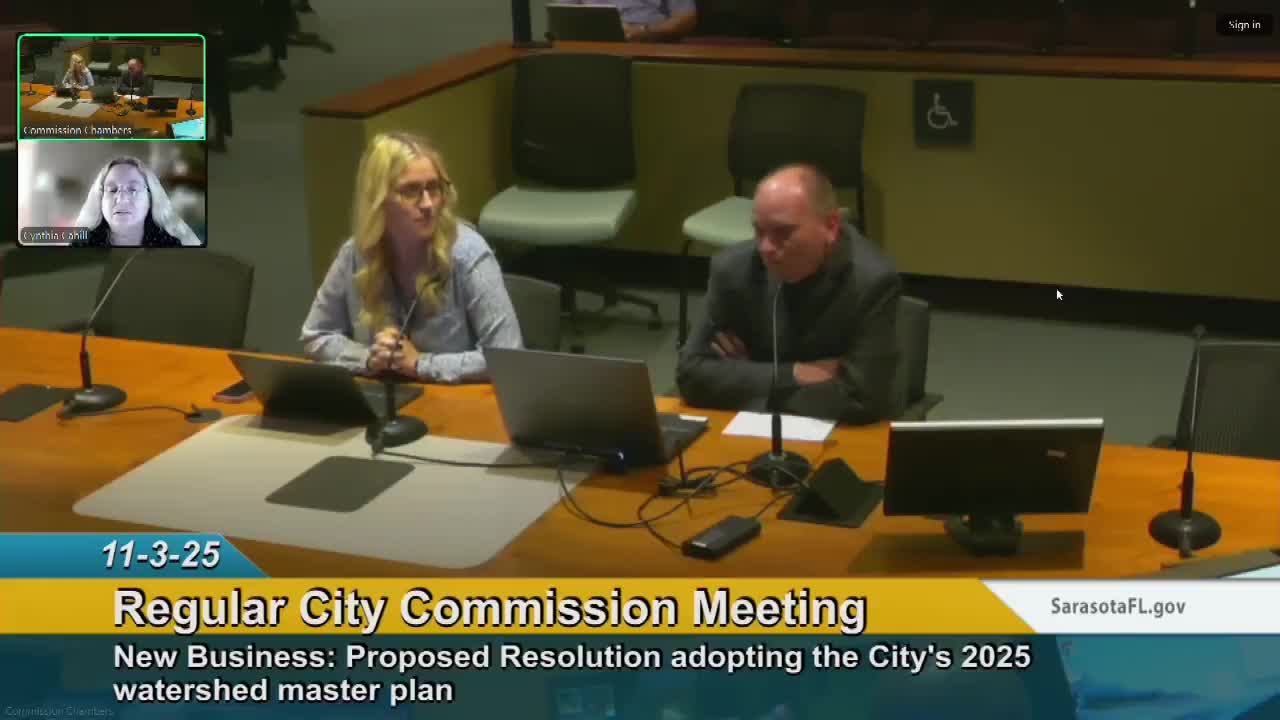
The Sarasota City Commission unanimously adopted the city’s Watershed Master Plan (WMP) on Nov. 3, approving a multi‑watershed, model‑based blueprint intended to reduce flood risk, improve water quality and position the city to earn additional points in FEMA’s Community Rating System (CRS).
FAU‑led hydrologic modeling covered three major basins — Phillippi Creek, Whitaker Bayou and Sarasota Bay frontal — and simulated multiple rainfall and storm scenarios, future build‑out, king tides and sea‑level rise. The WMP identified six major vulnerabilities, including aging and undersized seawalls, stormwater pipes that allow backflow, and inland low spots that will become harder to drain as sea levels rise.
Key near‑term recommendations include raising finished floor elevation standards in targeted areas, updating seawall elevation standards and supporting hybrid/biologically based seawall designs, implementing backflow prevention and monitoring programs for outfall pipes, and preserving or restoring open space to maintain flood storage. Staff noted the city had already acted on one WMP suggestion earlier in 2025 by updating the code to permit seawalls up to 7.27 feet in certain circumstances; FAU modeling supports seawall elevation increases of roughly 2–3 feet in many vulnerable locations over coming decades.
Adoption is also a technical prerequisite for the city to reach CRS Class 4 (the WMP was the mandatory plan required to earn the next CRS class). City staff said the combined effect of a higher CRS score would be further discounts on residents’ flood insurance; staff estimated about $300,000 in additional annual community savings if the city advances one class. The grant that funded the plan requires adoption before the grant closeout (Dec. 30, 2025), staff said.
Commissioners asked about public outreach and datasets; staff described ongoing outreach channels, the grant‑funded modeling effort, and next steps for capital investment planning.
Why this matters: The plan sets a technical, long‑range framework for where the city will invest to increase resilience to storms and sea‑level rise and unlocks additional financial benefits for property owners via the CRS program.
FAU‑led hydrologic modeling covered three major basins — Phillippi Creek, Whitaker Bayou and Sarasota Bay frontal — and simulated multiple rainfall and storm scenarios, future build‑out, king tides and sea‑level rise. The WMP identified six major vulnerabilities, including aging and undersized seawalls, stormwater pipes that allow backflow, and inland low spots that will become harder to drain as sea levels rise.
Key near‑term recommendations include raising finished floor elevation standards in targeted areas, updating seawall elevation standards and supporting hybrid/biologically based seawall designs, implementing backflow prevention and monitoring programs for outfall pipes, and preserving or restoring open space to maintain flood storage. Staff noted the city had already acted on one WMP suggestion earlier in 2025 by updating the code to permit seawalls up to 7.27 feet in certain circumstances; FAU modeling supports seawall elevation increases of roughly 2–3 feet in many vulnerable locations over coming decades.
Adoption is also a technical prerequisite for the city to reach CRS Class 4 (the WMP was the mandatory plan required to earn the next CRS class). City staff said the combined effect of a higher CRS score would be further discounts on residents’ flood insurance; staff estimated about $300,000 in additional annual community savings if the city advances one class. The grant that funded the plan requires adoption before the grant closeout (Dec. 30, 2025), staff said.
Commissioners asked about public outreach and datasets; staff described ongoing outreach channels, the grant‑funded modeling effort, and next steps for capital investment planning.
Why this matters: The plan sets a technical, long‑range framework for where the city will invest to increase resilience to storms and sea‑level rise and unlocks additional financial benefits for property owners via the CRS program.
View the Full Meeting & All Its Details
This article offers just a summary. Unlock complete video, transcripts, and insights as a Founder Member.
✓
Watch full, unedited meeting videos
✓
Search every word spoken in unlimited transcripts
✓
AI summaries & real-time alerts (all government levels)
✓
Permanent access to expanding government content
30-day money-back guarantee
