City attorney outlines limits, imposition steps and long timelines for extreme code‑enforcement cases
October 28, 2025 | Richland , Benton County, Washington
This article was created by AI summarizing key points discussed. AI makes mistakes, so for full details and context, please refer to the video of the full meeting. Please report any errors so we can fix them. Report an error »
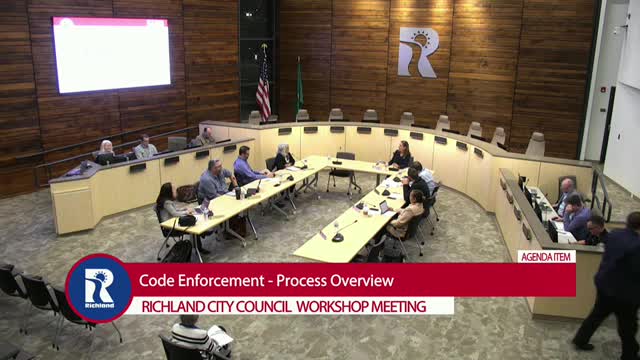
City Attorney Heather Kinsley briefed the City Council on Oct. 28 on the legal framework and practical limits of nuisance and code enforcement, emphasizing that most enforcement is a civil process and that extreme cases can require multi‑year litigation.
Kinsley reviewed the legal basis: municipal police‑power authority arises from the state constitution and enabling RCW sections that let cities declare nuisances and abate them. She said the state’s nuisance statutes (for example RCW 7.48) and local charter authority let the city set civil penalties and pursue abatement, but that the Fourth Amendment requires a warrant of abatement for entry onto private property in many cases; a Ninth Circuit precedent complicates warrantless, immediate entries in this region.
Kinsley described the typical complaint‑driven enforcement model: complaints prompt inspections, corrective notices and often voluntary compliance or a voluntary correction agreement. She cited recent enforcement metrics provided by RPD: a sharp increase in proactive cases in 2024 and a reported 98% voluntary compliance rate for those cases. Still, she cautioned, “extreme violators are the exception” and these matters have proven resource‑intensive and slow to resolve.
Kinsley reviewed long‑running local examples: a tire pile at Twin Bridges (filed as a case in 2022 and requiring costly abatement planning), the Jones Road property (a case filed in 2021 with recent abatement activity) and a burned or derelict house at Fourth Ayer that took until mid‑2023 to remove after a court process. “You have to be willing to play the long game,” Kinsley told council, noting that aggressive shortcuts can create liability for the city.
Councilmembers pressed for tools that could deliver clearance faster. Several suggested reworking process flow so that code enforcement or other directors can take immediate action when a fire marshal or building official concludes there is imminent danger, rather than cycling through a code‑board hearing first. Kinsley and councilors discussed alternatives including use of hearing examiners, more aggressive fine schedules for repeat offenders, and the potential to use police call data as part of evidence to support civil filings.
Ending: Kinsley told the council staff will continue to refine options — including separating immediate hazard authorities (fire, building) from longer nuisance adjudication — and to propose procedural adjustments and potential code changes for further discussion. The council asked staff to present models from Everett and other jurisdictions and to draft options that balance constitutional constraints with faster abatement for extreme cases.
Kinsley reviewed the legal basis: municipal police‑power authority arises from the state constitution and enabling RCW sections that let cities declare nuisances and abate them. She said the state’s nuisance statutes (for example RCW 7.48) and local charter authority let the city set civil penalties and pursue abatement, but that the Fourth Amendment requires a warrant of abatement for entry onto private property in many cases; a Ninth Circuit precedent complicates warrantless, immediate entries in this region.
Kinsley described the typical complaint‑driven enforcement model: complaints prompt inspections, corrective notices and often voluntary compliance or a voluntary correction agreement. She cited recent enforcement metrics provided by RPD: a sharp increase in proactive cases in 2024 and a reported 98% voluntary compliance rate for those cases. Still, she cautioned, “extreme violators are the exception” and these matters have proven resource‑intensive and slow to resolve.
Kinsley reviewed long‑running local examples: a tire pile at Twin Bridges (filed as a case in 2022 and requiring costly abatement planning), the Jones Road property (a case filed in 2021 with recent abatement activity) and a burned or derelict house at Fourth Ayer that took until mid‑2023 to remove after a court process. “You have to be willing to play the long game,” Kinsley told council, noting that aggressive shortcuts can create liability for the city.
Councilmembers pressed for tools that could deliver clearance faster. Several suggested reworking process flow so that code enforcement or other directors can take immediate action when a fire marshal or building official concludes there is imminent danger, rather than cycling through a code‑board hearing first. Kinsley and councilors discussed alternatives including use of hearing examiners, more aggressive fine schedules for repeat offenders, and the potential to use police call data as part of evidence to support civil filings.
Ending: Kinsley told the council staff will continue to refine options — including separating immediate hazard authorities (fire, building) from longer nuisance adjudication — and to propose procedural adjustments and potential code changes for further discussion. The council asked staff to present models from Everett and other jurisdictions and to draft options that balance constitutional constraints with faster abatement for extreme cases.
Don't Miss a Word: See the Full Meeting!
Go beyond summaries. Unlock every video, transcript, and key insight with a Founder Membership.
✓
Get instant access to full meeting videos
✓
Search and clip any phrase from complete transcripts
✓
Receive AI-powered summaries & custom alerts
✓
Enjoy lifetime, unrestricted access to government data
30-day money-back guarantee
