Meeker County orders restoration of altered segment of County Ditch 17 and assesses costs to property owner
January 01, 2025 | Meeker County, Minnesota
This article was created by AI summarizing key points discussed. AI makes mistakes, so for full details and context, please refer to the video of the full meeting. Please report any errors so we can fix them. Report an error »
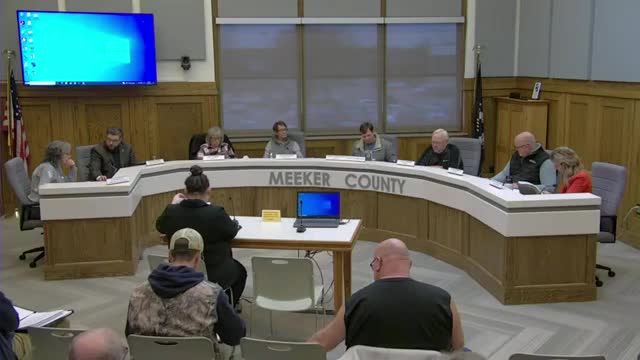
The Meeker County Board of Commissioners, sitting as the county Drainage Authority, voted Dec. 16 to order the restoration of a roughly 1,300-foot segment of County Ditch 17 altered without authorization and to assess the costs of investigation and restoration to property owner Tyler Service.
The board adopted written findings and a final order after hearing testimony from county staff and the drainage authority’s appointed engineer, and after receiving public comment. The order directs the engineer to prepare plans and specifications and directs the county treasurer to assess Service for costs incurred, including engineering, legal, notice and construction costs.
The hearing followed a preliminary determination the board made Nov. 19 that unauthorized work had been performed on CD 17 and that Service was the responsible party. At the Dec. 16 hearing, Meeker County Public Works Director Phil Schmalz and Ditch Inspector Mac Lochen described site inspections and photographic evidence showing bank removal, spoil material spread into adjacent wetland, and increased sediment in the channel. “Around 1,300 feet worth of county Ditch 17 had been altered,” Ditch Inspector Mac Lochen testified, adding Houston Engineering’s survey indicated “an influx of 2 to 2 and a half feet of sediment” in the altered reach.
Joe Lewis of Houston Engineering, the drainage authority’s contracted engineer, presented a restoration report that compared pre‑alteration cross‑section estimates with recent surveys. The report estimated the original channel had a 4–6 foot bottom width, 15–20 foot top width and 3–4 foot depth; after the alterations the channel depth was generally reduced by about 2 to 2½ feet and the top width increased in places to 30–40 feet. Lewis recommended “alternative 2,” which would reestablish spoil banks on both sides of the altered segment and reestablish vegetation buffers to reduce erosion and restore access for future maintenance.
Landowner Tyler Service disputed portions of the narrative and presented documentary exhibits and email correspondence about a prior settlement and recorded easement related to a realignment the authority previously accepted. Service told the board he had negotiated a $10,000 settlement with the county for earlier work and said he did not believe he should bear additional costs for the repair. “No, I do not believe that this should be a cost that should be on my shoulders,” Service said during his testimony. The drainage authority and its counsel responded that the settlement and easement addressed prior realignment work through November 2023, and that the unauthorized work at issue occurred after that date and is distinct from the earlier, authorized repair and settlement.
Public commenters including nearby landowners described uneven spoil spreading and asked about the timing and scope of future maintenance on the rest of CD 17. Greg Lang, who lives near the headwaters of the ditch, said he was “awaiting for a report on whether the repair work on County Ditch 17 is complete” and asked for clarity on additional repair timing. The board heard that DNR coordination and wetland/public waters considerations constrain what can be done and can make certain restorations more expensive or require additional permitting.
After deliberation, the board approved the draft findings and final order by roll call. The motion to adopt the findings and order was made by Commissioner Paul Johnson and seconded by Commissioner Beth Obert; the roll call recorded Commissioners Oberg, Bredesen, Johnson, Schmidt and Schiefelbein voting yes. The order confirms that unauthorized alterations occurred, finds Service to be the responsible party, directs the appointed engineer to design the restoration (option 2 in the report), and directs the county treasurer to assess Service for costs associated with investigation and restoring the unauthorized work.
The board’s findings note the long‑term maintenance risks from the altered condition — reduced channel depth, increased sediment deposition and potential for vegetation encroachment — and emphasize reestablishing spoil banks and perennial vegetation as priorities to limit erosion and to restore access for inspection and maintenance. The order reserves to the board those statutory functions that must be performed by the governing body while authorizing staff to implement the work and assessments.
Next steps spelled out in the order include Houston Engineering preparing plans and specifications for construction and the county proceeding with notice, scheduling and assessment steps. The board’s written findings, the engineer’s restoration report and photographic exhibits were made part of the official record.
The board adopted written findings and a final order after hearing testimony from county staff and the drainage authority’s appointed engineer, and after receiving public comment. The order directs the engineer to prepare plans and specifications and directs the county treasurer to assess Service for costs incurred, including engineering, legal, notice and construction costs.
The hearing followed a preliminary determination the board made Nov. 19 that unauthorized work had been performed on CD 17 and that Service was the responsible party. At the Dec. 16 hearing, Meeker County Public Works Director Phil Schmalz and Ditch Inspector Mac Lochen described site inspections and photographic evidence showing bank removal, spoil material spread into adjacent wetland, and increased sediment in the channel. “Around 1,300 feet worth of county Ditch 17 had been altered,” Ditch Inspector Mac Lochen testified, adding Houston Engineering’s survey indicated “an influx of 2 to 2 and a half feet of sediment” in the altered reach.
Joe Lewis of Houston Engineering, the drainage authority’s contracted engineer, presented a restoration report that compared pre‑alteration cross‑section estimates with recent surveys. The report estimated the original channel had a 4–6 foot bottom width, 15–20 foot top width and 3–4 foot depth; after the alterations the channel depth was generally reduced by about 2 to 2½ feet and the top width increased in places to 30–40 feet. Lewis recommended “alternative 2,” which would reestablish spoil banks on both sides of the altered segment and reestablish vegetation buffers to reduce erosion and restore access for future maintenance.
Landowner Tyler Service disputed portions of the narrative and presented documentary exhibits and email correspondence about a prior settlement and recorded easement related to a realignment the authority previously accepted. Service told the board he had negotiated a $10,000 settlement with the county for earlier work and said he did not believe he should bear additional costs for the repair. “No, I do not believe that this should be a cost that should be on my shoulders,” Service said during his testimony. The drainage authority and its counsel responded that the settlement and easement addressed prior realignment work through November 2023, and that the unauthorized work at issue occurred after that date and is distinct from the earlier, authorized repair and settlement.
Public commenters including nearby landowners described uneven spoil spreading and asked about the timing and scope of future maintenance on the rest of CD 17. Greg Lang, who lives near the headwaters of the ditch, said he was “awaiting for a report on whether the repair work on County Ditch 17 is complete” and asked for clarity on additional repair timing. The board heard that DNR coordination and wetland/public waters considerations constrain what can be done and can make certain restorations more expensive or require additional permitting.
After deliberation, the board approved the draft findings and final order by roll call. The motion to adopt the findings and order was made by Commissioner Paul Johnson and seconded by Commissioner Beth Obert; the roll call recorded Commissioners Oberg, Bredesen, Johnson, Schmidt and Schiefelbein voting yes. The order confirms that unauthorized alterations occurred, finds Service to be the responsible party, directs the appointed engineer to design the restoration (option 2 in the report), and directs the county treasurer to assess Service for costs associated with investigation and restoring the unauthorized work.
The board’s findings note the long‑term maintenance risks from the altered condition — reduced channel depth, increased sediment deposition and potential for vegetation encroachment — and emphasize reestablishing spoil banks and perennial vegetation as priorities to limit erosion and to restore access for inspection and maintenance. The order reserves to the board those statutory functions that must be performed by the governing body while authorizing staff to implement the work and assessments.
Next steps spelled out in the order include Houston Engineering preparing plans and specifications for construction and the county proceeding with notice, scheduling and assessment steps. The board’s written findings, the engineer’s restoration report and photographic exhibits were made part of the official record.
View the Full Meeting & All Its Details
This article offers just a summary. Unlock complete video, transcripts, and insights as a Founder Member.
✓
Watch full, unedited meeting videos
✓
Search every word spoken in unlimited transcripts
✓
AI summaries & real-time alerts (all government levels)
✓
Permanent access to expanding government content
30-day money-back guarantee
