Temple moves to weekly call-for-service model for brush and bulk pickups, cites reliability and fleet limits
August 08, 2025 | Temple, Bell County, Texas
This article was created by AI summarizing key points discussed. AI makes mistakes, so for full details and context, please refer to the video of the full meeting. Please report any errors so we can fix them. Report an error »
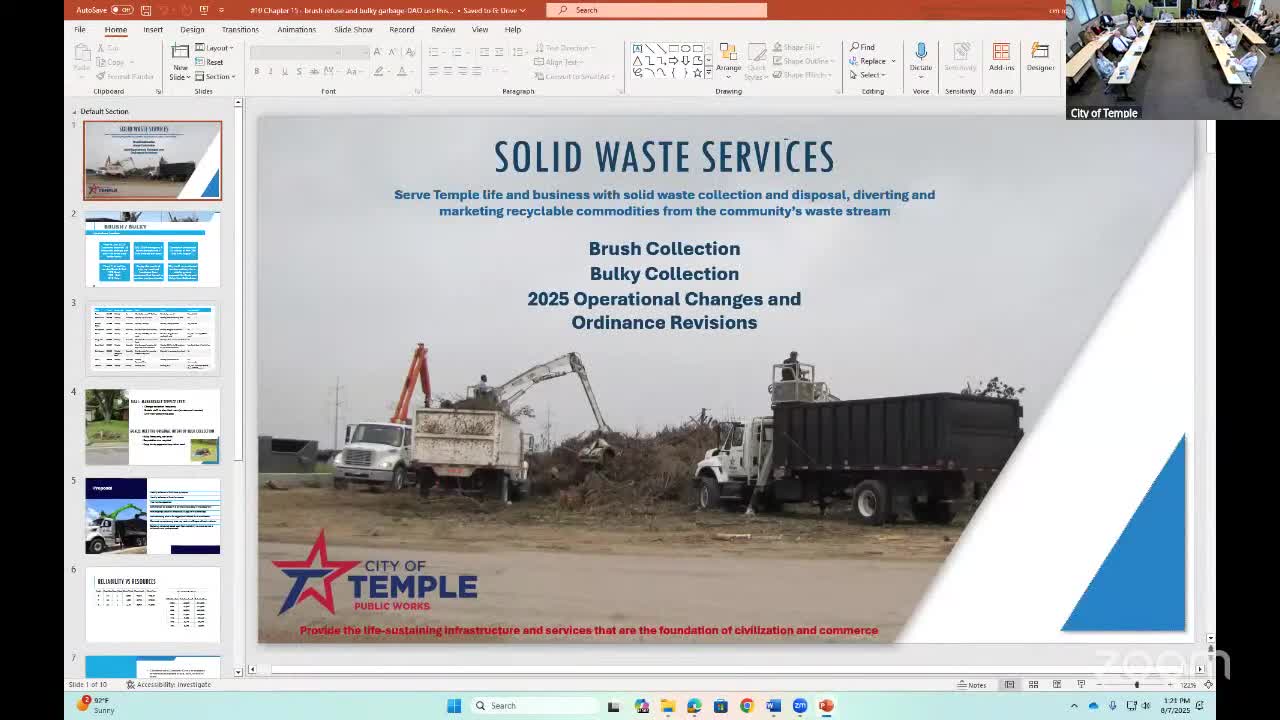
Temple City Council staff described a new call-for-service system for residential brush and bulk collections at a workshop where they said the change aims to make pickups more reliable and reduce long curbside piles.
The city transitioned from an earlier schedule to a model in which residents call to schedule a pickup during a given week. David (staff) said the change followed a recent contractor sweep that removed nearly 900 tons of material and consumed about 900 staff hours. He told the council the first week of the new system logged 313 requests (175 brush and 138 bulk) and said the city planned routes around truck availability: "We did 5 trucks times 60 collections a day times 4 days of service, and that is the number of collections that we were going to schedule out," David said.
City staff and customer-care leaders said the new workflow includes scripted questions for callers, an optional text reminder, and a written confirmation after a pickup. Heather (customer care staff) described capacity controls: callers are offered a week range for service and can opt into a text reminder; Friday is reserved as a buffer for re‑trips or operations tasks. Heather said the city was scheduling roughly 70 collections for a coming week and expected more as residents learned the system.
Why this matters: City staff framed the switch as an attempt to guarantee pickup when the city promises it and to reduce repeated missed pickups caused by a mix of older delivery schedules, thin truck availability and misuse of the service. Staff told council that predictable routes help lower maintenance costs and enable a dedicated day for moving large piles from the solid‑waste facility to a composting partner.
How it works and limits
Staff said the city is designing weeks based on fleet capacity and anticipating an ideal frontline fleet of eight trucks. Each truck is assumed to make about 60 stops per day during four collection days, yielding roughly 7,600 stops per month with eight trucks; staff said that number is fixed by fleet and routing constraints. Staff warned that if demand rises beyond capacity, customers would face longer waits even though the city would still honor a scheduled week.
Staff emphasized separation of material at the curb. David and Heather said crews are educating residents when piles are mixed (brush and bulk together) but that the city will not be punitive at first: callers whose piles do not conform will be educated and, when necessary, offered a re‑trip later in the same week rather than a delayed reschedule. David said the city will distinguish one‑time mistakes from habitual nonconformance using the call data.
Senior and special‑case service
Council members asked whether small yard trimmings may be placed in regular carts and whether elderly or disabled residents would still receive assistance. Staff said small bundles and yard clippings that fit in the regular trash cart may be collected during routine service and that an existing "tub‑out" program (no extra charge) remains available for residents who cannot bring cans to the curb. Staff said drivers would no longer be instructed to refuse small amounts placed in carts.
Illegal dumping, evictions and special events
Council and staff discussed recurring illegal dumping on vacant lots and household eviction piles. Code enforcement staff and solid‑waste staff said property owners remain responsible for cleanup; code can address persistent problem sites. For eviction piles, staff said the county sometimes notifies the city in advance and the city attempts to be present, and in one recent case the city used a roll‑off and warrant process to clear the yard after the legal notice period had elapsed.
Alternatives and pilot options
Staff presented a range of options: keep quarterly collections; move to monthly collections for both brush and bulk; or hybrid approaches (monthly brush with quarterly bulk, or vice versa). Council members and staff noted the seasonal nature of demand (spring cleaning and storms) and discussed temporary contractor support in high‑demand periods. Staff also described other programs: 18 planned neighborhood dumpster drops for the year, a tire trailer, document‑shredding events and a regular landfill/brush drop‑off for utility‑bill customers.
Communications and next steps
Communications staff recommended either a strategic pause to gather statistically valid resident feedback and operational data before making a permanent change, or an aggressive education campaign if council approves monthly service immediately. Heather said a self‑service scheduling tool (Salesforce integration) could be live in 2–3 weeks to let residents book available weekly slots online; she recommended continuing door hangers, email blasts and social media outreach while the system stabilizes.
Council reaction
Council members said they want reliability and better communication to residents and generally supported the call‑for‑service approach, while asking staff to return with utilization data and routing analyses to justify any future increases in frequency or new routes.
Ending note
Staff will continue to collect weekly utilization, truck maintenance and missed‑pickup metrics; council members asked for follow‑up reports and data that will guide any change in collection frequency or staff additions.
The city transitioned from an earlier schedule to a model in which residents call to schedule a pickup during a given week. David (staff) said the change followed a recent contractor sweep that removed nearly 900 tons of material and consumed about 900 staff hours. He told the council the first week of the new system logged 313 requests (175 brush and 138 bulk) and said the city planned routes around truck availability: "We did 5 trucks times 60 collections a day times 4 days of service, and that is the number of collections that we were going to schedule out," David said.
City staff and customer-care leaders said the new workflow includes scripted questions for callers, an optional text reminder, and a written confirmation after a pickup. Heather (customer care staff) described capacity controls: callers are offered a week range for service and can opt into a text reminder; Friday is reserved as a buffer for re‑trips or operations tasks. Heather said the city was scheduling roughly 70 collections for a coming week and expected more as residents learned the system.
Why this matters: City staff framed the switch as an attempt to guarantee pickup when the city promises it and to reduce repeated missed pickups caused by a mix of older delivery schedules, thin truck availability and misuse of the service. Staff told council that predictable routes help lower maintenance costs and enable a dedicated day for moving large piles from the solid‑waste facility to a composting partner.
How it works and limits
Staff said the city is designing weeks based on fleet capacity and anticipating an ideal frontline fleet of eight trucks. Each truck is assumed to make about 60 stops per day during four collection days, yielding roughly 7,600 stops per month with eight trucks; staff said that number is fixed by fleet and routing constraints. Staff warned that if demand rises beyond capacity, customers would face longer waits even though the city would still honor a scheduled week.
Staff emphasized separation of material at the curb. David and Heather said crews are educating residents when piles are mixed (brush and bulk together) but that the city will not be punitive at first: callers whose piles do not conform will be educated and, when necessary, offered a re‑trip later in the same week rather than a delayed reschedule. David said the city will distinguish one‑time mistakes from habitual nonconformance using the call data.
Senior and special‑case service
Council members asked whether small yard trimmings may be placed in regular carts and whether elderly or disabled residents would still receive assistance. Staff said small bundles and yard clippings that fit in the regular trash cart may be collected during routine service and that an existing "tub‑out" program (no extra charge) remains available for residents who cannot bring cans to the curb. Staff said drivers would no longer be instructed to refuse small amounts placed in carts.
Illegal dumping, evictions and special events
Council and staff discussed recurring illegal dumping on vacant lots and household eviction piles. Code enforcement staff and solid‑waste staff said property owners remain responsible for cleanup; code can address persistent problem sites. For eviction piles, staff said the county sometimes notifies the city in advance and the city attempts to be present, and in one recent case the city used a roll‑off and warrant process to clear the yard after the legal notice period had elapsed.
Alternatives and pilot options
Staff presented a range of options: keep quarterly collections; move to monthly collections for both brush and bulk; or hybrid approaches (monthly brush with quarterly bulk, or vice versa). Council members and staff noted the seasonal nature of demand (spring cleaning and storms) and discussed temporary contractor support in high‑demand periods. Staff also described other programs: 18 planned neighborhood dumpster drops for the year, a tire trailer, document‑shredding events and a regular landfill/brush drop‑off for utility‑bill customers.
Communications and next steps
Communications staff recommended either a strategic pause to gather statistically valid resident feedback and operational data before making a permanent change, or an aggressive education campaign if council approves monthly service immediately. Heather said a self‑service scheduling tool (Salesforce integration) could be live in 2–3 weeks to let residents book available weekly slots online; she recommended continuing door hangers, email blasts and social media outreach while the system stabilizes.
Council reaction
Council members said they want reliability and better communication to residents and generally supported the call‑for‑service approach, while asking staff to return with utilization data and routing analyses to justify any future increases in frequency or new routes.
Ending note
Staff will continue to collect weekly utilization, truck maintenance and missed‑pickup metrics; council members asked for follow‑up reports and data that will guide any change in collection frequency or staff additions.
Don't Miss a Word: See the Full Meeting!
Go beyond summaries. Unlock every video, transcript, and key insight with a Founder Membership.
✓
Get instant access to full meeting videos
✓
Search and clip any phrase from complete transcripts
✓
Receive AI-powered summaries & custom alerts
✓
Enjoy lifetime, unrestricted access to government data
30-day money-back guarantee
