Williamson County judges describe specialty courts’ results and resource needs during National Treatment Court Month
May 20, 2025 | Williamson County, Texas
This article was created by AI summarizing key points discussed. AI makes mistakes, so for full details and context, please refer to the video of the full meeting. Please report any errors so we can fix them. Report an error »
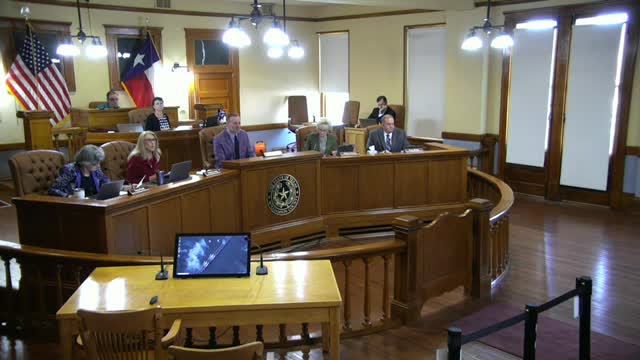
Williamson County judges and program leaders used the commissioners court meeting to mark National Treatment Court Month and to summarize how specialty courts are operating, the outcomes they report and outstanding funding needs.
The judges described voluntary court tracks that combine judicial oversight with treatment, supervision and case-management teams to reduce recidivism, promote recovery and support family reunification. Ryan Larson, judge of the 390th District Court, said independent researchers at the University of Texas at Arlington found children whose parents entered the county's Family Recovery Court were nearly twice as likely to reunify and that none of those children reentered foster care within six to 12 months when compared with a matched group in traditional CPS cases. "This work matters to the children who deserve safety and stability," Larson said.
Judges gave program-level details and participant counts, and identified funding sources and gaps. Laura Barker, judge of County Court at Law No. 2, said the court's DWI court has had 705 participants since inception with 560 successful graduates and 29 currently active; the veterans treatment court has had 310 participants, 247 successful graduates and 38 currently active. Barker said the DWI court is a minimum-12-month program with individualized treatment plans, five progress phases, drug-monitoring tools such as SCRAM and ignition interlocks, and a multidisciplinary team including a specialty court coordinator, probation officer, treatment counselor and law enforcement representative. Barker also said, "We don't have a grant for DWI court anymore," and discussed earlier grant support that paid for portions of specialty-court staffing.
Stacy Matthews, presiding judge of the 270th District Court, described the county's Transformative Justice (TJ) program for 17-to-24-year-olds, noting the program operates as a felony diversion and was started as a research project. Matthews said the TJ program typically has 20'30 participants and currently has 27; she described it as fee-free and said successful completion immediately speeds case dismissal and expungement. Matthews asked the court to allow a later presentation of research results once the researchers complete their analysis.
Donna King, judge of the 260th District Court, summarized the felony mental-health docket and its partnerships with Bluebonnet Trails Community Services, adult probation, the district attorney's office and NAMI Central Texas. King said the mental-health docket has had 75 total participants since 2019, with 38 graduates and 25 currently engaged, reporting an approximately 82 percent success rate to date.
Sarah Brook Miller, judge of the 360th District Court, described the felony DWI drug court, which accepts individuals with prior DWI convictions who volunteer for intensive supervision and treatment. She said participants typically appear weekly before the judge, undergo frequent testing and monitoring, and that the court has removed only about 10 percent of participants from the program since its expansion, which judges described as an indication of treatment effectiveness.
Judges and program staff also described noncourt supports and grant activity. Barker and others noted the veterans treatment court had sought a Texas Veterans Commission (TVC) grant; one county official present said the court asked for $320,000 and staff recommended $150,000 but the award ultimately matched the $320,000 request after advocacy at the grant hearing. Judges asked the commissioners to consider providing more budget detail (staff counts and approximate hours) so the court can plan staffing and sustain services.
The presentations underscored that the specialty-court models rely on cross-sector partnerships: prosecutors, defense counsel, probation, treatment providers, veteran services, peer mentors and nonprofit partners were all cited as core contributors. Judges emphasized different participant eligibility and disqualification criteria for each court (age limits, residency, prior charges, mental-health suitability, discharge status for veterans), and described typical program durations (minimum 12 months; some programs 12'24 months) and graduation benefits (reduction or dismissal of charges, avoidance of prison, expungement depending on track).
The commissioners did not take formal policy votes tied to these presentations at the time; judges requested follow-up information for budgeting and proposed a fuller research briefing when evaluation data are available.
The presentations closed with invitations to observe graduations and with judges thanking staff and community partners for program delivery.
The judges described voluntary court tracks that combine judicial oversight with treatment, supervision and case-management teams to reduce recidivism, promote recovery and support family reunification. Ryan Larson, judge of the 390th District Court, said independent researchers at the University of Texas at Arlington found children whose parents entered the county's Family Recovery Court were nearly twice as likely to reunify and that none of those children reentered foster care within six to 12 months when compared with a matched group in traditional CPS cases. "This work matters to the children who deserve safety and stability," Larson said.
Judges gave program-level details and participant counts, and identified funding sources and gaps. Laura Barker, judge of County Court at Law No. 2, said the court's DWI court has had 705 participants since inception with 560 successful graduates and 29 currently active; the veterans treatment court has had 310 participants, 247 successful graduates and 38 currently active. Barker said the DWI court is a minimum-12-month program with individualized treatment plans, five progress phases, drug-monitoring tools such as SCRAM and ignition interlocks, and a multidisciplinary team including a specialty court coordinator, probation officer, treatment counselor and law enforcement representative. Barker also said, "We don't have a grant for DWI court anymore," and discussed earlier grant support that paid for portions of specialty-court staffing.
Stacy Matthews, presiding judge of the 270th District Court, described the county's Transformative Justice (TJ) program for 17-to-24-year-olds, noting the program operates as a felony diversion and was started as a research project. Matthews said the TJ program typically has 20'30 participants and currently has 27; she described it as fee-free and said successful completion immediately speeds case dismissal and expungement. Matthews asked the court to allow a later presentation of research results once the researchers complete their analysis.
Donna King, judge of the 260th District Court, summarized the felony mental-health docket and its partnerships with Bluebonnet Trails Community Services, adult probation, the district attorney's office and NAMI Central Texas. King said the mental-health docket has had 75 total participants since 2019, with 38 graduates and 25 currently engaged, reporting an approximately 82 percent success rate to date.
Sarah Brook Miller, judge of the 360th District Court, described the felony DWI drug court, which accepts individuals with prior DWI convictions who volunteer for intensive supervision and treatment. She said participants typically appear weekly before the judge, undergo frequent testing and monitoring, and that the court has removed only about 10 percent of participants from the program since its expansion, which judges described as an indication of treatment effectiveness.
Judges and program staff also described noncourt supports and grant activity. Barker and others noted the veterans treatment court had sought a Texas Veterans Commission (TVC) grant; one county official present said the court asked for $320,000 and staff recommended $150,000 but the award ultimately matched the $320,000 request after advocacy at the grant hearing. Judges asked the commissioners to consider providing more budget detail (staff counts and approximate hours) so the court can plan staffing and sustain services.
The presentations underscored that the specialty-court models rely on cross-sector partnerships: prosecutors, defense counsel, probation, treatment providers, veteran services, peer mentors and nonprofit partners were all cited as core contributors. Judges emphasized different participant eligibility and disqualification criteria for each court (age limits, residency, prior charges, mental-health suitability, discharge status for veterans), and described typical program durations (minimum 12 months; some programs 12'24 months) and graduation benefits (reduction or dismissal of charges, avoidance of prison, expungement depending on track).
The commissioners did not take formal policy votes tied to these presentations at the time; judges requested follow-up information for budgeting and proposed a fuller research briefing when evaluation data are available.
The presentations closed with invitations to observe graduations and with judges thanking staff and community partners for program delivery.
Don't Miss a Word: See the Full Meeting!
Go beyond summaries. Unlock every video, transcript, and key insight with a Founder Membership.
✓
Get instant access to full meeting videos
✓
Search and clip any phrase from complete transcripts
✓
Receive AI-powered summaries & custom alerts
✓
Enjoy lifetime, unrestricted access to government data
30-day money-back guarantee
