Oro Valley staff outline outreach plan for proposed use, telecom and commercial rental taxes
May 20, 2025 | Oro Valley, Pima County, Arizona
This article was created by AI summarizing key points discussed. AI makes mistakes, so for full details and context, please refer to the video of the full meeting. Please report any errors so we can fix them. Report an error »
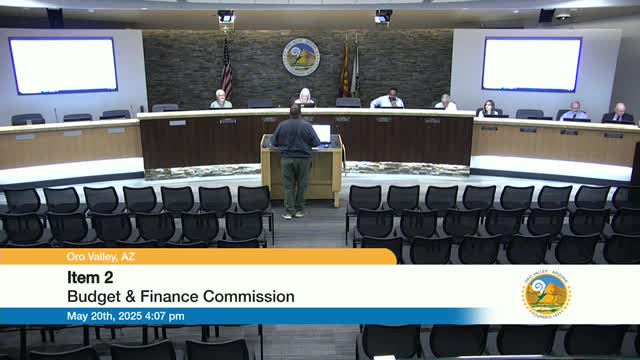
Michael Spade, current planning principal planner for the Town of Oro Valley and project manager for the engagement effort, told the Budget and Finance Commission on May 20 that staff will run a coordinated public outreach program to explain three concurrent fee and tax proposals and to collect feedback.
Spade said staff will hold three community Zoom events in mid‑July focused on parks and recreation, finance/other revenues and stormwater and that the outreach will use newsletters, social media and bill inserts. "We're going to utilize a process that we've used in the planning world, pretty frequently ... utilizing some Zoom community engagement events to try and get the word out to educate residents about all 3 fee proposals," Spade said.
Why it matters: Commissioners and staff said the town lacks several revenue categories used by neighboring jurisdictions and that new revenue could be dedicated to capital needs such as public safety and roads. Town staff said the change could improve long‑term financial stability and limit reliance on future debt.
Town finance staff (identified in the meeting as "Mister Gephardt") described the proposed tax categories and preliminary rates: a use tax roughly equivalent to the town's retail sales tax (proposed at about 2.5 percent), a telecommunications tax proposed at about 2 to 2.5 percent, and a commercial rental tax (rate not specified in the presentation). Gephardt said those categories are common in nearby municipalities and that preliminary revenue estimates for all three combined are a wide range — roughly $900,000 to $1,800,000 annually — pending additional modeling and Department of Revenue data.
Staff emphasized that the proposed revenues would be dedicated to capital. "What we would, propose is that all of these new revenues, would be dedicated towards capital," Gephardt said, adding that council could consider further restricting the dedication to public safety and roads.
Business and equity outreach: Commissioners asked how businesses and lower‑income residents would be informed and assessed. Spade and Gephardt said outreach will include a Chamber of Commerce briefing (staff noted a prior one‑on‑one with Chamber President Kristen Sharp), email and social notifications, and that staff plan targeted business outreach. Gephardt said the town is analyzing distributional impacts and will seek Department of Revenue data to refine business and small‑business effects.
Parks and recreation fees: Deputy Parks Director Matt Jankowski provided a separate estimate for proposed parks fee changes, saying the department anticipates about a $400,000 increase from the fee adjustments. Jankowski said staff had met with organized youth sports groups and the Parks and Recreation Advisory Board and that feedback was generally positive.
Timing and implementation: Gephardt said if council approves new tax categories, Arizona Department of Revenue needs at least 60 days to implement collection, so the earliest possible collection date would be Jan. 1 or Feb. 1 following council action. He also said the town aims to bring final recommendations to town council in October after study sessions and board/commission recommendations.
What remains to be decided: Staff said the revenue estimates are preliminary and will be refined after queries to the Department of Revenue, and that the town has not settled final rates or exact legal language. Gephardt repeatedly framed the numbers as draft estimates and repeatedly stressed the need for further analysis before final decisions are made.
Ending: Commissioners recommended careful framing of any dedication language and suggested staff consider partial dedication or debt‑service language so future operating costs for new facilities are not automatically funded solely from the new revenue.
Spade said staff will hold three community Zoom events in mid‑July focused on parks and recreation, finance/other revenues and stormwater and that the outreach will use newsletters, social media and bill inserts. "We're going to utilize a process that we've used in the planning world, pretty frequently ... utilizing some Zoom community engagement events to try and get the word out to educate residents about all 3 fee proposals," Spade said.
Why it matters: Commissioners and staff said the town lacks several revenue categories used by neighboring jurisdictions and that new revenue could be dedicated to capital needs such as public safety and roads. Town staff said the change could improve long‑term financial stability and limit reliance on future debt.
Town finance staff (identified in the meeting as "Mister Gephardt") described the proposed tax categories and preliminary rates: a use tax roughly equivalent to the town's retail sales tax (proposed at about 2.5 percent), a telecommunications tax proposed at about 2 to 2.5 percent, and a commercial rental tax (rate not specified in the presentation). Gephardt said those categories are common in nearby municipalities and that preliminary revenue estimates for all three combined are a wide range — roughly $900,000 to $1,800,000 annually — pending additional modeling and Department of Revenue data.
Staff emphasized that the proposed revenues would be dedicated to capital. "What we would, propose is that all of these new revenues, would be dedicated towards capital," Gephardt said, adding that council could consider further restricting the dedication to public safety and roads.
Business and equity outreach: Commissioners asked how businesses and lower‑income residents would be informed and assessed. Spade and Gephardt said outreach will include a Chamber of Commerce briefing (staff noted a prior one‑on‑one with Chamber President Kristen Sharp), email and social notifications, and that staff plan targeted business outreach. Gephardt said the town is analyzing distributional impacts and will seek Department of Revenue data to refine business and small‑business effects.
Parks and recreation fees: Deputy Parks Director Matt Jankowski provided a separate estimate for proposed parks fee changes, saying the department anticipates about a $400,000 increase from the fee adjustments. Jankowski said staff had met with organized youth sports groups and the Parks and Recreation Advisory Board and that feedback was generally positive.
Timing and implementation: Gephardt said if council approves new tax categories, Arizona Department of Revenue needs at least 60 days to implement collection, so the earliest possible collection date would be Jan. 1 or Feb. 1 following council action. He also said the town aims to bring final recommendations to town council in October after study sessions and board/commission recommendations.
What remains to be decided: Staff said the revenue estimates are preliminary and will be refined after queries to the Department of Revenue, and that the town has not settled final rates or exact legal language. Gephardt repeatedly framed the numbers as draft estimates and repeatedly stressed the need for further analysis before final decisions are made.
Ending: Commissioners recommended careful framing of any dedication language and suggested staff consider partial dedication or debt‑service language so future operating costs for new facilities are not automatically funded solely from the new revenue.
Don't Miss a Word: See the Full Meeting!
Go beyond summaries. Unlock every video, transcript, and key insight with a Founder Membership.
✓
Get instant access to full meeting videos
✓
Search and clip any phrase from complete transcripts
✓
Receive AI-powered summaries & custom alerts
✓
Enjoy lifetime, unrestricted access to government data
30-day money-back guarantee
