Andy’s Place recovery housing cited as model for pairing settlement funds with tax credits
May 20, 2025 | 2025-2026 House Legislature MI, Michigan
This article was created by AI summarizing key points discussed. AI makes mistakes, so for full details and context, please refer to the video of the full meeting. Please report any errors so we can fix them. Report an error »
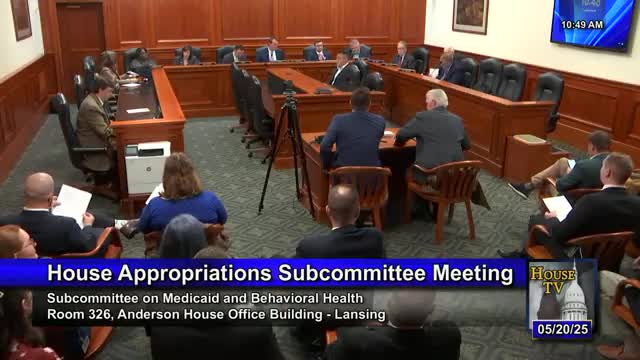
A presentation to the House Appropriations Subcommittee highlighted Andy’s Place, a long-term recovery housing complex in Jackson, as a replicable model that combines opioid settlement grants with federal Low-Income Housing Tax Credits to close capital funding gaps.
Why it matters: Long-term supportive housing proponents told the committee that housing stability, on-site treatment and structured peer communities help sustain recovery and reduce calls for emergency services.
Harvey Hoffman, a retired Eaton County treatment court judge who leads housing work for the Michigan Association of Treatment Court Professionals, described Andy’s Place as a 50-unit complex with one- and two-bedroom apartments, on-site treatment spaces and 24/7 security. “People can stay there as long as they want,” Hoffman said, adding the facility provides Section 8-based rent control and furnished units. He said the program’s primary referral source is treatment courts and the facility is targeted to people in treatment court with substance use disorders, with an emphasis on opioid use disorder.
JT Mackey, representing Senaire (a nonprofit community development financial institution), told the committee that unit financing typically relies on a combination of a 9% housing tax-credit allocation, tax-credit equity covering a large share of development costs, low-cost debt and grants — including opioid settlement grants — to make projects “pencil out.” Mackey said for Andy’s Place phase 2, tax-credit equity covered roughly 66% of development costs and an opioid settlement grant helped close the remaining capital gap.
Hoffman said Andy’s Place has produced low emergency-call volumes and strong local law-enforcement support. He described plans for multiple new projects around the state — including an 80-unit development in Southfield and other projects in Kalamazoo, Saginaw Bay, Midland, Washtenaw, Kent, Ottawa, Traverse City and Lansing.
What was not decided: The committee did not approve any funding or commit settlement dollars to specific housing projects during the hearing.
Next steps: Proponents said they would provide contact information for follow-up and asked legislators to consider pairing settlement funds with MSHDA tax credits to finance additional recovery housing across Michigan.
Why it matters: Long-term supportive housing proponents told the committee that housing stability, on-site treatment and structured peer communities help sustain recovery and reduce calls for emergency services.
Harvey Hoffman, a retired Eaton County treatment court judge who leads housing work for the Michigan Association of Treatment Court Professionals, described Andy’s Place as a 50-unit complex with one- and two-bedroom apartments, on-site treatment spaces and 24/7 security. “People can stay there as long as they want,” Hoffman said, adding the facility provides Section 8-based rent control and furnished units. He said the program’s primary referral source is treatment courts and the facility is targeted to people in treatment court with substance use disorders, with an emphasis on opioid use disorder.
JT Mackey, representing Senaire (a nonprofit community development financial institution), told the committee that unit financing typically relies on a combination of a 9% housing tax-credit allocation, tax-credit equity covering a large share of development costs, low-cost debt and grants — including opioid settlement grants — to make projects “pencil out.” Mackey said for Andy’s Place phase 2, tax-credit equity covered roughly 66% of development costs and an opioid settlement grant helped close the remaining capital gap.
Hoffman said Andy’s Place has produced low emergency-call volumes and strong local law-enforcement support. He described plans for multiple new projects around the state — including an 80-unit development in Southfield and other projects in Kalamazoo, Saginaw Bay, Midland, Washtenaw, Kent, Ottawa, Traverse City and Lansing.
What was not decided: The committee did not approve any funding or commit settlement dollars to specific housing projects during the hearing.
Next steps: Proponents said they would provide contact information for follow-up and asked legislators to consider pairing settlement funds with MSHDA tax credits to finance additional recovery housing across Michigan.
Don't Miss a Word: See the Full Meeting!
Go beyond summaries. Unlock every video, transcript, and key insight with a Founder Membership.
✓
Get instant access to full meeting videos
✓
Search and clip any phrase from complete transcripts
✓
Receive AI-powered summaries & custom alerts
✓
Enjoy lifetime, unrestricted access to government data
30-day money-back guarantee
