Clover Park presents preliminary 2025-26 budget; public hearing draws no commenters
July 08, 2025 | Clover Park School District, School Districts, Washington
This article was created by AI summarizing key points discussed. AI makes mistakes, so for full details and context, please refer to the video of the full meeting. Please report any errors so we can fix them. Report an error »
Clover Park School District’s director of finance, Amy Day, presented a preliminary budget for the 2025-26 school year at a public hearing on July 7, outlining roughly $278 million in projected operating revenue and a projected ending general-fund balance near $21 million.
Day said the district projects to begin 2025-26 with a fund balance in the mid‑tens of millions of dollars and described the revenue mix as led by state general purpose (basic education) funding, state special purpose grants, and federal grants. “You can see at the bottom that we are projected to start the year with a $37,000,000 fund balance,” Day said; elsewhere in her slides she listed the beginning fund balance as $37,800,000, and the presentation summarized the projected ending fund balance as about $21,000,000.
Day presented the budget using the reporting format recommended by the Office of Superintendent of Public Instruction (OSPI) and said salary and benefits account for roughly 82% of budgeted expenditures—consistent with the district’s historical staffing range of 80%–85% of total spending. She said projected operating revenue includes nearly $135 million in state general purpose (basic education) funding, about $65 million in state special purpose funding (including special education and multilingual support), and about $38 million in federal funding (including Title grants and federal special education funds). The presentation also included a $9.5 million contingency capacity for grant awards and other incoming funds.
By object, Day said the district is budgeting approximately $295 million in expenditures. By program, regular instruction is the largest category; Day noted a special education budget near $52 million and compensatory spending of nearly $21 million. She described the district’s three largest cost pressures—special education, materials/supplies and operating costs (MSOC), and transportation—and said state funding has not kept pace with those increasing costs.
Day reviewed other funds: the student-based (ASB/RAM) budget, a debt service fund supported primarily by property tax revenue, a capital projects fund with no major new-construction plans for 2025-26 (the slides included a $25 million spending capacity), and a transportation vehicle fund that can be used only to purchase yellow school buses.
Board leaders opened the hearing for public comment but said no members of the public attended. “This hearing is for the public to provide comments, so the board will not be commenting or responding to remarks tonight,” the board president said. With no public comment, Director Thomas moved to adjourn the hearing; Director Kim seconded. The motion carried by voice vote and the hearing was adjourned at 5:08 p.m. The board’s regular meeting was scheduled to begin at 6 p.m.
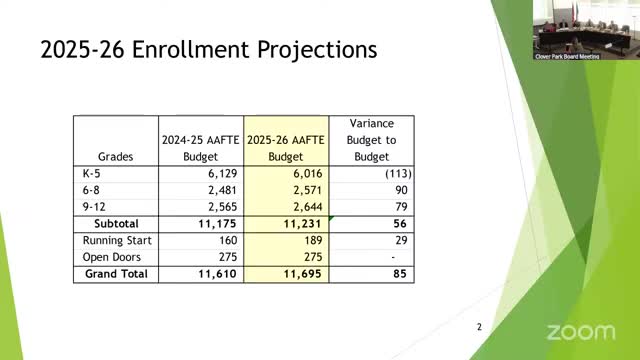
The presentation was introductory: Day characterized the multi‑year projections as estimates, noting modest projected enrollment growth of about 1% and that assumptions could change. No formal action on the budget was taken at the hearing; the session served to present the preliminary figures and receive public input.
Day said the district projects to begin 2025-26 with a fund balance in the mid‑tens of millions of dollars and described the revenue mix as led by state general purpose (basic education) funding, state special purpose grants, and federal grants. “You can see at the bottom that we are projected to start the year with a $37,000,000 fund balance,” Day said; elsewhere in her slides she listed the beginning fund balance as $37,800,000, and the presentation summarized the projected ending fund balance as about $21,000,000.
Day presented the budget using the reporting format recommended by the Office of Superintendent of Public Instruction (OSPI) and said salary and benefits account for roughly 82% of budgeted expenditures—consistent with the district’s historical staffing range of 80%–85% of total spending. She said projected operating revenue includes nearly $135 million in state general purpose (basic education) funding, about $65 million in state special purpose funding (including special education and multilingual support), and about $38 million in federal funding (including Title grants and federal special education funds). The presentation also included a $9.5 million contingency capacity for grant awards and other incoming funds.
By object, Day said the district is budgeting approximately $295 million in expenditures. By program, regular instruction is the largest category; Day noted a special education budget near $52 million and compensatory spending of nearly $21 million. She described the district’s three largest cost pressures—special education, materials/supplies and operating costs (MSOC), and transportation—and said state funding has not kept pace with those increasing costs.
Day reviewed other funds: the student-based (ASB/RAM) budget, a debt service fund supported primarily by property tax revenue, a capital projects fund with no major new-construction plans for 2025-26 (the slides included a $25 million spending capacity), and a transportation vehicle fund that can be used only to purchase yellow school buses.
Board leaders opened the hearing for public comment but said no members of the public attended. “This hearing is for the public to provide comments, so the board will not be commenting or responding to remarks tonight,” the board president said. With no public comment, Director Thomas moved to adjourn the hearing; Director Kim seconded. The motion carried by voice vote and the hearing was adjourned at 5:08 p.m. The board’s regular meeting was scheduled to begin at 6 p.m.
The presentation was introductory: Day characterized the multi‑year projections as estimates, noting modest projected enrollment growth of about 1% and that assumptions could change. No formal action on the budget was taken at the hearing; the session served to present the preliminary figures and receive public input.
View the Full Meeting & All Its Details
This article offers just a summary. Unlock complete video, transcripts, and insights as a Founder Member.
✓
Watch full, unedited meeting videos
✓
Search every word spoken in unlimited transcripts
✓
AI summaries & real-time alerts (all government levels)
✓
Permanent access to expanding government content
30-day money-back guarantee
