New Carlsbad environmental commission elects officers, hears department overview and begins work plan; public raises Ponto open‑space, beach concerns
August 07, 2025 | Carlsbad, San Diego County, California
This article was created by AI summarizing key points discussed. AI makes mistakes, so for full details and context, please refer to the video of the full meeting. Please report any errors so we can fix them. Report an error »
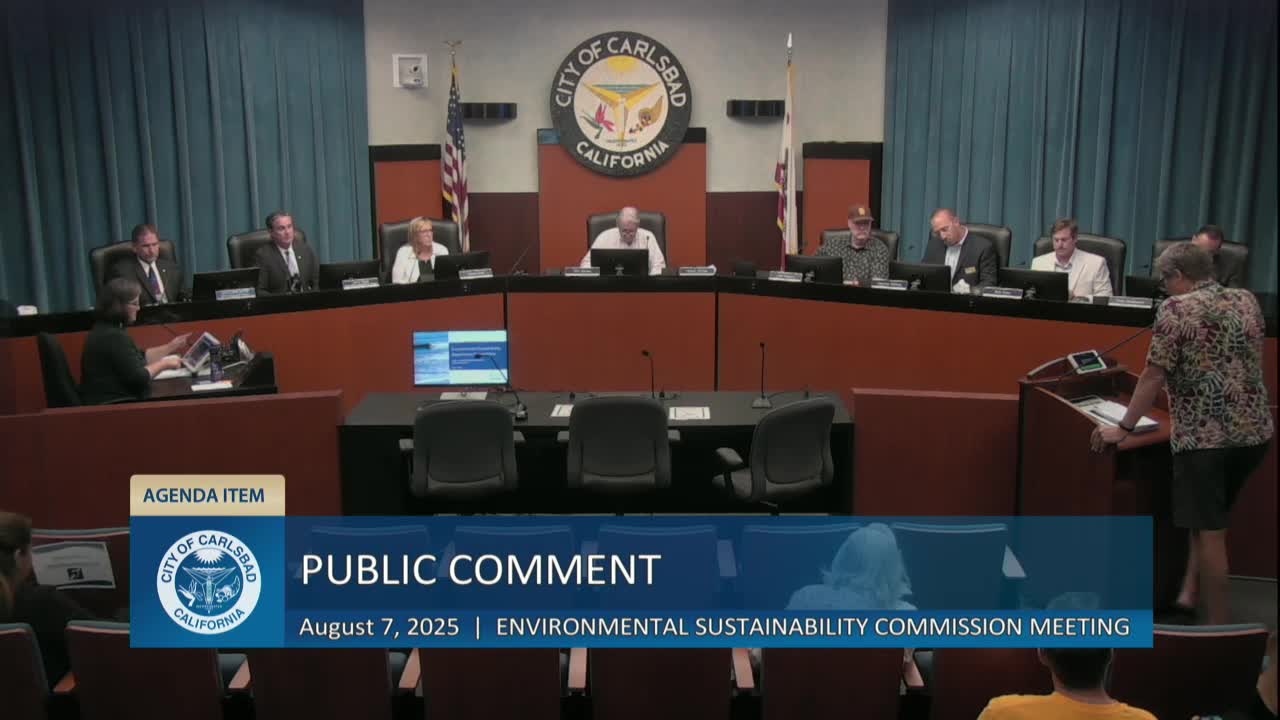
Dr. Cynthia Norell was elected chair and Commissioner Ferguson was selected vice chair of the City of Carlsbad Environmental Sustainability Commission at the panel’s first meeting on Sept. 18, 2025. The commission heard an overview of the city’s new Environmental Sustainability Department, received public comments on missing open space at Ponto and other coastal concerns, and directed staff to return with a draft 2026 work plan at the commission’s Oct. 2 meeting.
The commission’s selection of officers came by nomination and roll‑call vote. Dr. Cynthia Norell accepted a nomination for chair and the commission voted in favor; the clerk recorded the tally as 6 yes, 0 no, with Commissioner Woolsey absent. Commissioner Ferguson was nominated and approved as vice chair; the clerk recorded 5 yes votes and one abstention, with Commissioner Woolsey absent. Those officer votes were taken at the start of the meeting to establish leadership for the newly constituted panel.
Jamie Wood, the city’s environmental sustainability director, gave a 45‑minute overview of the department’s structure and recent accomplishments. Wood said the department has four divisions—Climate Action Plan, Habitat Management, Sustainable Materials Management, and Watershed Protection—about 17 full‑time and three part‑time staff, and an annual budget of about $5.4 million funded by a combination of general fund and enterprise fees.
Wood said the Climate Action Plan division oversees implementation, monitoring and public outreach and supports development review through a CEQA‑qualified plan and consistency checklist. He said the city adopted an updated Climate Action Plan in November 2024 and moved all city facilities to 100% renewable energy service through the Clean Energy Alliance green option effective July 1, 2025. Wood also noted the city recently launched an online CAP dashboard to track implementation.
Avicita Jones, senior program manager for Sustainable Materials Management, summarized the city’s work to meet state recycling and organics requirements, including full implementation of SB 1383. Jones said the division has seven full‑time staff and one part‑time staff, supports a bins‑for‑business program that has helped more than 100 businesses, and reported a measured landfill reduction of roughly 6,000 pounds per year tied to recent program work. The division also enforces solid‑waste franchise contracts, runs household hazardous‑waste and refill‑station grants, and recognizes green businesses; Wood said 53 businesses are certified through the city program, including five city facilities.
Tim Murphy, senior program manager for Watershed Protection, described permit‑driven stormwater programs. Murphy said his six‑person team completed required municipal stormwater permit activities for fiscal year 2025, responded to 100% of high‑priority complaints within 45 minutes, investigated and eliminated 54 illicit discharges, participated in 15 outreach events and reached more than 1,200 students through education programs.
Roseanne Humphrey, senior program manager for Habitat Management, explained the Habitat Management Plan (HMP), a 50‑year regulatory and conservation agreement with state and federal wildlife agencies. Humphrey said the city has achieved about 96% of the acreage target called for by the HMP, but the city directly owns only about 11% of the required preserve lands and must coordinate with private owners and other managers to meet long‑term monitoring and management obligations.
Public commenters focused on open space at Ponto, beach access and the need for island‑wide coastal coordination. Lance Schulte told commissioners that residents submitted some 7,500 petitions and records requests about “missing” open space at Ponto and said some developers there had been exempted from providing required open‑space acreage; he said the area is more densely developed than the rest of Carlsbad and that sea‑level rise will eliminate roughly 32 acres of open space identified in 2017. Vanessa Forsyth and Diane Nygard, representing Sierra Club and Preserve Calavera respectively, urged the commission to make open space, beach preservation and accelerated greenhouse‑gas measures priorities in the new work plan. Kathleen Steinberger, a former Beach Preservation Commissioner, asked the commission to track beach‑access projects such as the Terramar stair repairs and the “Dip in the Road” adaptation concept and to refrain from taking positions on regional projects before final plans are available.
Commissioners asked staff for clarifications on several technical points: the department is still using 2016 greenhouse‑gas baseline inventory data because recent SANDAG inventories are delayed and 2020 COVID‑era data complicated the series; Wood said staff have budgeted money to update inventories and are evaluating how to obtain more timely raw data and modeling. Humphrey explained that the HMP incorporates requirements from the U.S. Fish and Wildlife Service and the California Department of Fish and Wildlife and that many Coastal Commission requirements are implemented through the city’s Local Coastal Program.
The commission also discussed how to incorporate beach preservation items from the former Beach Preservation Commission into the new work plan. Staff told the commissioners that City Council directed on Nov. 19, 2024, that open space be added to the new commission’s purview and asked the commission to consider a policy discouraging exemptions to development standards that would reduce open space; staff said that direction will be included in the draft work plan.
For next steps, staff will assemble the topics raised—open space acquisition and management, beach preservation and access, climate action monitoring and modeling, watershed stormwater priorities, sustainable materials and business outreach—into a draft work plan and post it under Brown Act requirements for the commission’s Oct. 2 meeting, when the commission will hold a facilitated discussion and further prioritize goals for 2026. Staff also agreed to provide links and background documents (Climate Action Plan, Habitat Management Plan, Local Coastal Program, Carlsbad Tomorrow growth‑management report and the prior Beach Preservation Commission work plan) so commissioners can review materials before the next meeting.
The meeting closed with commissioners endorsing regular updates from Coastal Commission and neighboring jurisdictions on regional beach projects and encouraging staff to preserve opportunities for public education, business outreach and measurable milestones in the annual work plan.
The commission’s selection of officers came by nomination and roll‑call vote. Dr. Cynthia Norell accepted a nomination for chair and the commission voted in favor; the clerk recorded the tally as 6 yes, 0 no, with Commissioner Woolsey absent. Commissioner Ferguson was nominated and approved as vice chair; the clerk recorded 5 yes votes and one abstention, with Commissioner Woolsey absent. Those officer votes were taken at the start of the meeting to establish leadership for the newly constituted panel.
Jamie Wood, the city’s environmental sustainability director, gave a 45‑minute overview of the department’s structure and recent accomplishments. Wood said the department has four divisions—Climate Action Plan, Habitat Management, Sustainable Materials Management, and Watershed Protection—about 17 full‑time and three part‑time staff, and an annual budget of about $5.4 million funded by a combination of general fund and enterprise fees.
Wood said the Climate Action Plan division oversees implementation, monitoring and public outreach and supports development review through a CEQA‑qualified plan and consistency checklist. He said the city adopted an updated Climate Action Plan in November 2024 and moved all city facilities to 100% renewable energy service through the Clean Energy Alliance green option effective July 1, 2025. Wood also noted the city recently launched an online CAP dashboard to track implementation.
Avicita Jones, senior program manager for Sustainable Materials Management, summarized the city’s work to meet state recycling and organics requirements, including full implementation of SB 1383. Jones said the division has seven full‑time staff and one part‑time staff, supports a bins‑for‑business program that has helped more than 100 businesses, and reported a measured landfill reduction of roughly 6,000 pounds per year tied to recent program work. The division also enforces solid‑waste franchise contracts, runs household hazardous‑waste and refill‑station grants, and recognizes green businesses; Wood said 53 businesses are certified through the city program, including five city facilities.
Tim Murphy, senior program manager for Watershed Protection, described permit‑driven stormwater programs. Murphy said his six‑person team completed required municipal stormwater permit activities for fiscal year 2025, responded to 100% of high‑priority complaints within 45 minutes, investigated and eliminated 54 illicit discharges, participated in 15 outreach events and reached more than 1,200 students through education programs.
Roseanne Humphrey, senior program manager for Habitat Management, explained the Habitat Management Plan (HMP), a 50‑year regulatory and conservation agreement with state and federal wildlife agencies. Humphrey said the city has achieved about 96% of the acreage target called for by the HMP, but the city directly owns only about 11% of the required preserve lands and must coordinate with private owners and other managers to meet long‑term monitoring and management obligations.
Public commenters focused on open space at Ponto, beach access and the need for island‑wide coastal coordination. Lance Schulte told commissioners that residents submitted some 7,500 petitions and records requests about “missing” open space at Ponto and said some developers there had been exempted from providing required open‑space acreage; he said the area is more densely developed than the rest of Carlsbad and that sea‑level rise will eliminate roughly 32 acres of open space identified in 2017. Vanessa Forsyth and Diane Nygard, representing Sierra Club and Preserve Calavera respectively, urged the commission to make open space, beach preservation and accelerated greenhouse‑gas measures priorities in the new work plan. Kathleen Steinberger, a former Beach Preservation Commissioner, asked the commission to track beach‑access projects such as the Terramar stair repairs and the “Dip in the Road” adaptation concept and to refrain from taking positions on regional projects before final plans are available.
Commissioners asked staff for clarifications on several technical points: the department is still using 2016 greenhouse‑gas baseline inventory data because recent SANDAG inventories are delayed and 2020 COVID‑era data complicated the series; Wood said staff have budgeted money to update inventories and are evaluating how to obtain more timely raw data and modeling. Humphrey explained that the HMP incorporates requirements from the U.S. Fish and Wildlife Service and the California Department of Fish and Wildlife and that many Coastal Commission requirements are implemented through the city’s Local Coastal Program.
The commission also discussed how to incorporate beach preservation items from the former Beach Preservation Commission into the new work plan. Staff told the commissioners that City Council directed on Nov. 19, 2024, that open space be added to the new commission’s purview and asked the commission to consider a policy discouraging exemptions to development standards that would reduce open space; staff said that direction will be included in the draft work plan.
For next steps, staff will assemble the topics raised—open space acquisition and management, beach preservation and access, climate action monitoring and modeling, watershed stormwater priorities, sustainable materials and business outreach—into a draft work plan and post it under Brown Act requirements for the commission’s Oct. 2 meeting, when the commission will hold a facilitated discussion and further prioritize goals for 2026. Staff also agreed to provide links and background documents (Climate Action Plan, Habitat Management Plan, Local Coastal Program, Carlsbad Tomorrow growth‑management report and the prior Beach Preservation Commission work plan) so commissioners can review materials before the next meeting.
The meeting closed with commissioners endorsing regular updates from Coastal Commission and neighboring jurisdictions on regional beach projects and encouraging staff to preserve opportunities for public education, business outreach and measurable milestones in the annual work plan.
Don't Miss a Word: See the Full Meeting!
Go beyond summaries. Unlock every video, transcript, and key insight with a Founder Membership.
✓
Get instant access to full meeting videos
✓
Search and clip any phrase from complete transcripts
✓
Receive AI-powered summaries & custom alerts
✓
Enjoy lifetime, unrestricted access to government data
30-day money-back guarantee
