Board weighs student surveys and "pathway indicators" to inform teaching and graduation supports
August 07, 2025 | Albany County School District #1, School Districts, Wyoming
This article was created by AI summarizing key points discussed. AI makes mistakes, so for full details and context, please refer to the video of the full meeting. Please report any errors so we can fix them. Report an error »
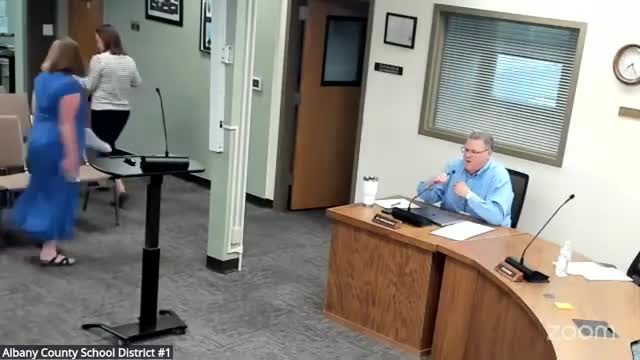
Albany County School District #1 work-session discussion advanced two related proposals: a voluntary student feedback survey for classroom growth and a system of "pathway indicators" to track markers from kindergarten to graduation.
At the start of the agenda item, Dr. Goldhart told trustees he had circulated draft student surveys for classroom teaching and coaching and emphasized the district's intent that surveys support teacher improvement rather than serve as formal evaluation. "For this to work, I think we need to spend the time in going down into the nitty gritty, especially with staff members, so it can be done, to help people and not to feel like it's... something that's going to be used against them," Goldhart said.
Survey design and logistics
Goldhart and trustees discussed logistics for secondary students, who may have many teachers. The board considered randomized assignment (students complete a subset of surveys) vs. allowing students to complete all surveys voluntarily. Trustees noted potential sampling bias if students self-select which teacher surveys to fill out and low response rates in other states' examples. On the record, trustees and staff favored using the district's meet-and-confer process to develop teacher-facing logistics and protections so the data are formative and private to help teachers improve instruction.
Trustee comments and staff responses
- Trustee Janice Marshall asked for a development timeline and staff consultation; Goldhart said the district will involve meet-and-confer and coaching staff and produce a package intended to help teachers without punitive use. "The data is for the teacher and it's not like put out there... we don't want anybody to feel like they're being pointed out," Goldhart said.
- Trustee Kim Sorensen asked whether students could fill out surveys for as many teachers as they wished; Goldhart said the district could allow that, but cautioned that response volume and sampling would need testing to ensure usefulness. He noted other states that used student survey data within formal evaluations experienced issues with low return rates and complexity.
Pathway indicators
District staff also proposed developing "pathway indicators" — measurable milestones such as attendance, third-grade literacy and freshman credit accumulation — to provide formative, system-level information that can guide interventions. Dr. Goldhart described the indicators as analogous to formative classroom assessments: "A good formative assessment... helps give direction to the instructor," he said. Trustees were invited to participate in a brief sticky-note exercise to propose candidate indicators; staff will also solicit principals' input and synthesize the results.
Why it matters
District leaders framed both initiatives as tools to improve instruction and student outcomes: student surveys to provide teacher-facing feedback from learners, and pathway indicators to flag early signals (attendance, suspensions, credit accumulation, literacy benchmarks) that correlate with later graduation outcomes.
Next steps and board requests
- Staff will consult with meet-and-confer and coaching staff on survey design, sampling and protections; trustees asked that survey use be explicitly formative and not part of punitive evaluation unless the board later decides otherwise.
- Staff will gather principals' input on pathway indicators and return a consolidated list and recommendations for publicly viewable metrics intended to guide interventions.
Votes at a glance
The board adjourned into executive session at the end of the work session by unanimous procedural motion; that procedural motion appears in the meeting record (see Actions).
At the start of the agenda item, Dr. Goldhart told trustees he had circulated draft student surveys for classroom teaching and coaching and emphasized the district's intent that surveys support teacher improvement rather than serve as formal evaluation. "For this to work, I think we need to spend the time in going down into the nitty gritty, especially with staff members, so it can be done, to help people and not to feel like it's... something that's going to be used against them," Goldhart said.
Survey design and logistics
Goldhart and trustees discussed logistics for secondary students, who may have many teachers. The board considered randomized assignment (students complete a subset of surveys) vs. allowing students to complete all surveys voluntarily. Trustees noted potential sampling bias if students self-select which teacher surveys to fill out and low response rates in other states' examples. On the record, trustees and staff favored using the district's meet-and-confer process to develop teacher-facing logistics and protections so the data are formative and private to help teachers improve instruction.
Trustee comments and staff responses
- Trustee Janice Marshall asked for a development timeline and staff consultation; Goldhart said the district will involve meet-and-confer and coaching staff and produce a package intended to help teachers without punitive use. "The data is for the teacher and it's not like put out there... we don't want anybody to feel like they're being pointed out," Goldhart said.
- Trustee Kim Sorensen asked whether students could fill out surveys for as many teachers as they wished; Goldhart said the district could allow that, but cautioned that response volume and sampling would need testing to ensure usefulness. He noted other states that used student survey data within formal evaluations experienced issues with low return rates and complexity.
Pathway indicators
District staff also proposed developing "pathway indicators" — measurable milestones such as attendance, third-grade literacy and freshman credit accumulation — to provide formative, system-level information that can guide interventions. Dr. Goldhart described the indicators as analogous to formative classroom assessments: "A good formative assessment... helps give direction to the instructor," he said. Trustees were invited to participate in a brief sticky-note exercise to propose candidate indicators; staff will also solicit principals' input and synthesize the results.
Why it matters
District leaders framed both initiatives as tools to improve instruction and student outcomes: student surveys to provide teacher-facing feedback from learners, and pathway indicators to flag early signals (attendance, suspensions, credit accumulation, literacy benchmarks) that correlate with later graduation outcomes.
Next steps and board requests
- Staff will consult with meet-and-confer and coaching staff on survey design, sampling and protections; trustees asked that survey use be explicitly formative and not part of punitive evaluation unless the board later decides otherwise.
- Staff will gather principals' input on pathway indicators and return a consolidated list and recommendations for publicly viewable metrics intended to guide interventions.
Votes at a glance
The board adjourned into executive session at the end of the work session by unanimous procedural motion; that procedural motion appears in the meeting record (see Actions).
Don't Miss a Word: See the Full Meeting!
Go beyond summaries. Unlock every video, transcript, and key insight with a Founder Membership.
✓
Get instant access to full meeting videos
✓
Search and clip any phrase from complete transcripts
✓
Receive AI-powered summaries & custom alerts
✓
Enjoy lifetime, unrestricted access to government data
30-day money-back guarantee
