Court of Appeals hears argument over whether trial court denied Bridgewater right to self-representation
August 07, 2025 | Utah Court of Appeals Live Stream, Utah Appellate Court, Utah Judicial Branch, Utah
This article was created by AI summarizing key points discussed. AI makes mistakes, so for full details and context, please refer to the video of the full meeting. Please report any errors so we can fix them. Report an error »
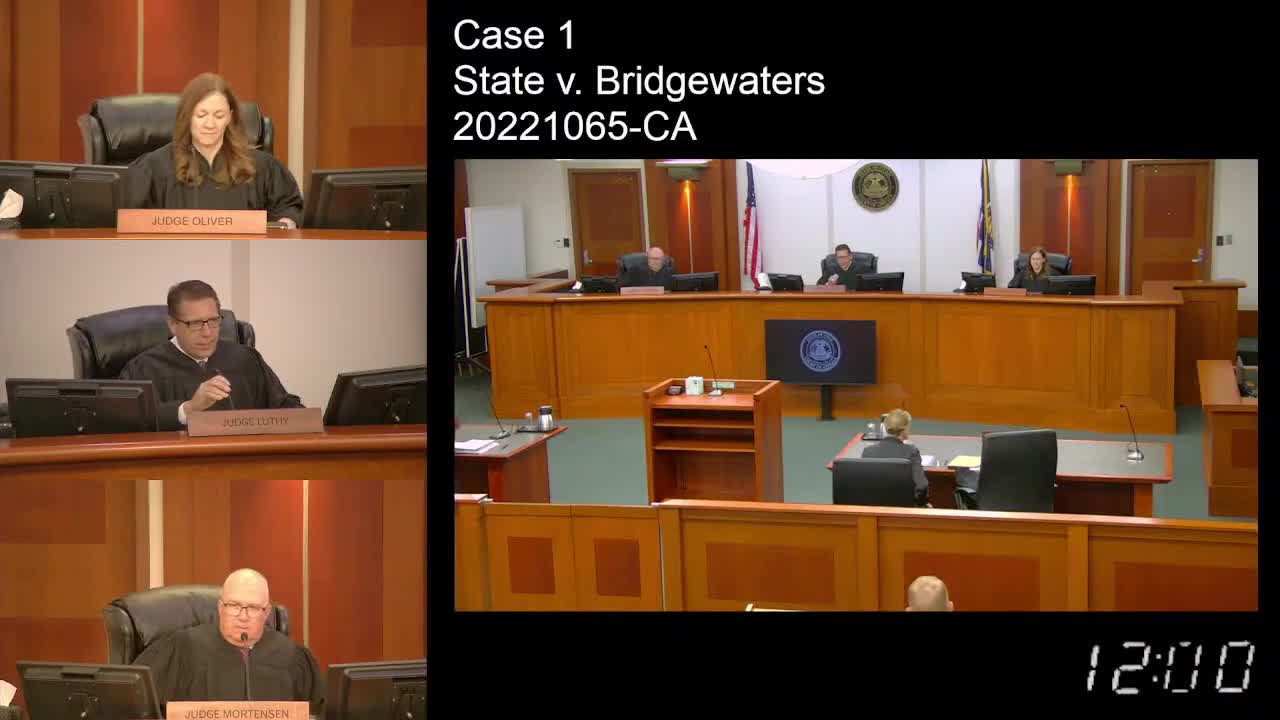
The Utah Court of Appeals heard argument on whether the trial court violated Joshua Ryan Bridgewater's right to represent himself, focusing on whether the record shows an informed, knowing waiver of counsel.
At oral argument on the court's livestream, Robert Denney, counsel for the appellant, told the panel that "the trial court violated mister Bridgewater's right to represent himself when he requested 5 months before trial to defend himself pro se." Denney said the court failed to make the necessary finding that any waiver was knowing and intelligent and stressed there is no transcript evidence of a full colloquy at the relevant time.
The issue matters, Denney said, because courts must evaluate waiver at the time it is made: "under Kadoki, the relevant time period is the time of waiver. So even if there was a prior colloquy, the trial court needed to make the determination as to a known intelligent waiver at the specific time that he set aside for this." He pointed to a July 2021 hearing in which the district court permitted Bridgewater to proceed pro se with standby counsel and argued the later denial of pro se status required explicit findings tied to the defendant's conduct.
Lindsay Wheeler, representing the State, countered that Bridgewater repeatedly changed his mind over roughly five years, asking at various times for private counsel, appointed counsel and to represent himself, and that the district court reasonably considered that history. "The defendant flip flopped through 5 years between having conflicts with counsel, wanting to hire counsel, wanting appointed counsel, wanting to represent himself and then flip flopping back," Wheeler told the court, arguing that the record supports an implicit finding the court could rely on to deny a renewed pro se request.
The parties disputed the effect of missing portions of the trial record. Denney urged that the absence of transcripts for some hearings prevents meaningful review; Wheeler said the district court found it had "gone through the colloquy before" and that the appellant bears the burden of producing a record demonstrating error. Wheeler also told the panel that she believed the record showed the court had encountered repeated attempts by the defendant to delay trial, describing the matter as "Groundhog Day" for the district court.
The panel's questions focused on whether the court may rely on prior colloquies or must conduct a new, contemporaneous Frampton-style advisement each time a defendant seeks to proceed pro se; whether an implicit finding of non-waiver may stand when parts of the record are missing; and whether a court must warn a defendant that continued conduct may forfeit the right to counsel before imposing a limitation. Judge Luthy asked how to treat a prosecutor's statement that a full colloquy had occurred earlier when no transcript of that colloquy appears in the record.
Both parties cited appellate authority during argument. Denney relied on Pedoki (discussed as a Utah Supreme Court case), and on Frampton and Ferretta, to argue that an implied waiver requires a warning tying the conduct to loss of the right to counsel. Wheeler relied on this court's decisions including Bozarth and Summer v. Summer to argue the district court may consider the full procedural history and may presume regularity in the absence of an adequate record from the appellant.
Counsel and the judges also discussed practical administration of trials: whether trial courts should issue warnings when a defendant repeatedly requests to proceed pro se, and if so when such warnings become necessary given repeated changes of mind over years.
The Court of Appeals took the matter under advisement. As Judge Luthy announced at the hearing's close, "We'll take the matter under advisement and issue a written opinion as soon as we're able."
At oral argument on the court's livestream, Robert Denney, counsel for the appellant, told the panel that "the trial court violated mister Bridgewater's right to represent himself when he requested 5 months before trial to defend himself pro se." Denney said the court failed to make the necessary finding that any waiver was knowing and intelligent and stressed there is no transcript evidence of a full colloquy at the relevant time.
The issue matters, Denney said, because courts must evaluate waiver at the time it is made: "under Kadoki, the relevant time period is the time of waiver. So even if there was a prior colloquy, the trial court needed to make the determination as to a known intelligent waiver at the specific time that he set aside for this." He pointed to a July 2021 hearing in which the district court permitted Bridgewater to proceed pro se with standby counsel and argued the later denial of pro se status required explicit findings tied to the defendant's conduct.
Lindsay Wheeler, representing the State, countered that Bridgewater repeatedly changed his mind over roughly five years, asking at various times for private counsel, appointed counsel and to represent himself, and that the district court reasonably considered that history. "The defendant flip flopped through 5 years between having conflicts with counsel, wanting to hire counsel, wanting appointed counsel, wanting to represent himself and then flip flopping back," Wheeler told the court, arguing that the record supports an implicit finding the court could rely on to deny a renewed pro se request.
The parties disputed the effect of missing portions of the trial record. Denney urged that the absence of transcripts for some hearings prevents meaningful review; Wheeler said the district court found it had "gone through the colloquy before" and that the appellant bears the burden of producing a record demonstrating error. Wheeler also told the panel that she believed the record showed the court had encountered repeated attempts by the defendant to delay trial, describing the matter as "Groundhog Day" for the district court.
The panel's questions focused on whether the court may rely on prior colloquies or must conduct a new, contemporaneous Frampton-style advisement each time a defendant seeks to proceed pro se; whether an implicit finding of non-waiver may stand when parts of the record are missing; and whether a court must warn a defendant that continued conduct may forfeit the right to counsel before imposing a limitation. Judge Luthy asked how to treat a prosecutor's statement that a full colloquy had occurred earlier when no transcript of that colloquy appears in the record.
Both parties cited appellate authority during argument. Denney relied on Pedoki (discussed as a Utah Supreme Court case), and on Frampton and Ferretta, to argue that an implied waiver requires a warning tying the conduct to loss of the right to counsel. Wheeler relied on this court's decisions including Bozarth and Summer v. Summer to argue the district court may consider the full procedural history and may presume regularity in the absence of an adequate record from the appellant.
Counsel and the judges also discussed practical administration of trials: whether trial courts should issue warnings when a defendant repeatedly requests to proceed pro se, and if so when such warnings become necessary given repeated changes of mind over years.
The Court of Appeals took the matter under advisement. As Judge Luthy announced at the hearing's close, "We'll take the matter under advisement and issue a written opinion as soon as we're able."
View the Full Meeting & All Its Details
This article offers just a summary. Unlock complete video, transcripts, and insights as a Founder Member.
✓
Watch full, unedited meeting videos
✓
Search every word spoken in unlimited transcripts
✓
AI summaries & real-time alerts (all government levels)
✓
Permanent access to expanding government content
30-day money-back guarantee
