Harris County commissioners confront a projected $200M shortfall as debate over tax rate, law‑enforcement raises and service cuts heats up
August 07, 2025 | Harris County, Texas
This article was created by AI summarizing key points discussed. AI makes mistakes, so for full details and context, please refer to the video of the full meeting. Please report any errors so we can fix them. Report an error »
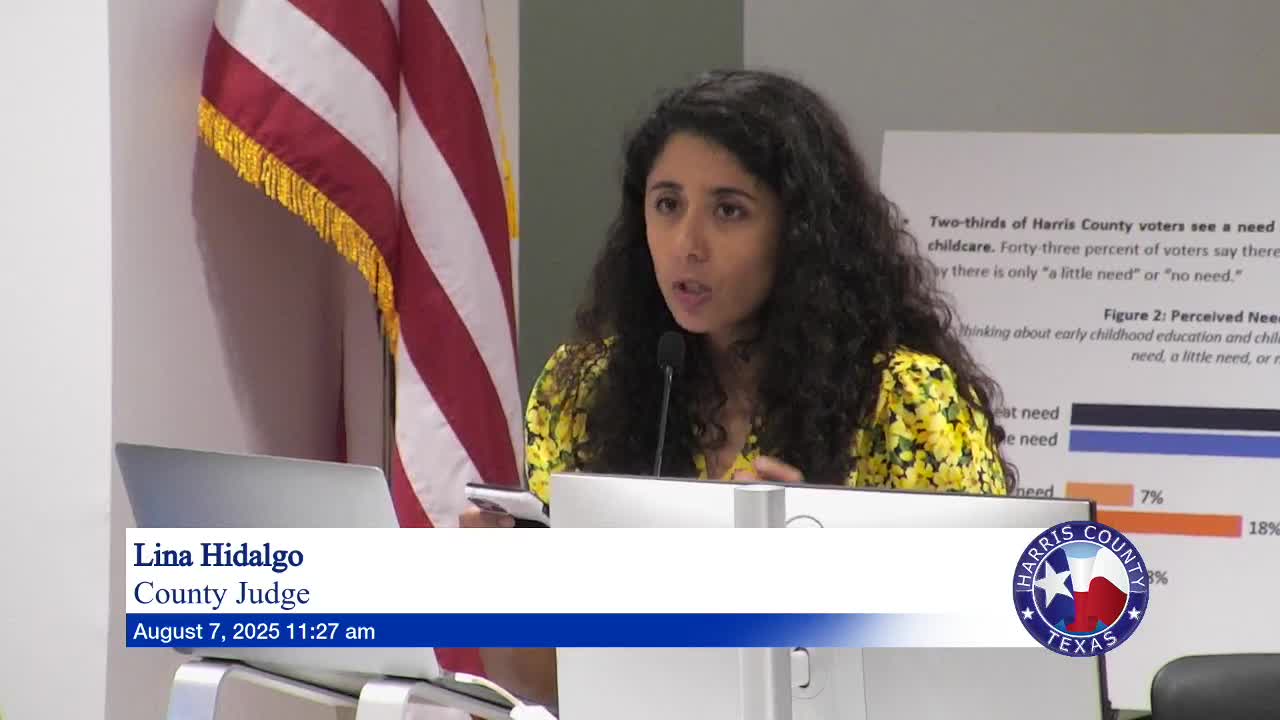
Harris County officials spent large portions of an Aug. 7 Commissioners Court meeting debating how to close an emerging multi‑hundred million‑dollar budget shortfall that staff estimated at roughly $200 million for the coming year.
The shortfall has multiple drivers, county budget staff said: a recent series of pay increases for law‑enforcement agencies; a projected rise of roughly $57 million in indigent‑defense payments driven by increased trials and vouchers; continued costs tied to outsourcing jail beds while the jail population rebalances; and other pressures on departmental budgets. Daniel Ramos, director of the Office of Management & Budget (OMB), told the court that the county’s revenue picture had improved since mid‑year but that structural gaps remain.
Several commissioners pushed different remedies. Commissioner Rodney Ellis argued for asking voters to approve new revenue — specifically moving to set public hearings so residents could weigh in — and warned that continued constraints on local taxing authority from recent state legislation make the county’s choices harder. Commissioner Lesley Ramsey said she favored pursuing additional revenue from voters rather than cuts but emphasized the need to vet spending across the budget; Commissioner Briones and Commissioner Garcia urged deeper review of non‑essential spending and asked for clearer options before any November ballot question.
Law enforcement pay raises drove a large portion of the public discussion. Commissioners and staff acknowledged political and operational tradeoffs: raising compensation aimed at recruitment and retention, but the increases were not fully funded in the current commitments and would add recurring costs. Commissioners debated whether to offset raises with precinct or departmental cuts, or to put the question about funding those raises directly to voters.
Staff outlined several one‑time offsets and efficiency efforts — roughly $30 million in near‑term measures — but warned those would not eliminate the recurring budget gap. County staff and several commissioners suggested that without new revenue the court would need to make tough cuts affecting public services. Commissioners asked OMB and department heads for a detailed budget book and timeline; directors said a full proposed budget would be delivered to the court the following week for review, with formal adoption scheduled later in the season.
Other budget‑related decisions and votes: the court approved a staffing expansion for the HEART crisis response program (18 positions) and voted to expand CERT/alternative dispatch resources; commissioners also approved measures to bring toll‑collection operations and associated business rules under county control, a move staff said would standardize customer service and billing policies across regional toll networks.
Outcome and next steps: OMB will deliver a full proposed FY2026 budget and a list of prioritized cuts and offsets to commissioners for review; commissioners directed staff to prepare legal notices and options should the court decide to ask voters to approve revenue measures. No final budget adoption occurred at the Aug. 7 meeting.
Why it matters: The county — one of the nation’s largest — is balancing long‑term personnel commitments (including law enforcement compensation), rising justice‑system costs and one‑time federal aid that will expire in 2026. How the court resolves the gap will affect public safety, public health, early childhood programs and other services.
Attribution and accuracy: Statements about projected shortfall, indigent defense increases and outsourcing are based on OMB and department briefings presented in open session; specific dollar figures referenced during the meeting were labeled estimates by staff.
Key votes recorded Aug. 7: HEART expansion (approved); toll revenue operational transfer to HECRA (approved). Other actions were deferred pending the FY2026 budget process.
The shortfall has multiple drivers, county budget staff said: a recent series of pay increases for law‑enforcement agencies; a projected rise of roughly $57 million in indigent‑defense payments driven by increased trials and vouchers; continued costs tied to outsourcing jail beds while the jail population rebalances; and other pressures on departmental budgets. Daniel Ramos, director of the Office of Management & Budget (OMB), told the court that the county’s revenue picture had improved since mid‑year but that structural gaps remain.
Several commissioners pushed different remedies. Commissioner Rodney Ellis argued for asking voters to approve new revenue — specifically moving to set public hearings so residents could weigh in — and warned that continued constraints on local taxing authority from recent state legislation make the county’s choices harder. Commissioner Lesley Ramsey said she favored pursuing additional revenue from voters rather than cuts but emphasized the need to vet spending across the budget; Commissioner Briones and Commissioner Garcia urged deeper review of non‑essential spending and asked for clearer options before any November ballot question.
Law enforcement pay raises drove a large portion of the public discussion. Commissioners and staff acknowledged political and operational tradeoffs: raising compensation aimed at recruitment and retention, but the increases were not fully funded in the current commitments and would add recurring costs. Commissioners debated whether to offset raises with precinct or departmental cuts, or to put the question about funding those raises directly to voters.
Staff outlined several one‑time offsets and efficiency efforts — roughly $30 million in near‑term measures — but warned those would not eliminate the recurring budget gap. County staff and several commissioners suggested that without new revenue the court would need to make tough cuts affecting public services. Commissioners asked OMB and department heads for a detailed budget book and timeline; directors said a full proposed budget would be delivered to the court the following week for review, with formal adoption scheduled later in the season.
Other budget‑related decisions and votes: the court approved a staffing expansion for the HEART crisis response program (18 positions) and voted to expand CERT/alternative dispatch resources; commissioners also approved measures to bring toll‑collection operations and associated business rules under county control, a move staff said would standardize customer service and billing policies across regional toll networks.
Outcome and next steps: OMB will deliver a full proposed FY2026 budget and a list of prioritized cuts and offsets to commissioners for review; commissioners directed staff to prepare legal notices and options should the court decide to ask voters to approve revenue measures. No final budget adoption occurred at the Aug. 7 meeting.
Why it matters: The county — one of the nation’s largest — is balancing long‑term personnel commitments (including law enforcement compensation), rising justice‑system costs and one‑time federal aid that will expire in 2026. How the court resolves the gap will affect public safety, public health, early childhood programs and other services.
Attribution and accuracy: Statements about projected shortfall, indigent defense increases and outsourcing are based on OMB and department briefings presented in open session; specific dollar figures referenced during the meeting were labeled estimates by staff.
Key votes recorded Aug. 7: HEART expansion (approved); toll revenue operational transfer to HECRA (approved). Other actions were deferred pending the FY2026 budget process.
View the Full Meeting & All Its Details
This article offers just a summary. Unlock complete video, transcripts, and insights as a Founder Member.
✓
Watch full, unedited meeting videos
✓
Search every word spoken in unlimited transcripts
✓
AI summaries & real-time alerts (all government levels)
✓
Permanent access to expanding government content
30-day money-back guarantee
