Marion County adopts street vendor ordinance, sets $50 permit fee
August 07, 2025 | Marion County, Oregon
This article was created by AI summarizing key points discussed. AI makes mistakes, so for full details and context, please refer to the video of the full meeting. Please report any errors so we can fix them. Report an error »
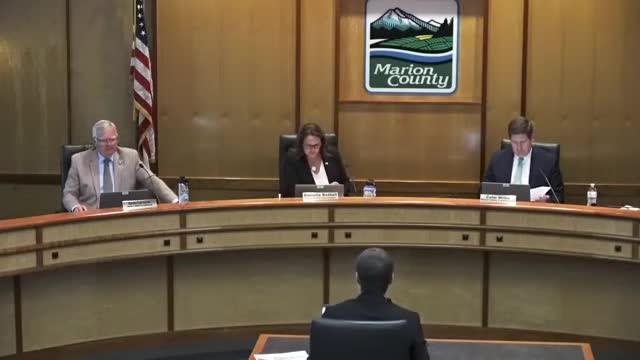
The Marion County Board of Commissioners on Aug. 6 adopted an ordinance creating a permitting and regulatory framework for street vendors operating in unincorporated areas of the county and set the application fee at $50.
Steve Elzinga, Marion County counsel, told the Board the ordinance was drafted in collaboration with the Marion County Farm Bureau and other partners to address safety concerns where street vendors operate near rights of way, interfere with traffic flow or trespass on private property. “The goal is to improve safety for the street vendors themselves by ensuring they're operating in a safe location, as well as for drivers, pedestrians, etcetera,” Elzinga said during the public hearing.
Key provisions in the adopted ordinance require a single-page permit for vendors who are not already covered by another permit (for example, a licensed food truck or temporary restaurant permit). The county will not require a second permit where another county, state or city license already applies. The draft permit requires vendors to carry insurance and to list every employee operating under the permit to make on‑the‑spot enforcement by deputies simpler, Elzinga said.
The ordinance contains specific exceptions and accommodations: it does not target ordinary youth lemonade stands on private property; it makes a special provision for ice cream trucks consistent with some city ordinances; and it recognizes temporary closures for parades, farmers markets and some restaurant sidewalk uses. The ordinance applies only in unincorporated Marion County unless a city voluntarily opts in.
Enforcement was described as education-first, with voluntary compliance the priority. The ordinance permits issuance of fines and impoundment of nonperishable equipment for violations; equipment may be returned once fines are paid. The ordinance includes an emergency appeal path to a hearings officer to address potential enforcement errors quickly.
Elzinga said the draft permit form and supporting educational materials are nearly final; Marion County Health and Human Services is developing an informational flyer to explain what is allowed. The Board approved the ordinance on a motion, and separately approved an order setting the application fee at $50.
During discussion commissioners and counsel noted enforcement limits on state-owned rights of way. Elzinga said Marion County can seek an agreement with the Oregon Department of Transportation to allow county deputies to enforce the ordinance on ODOT property in specific locations — a step the county said it will pursue if necessary.
A public comment email from Kathy Rogers requested an outright prohibition on street vending in residential neighborhoods; the Board discussed the suggestion and left the ordinance language intact to allow staff and deputies to monitor whether amendments are needed in the future.
The ordinance is recorded as an amendment to Marion County Code chapter 10.1; the $50 application fee was adopted by separate order at the same meeting.
Steve Elzinga, Marion County counsel, told the Board the ordinance was drafted in collaboration with the Marion County Farm Bureau and other partners to address safety concerns where street vendors operate near rights of way, interfere with traffic flow or trespass on private property. “The goal is to improve safety for the street vendors themselves by ensuring they're operating in a safe location, as well as for drivers, pedestrians, etcetera,” Elzinga said during the public hearing.
Key provisions in the adopted ordinance require a single-page permit for vendors who are not already covered by another permit (for example, a licensed food truck or temporary restaurant permit). The county will not require a second permit where another county, state or city license already applies. The draft permit requires vendors to carry insurance and to list every employee operating under the permit to make on‑the‑spot enforcement by deputies simpler, Elzinga said.
The ordinance contains specific exceptions and accommodations: it does not target ordinary youth lemonade stands on private property; it makes a special provision for ice cream trucks consistent with some city ordinances; and it recognizes temporary closures for parades, farmers markets and some restaurant sidewalk uses. The ordinance applies only in unincorporated Marion County unless a city voluntarily opts in.
Enforcement was described as education-first, with voluntary compliance the priority. The ordinance permits issuance of fines and impoundment of nonperishable equipment for violations; equipment may be returned once fines are paid. The ordinance includes an emergency appeal path to a hearings officer to address potential enforcement errors quickly.
Elzinga said the draft permit form and supporting educational materials are nearly final; Marion County Health and Human Services is developing an informational flyer to explain what is allowed. The Board approved the ordinance on a motion, and separately approved an order setting the application fee at $50.
During discussion commissioners and counsel noted enforcement limits on state-owned rights of way. Elzinga said Marion County can seek an agreement with the Oregon Department of Transportation to allow county deputies to enforce the ordinance on ODOT property in specific locations — a step the county said it will pursue if necessary.
A public comment email from Kathy Rogers requested an outright prohibition on street vending in residential neighborhoods; the Board discussed the suggestion and left the ordinance language intact to allow staff and deputies to monitor whether amendments are needed in the future.
The ordinance is recorded as an amendment to Marion County Code chapter 10.1; the $50 application fee was adopted by separate order at the same meeting.
View the Full Meeting & All Its Details
This article offers just a summary. Unlock complete video, transcripts, and insights as a Founder Member.
✓
Watch full, unedited meeting videos
✓
Search every word spoken in unlimited transcripts
✓
AI summaries & real-time alerts (all government levels)
✓
Permanent access to expanding government content
30-day money-back guarantee
