Vacaville staff detail citywide park upgrades and urge higher impact fees to meet demand
August 07, 2025 | Vacaville City, Solano County, California
This article was created by AI summarizing key points discussed. AI makes mistakes, so for full details and context, please refer to the video of the full meeting. Please report any errors so we can fix them. Report an error »
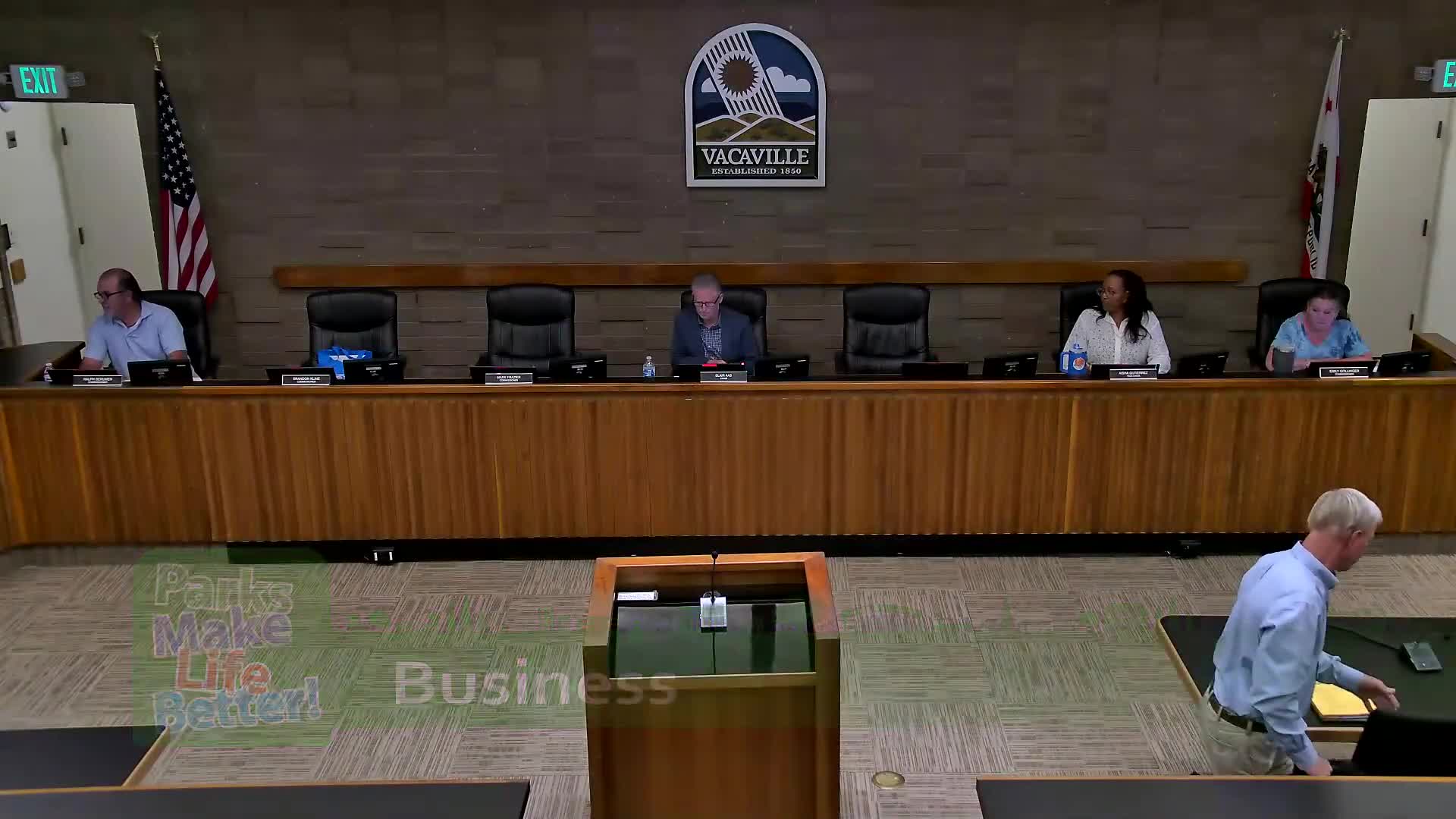
Vacaville City parks staff presented a citywide parks update on Aug. 6, 2025, outlining roughly 15 projects — from neighborhood playgrounds to regional amenities — funded through a mix of Measure M revenues, developer turnkey agreements, capital improvement program allocations and grants. Staff also told the Park and Recreation Commission that an updated development impact fee, scheduled for city review this fall, will be necessary to fund future parks at the level identified in the city’s plans.
The presentation, introduced by Director Mulle, included speakers from the park planning team: Imbo Gonzalez, Tricia Cagat and Hugh Hesterman. "This is a citywide park improvements update," Mulle said as he turned the presentation over to staff. Gonzalez told commissioners: "I'm pretty excited to show you what we've been working on for the last couple of years." The update ran through completed and upcoming work at neighborhood parks such as Corderos, Meadowlands, Troward, Sierra Vista, Alamo Creek and Pheasant Country, plus larger projects at Lagoon Valley, Centennial Park and the Play for All site.
Why it matters: Commissioners pressed staff on how the city will maintain an aging park inventory and deliver new facilities as Vacaville grows. Staff repeatedly framed rehabilitation work as largely dependent on Measure M and grants, while new park construction typically relies on developer-provided land or impact fees; staff said the city-wide level of service in planning documents will require higher impact fees from new development to avoid shifting costs to existing residents.
Park projects and timelines: Staff described several projects as either completed, nearing completion or in design and bid stages. Highlights included:
- Corderos Park Phase 2: staff said the project is essentially complete, with a short plant-establishment period remaining and city council acceptance expected roughly 90 days after that period ends.
- Meadowlands Park: repairs and upgrades (tables, benches, loop trail and an accessible swing) that followed neighborhood outreach.
- Troward Park (District 3): construction began in April and is expected to continue into the fall, with an establishment period afterward and an anticipated winter opening.
- Sierra Vista Park (District 4): the project was out to bid at the meeting and staff expected a contract award within about a month, with construction extending into 2026 and provisions to stub in utilities for a potential future modular building.
- Alamo Creek and Pheasant Country parks: renovations focused on surfacing, seating, erosion control and accessibility upgrades; some planned items (adult fitness equipment) were deferred when bids exceeded estimates but were later added through separate funding.
- Lagoon Valley regional projects: a state grant awarded in 2022 plus Measure M match funded a new archery range and accessible infrastructure; staff said the construction was completed in May and accepted by council in June and is now open. A separate developer-funded restroom at Lagoon Valley is in negotiation and anticipated for construction in a future phase.
- Centennial Bike Park: staff described a multi-year fill program requiring about 900,000 cubic yards of dirt; the project is being funded by a private partner that accepts fill and uses tip fees to finance construction (staff estimated the value to the city at roughly $10 million).
- De Colores Park and Miliquis Montoya Center (District 3): split into two phases, with Phase 1 including a neighborhood park and a 2,500-square-foot community center. The city’s housing department received a state grant (recorded in staff materials as $6,700,000) to support the larger project; staff expected construction bidding to start late 2025 or early 2026 with award in 2026 and a Phase 1 construction completion target around 2027.
Funding and policy context: Commissioners asked how Measure M, impact fees and developer agreements fit together. Staff described Measure M as the principal source for rehabilitating existing parks while new parks come from developer-funded land/builds or impact fees that must be calibrated to the city’s level-of-service targets. "Impact fees can only be used to mitigate for future growth," park planning staff said, noting that fee updates are recommended every five years and that the city adjusted park impact fees in 2022 to begin addressing a long-running shortfall.
Staff also summarized the development impact fee update timeline: a final public meeting with the development community was scheduled for Aug. 25; the commission would receive a park impact-fee business item at its Sept. 3 meeting; the City Council planned a study session Sept. 23 and a final council action on Oct. 28. Director Mulle told commissioners the nexus study and the city’s adopted park standards require a substantial fee increase so new development pays its proportionate share.
Community priorities and tradeoffs: Commissioners and staff discussed program choices (e.g., when to add pickleball, bocce, courts or basketball) and the role of public outreach in selecting amenities. Staff said neighborhood parks typically include playgrounds, picnic areas and a court, while larger community parks are planned to provide more specialized facilities. Several commissioners urged more outreach and thanked staff for recent improvements such as resurfaced tracks and new pickleball courts converted from underused volleyball courts.
Next steps and staff direction: Staff said they will bring the park development impact fee update back to the commission on Sept. 3 and that further community outreach and design work will continue for upcoming park projects. No formal policy or budget vote was taken at the Aug. 6 meeting; the item was a presentation and Q&A.
A commission member closed the discussion by noting local pride in the system: "I can't help just say how... feeling of pride in Vacaville as you go through all of those parks," Chair Oz said after the presentation.
The presentation, introduced by Director Mulle, included speakers from the park planning team: Imbo Gonzalez, Tricia Cagat and Hugh Hesterman. "This is a citywide park improvements update," Mulle said as he turned the presentation over to staff. Gonzalez told commissioners: "I'm pretty excited to show you what we've been working on for the last couple of years." The update ran through completed and upcoming work at neighborhood parks such as Corderos, Meadowlands, Troward, Sierra Vista, Alamo Creek and Pheasant Country, plus larger projects at Lagoon Valley, Centennial Park and the Play for All site.
Why it matters: Commissioners pressed staff on how the city will maintain an aging park inventory and deliver new facilities as Vacaville grows. Staff repeatedly framed rehabilitation work as largely dependent on Measure M and grants, while new park construction typically relies on developer-provided land or impact fees; staff said the city-wide level of service in planning documents will require higher impact fees from new development to avoid shifting costs to existing residents.
Park projects and timelines: Staff described several projects as either completed, nearing completion or in design and bid stages. Highlights included:
- Corderos Park Phase 2: staff said the project is essentially complete, with a short plant-establishment period remaining and city council acceptance expected roughly 90 days after that period ends.
- Meadowlands Park: repairs and upgrades (tables, benches, loop trail and an accessible swing) that followed neighborhood outreach.
- Troward Park (District 3): construction began in April and is expected to continue into the fall, with an establishment period afterward and an anticipated winter opening.
- Sierra Vista Park (District 4): the project was out to bid at the meeting and staff expected a contract award within about a month, with construction extending into 2026 and provisions to stub in utilities for a potential future modular building.
- Alamo Creek and Pheasant Country parks: renovations focused on surfacing, seating, erosion control and accessibility upgrades; some planned items (adult fitness equipment) were deferred when bids exceeded estimates but were later added through separate funding.
- Lagoon Valley regional projects: a state grant awarded in 2022 plus Measure M match funded a new archery range and accessible infrastructure; staff said the construction was completed in May and accepted by council in June and is now open. A separate developer-funded restroom at Lagoon Valley is in negotiation and anticipated for construction in a future phase.
- Centennial Bike Park: staff described a multi-year fill program requiring about 900,000 cubic yards of dirt; the project is being funded by a private partner that accepts fill and uses tip fees to finance construction (staff estimated the value to the city at roughly $10 million).
- De Colores Park and Miliquis Montoya Center (District 3): split into two phases, with Phase 1 including a neighborhood park and a 2,500-square-foot community center. The city’s housing department received a state grant (recorded in staff materials as $6,700,000) to support the larger project; staff expected construction bidding to start late 2025 or early 2026 with award in 2026 and a Phase 1 construction completion target around 2027.
Funding and policy context: Commissioners asked how Measure M, impact fees and developer agreements fit together. Staff described Measure M as the principal source for rehabilitating existing parks while new parks come from developer-funded land/builds or impact fees that must be calibrated to the city’s level-of-service targets. "Impact fees can only be used to mitigate for future growth," park planning staff said, noting that fee updates are recommended every five years and that the city adjusted park impact fees in 2022 to begin addressing a long-running shortfall.
Staff also summarized the development impact fee update timeline: a final public meeting with the development community was scheduled for Aug. 25; the commission would receive a park impact-fee business item at its Sept. 3 meeting; the City Council planned a study session Sept. 23 and a final council action on Oct. 28. Director Mulle told commissioners the nexus study and the city’s adopted park standards require a substantial fee increase so new development pays its proportionate share.
Community priorities and tradeoffs: Commissioners and staff discussed program choices (e.g., when to add pickleball, bocce, courts or basketball) and the role of public outreach in selecting amenities. Staff said neighborhood parks typically include playgrounds, picnic areas and a court, while larger community parks are planned to provide more specialized facilities. Several commissioners urged more outreach and thanked staff for recent improvements such as resurfaced tracks and new pickleball courts converted from underused volleyball courts.
Next steps and staff direction: Staff said they will bring the park development impact fee update back to the commission on Sept. 3 and that further community outreach and design work will continue for upcoming park projects. No formal policy or budget vote was taken at the Aug. 6 meeting; the item was a presentation and Q&A.
A commission member closed the discussion by noting local pride in the system: "I can't help just say how... feeling of pride in Vacaville as you go through all of those parks," Chair Oz said after the presentation.
Don't Miss a Word: See the Full Meeting!
Go beyond summaries. Unlock every video, transcript, and key insight with a Founder Membership.
✓
Get instant access to full meeting videos
✓
Search and clip any phrase from complete transcripts
✓
Receive AI-powered summaries & custom alerts
✓
Enjoy lifetime, unrestricted access to government data
30-day money-back guarantee
