Commission backs mobility fee ordinance replacing 2006 road impact fees; vote 4-1
August 07, 2025 | Cape Coral City, Lee County, Florida
This article was created by AI summarizing key points discussed. AI makes mistakes, so for full details and context, please refer to the video of the full meeting. Please report any errors so we can fix them. Report an error »
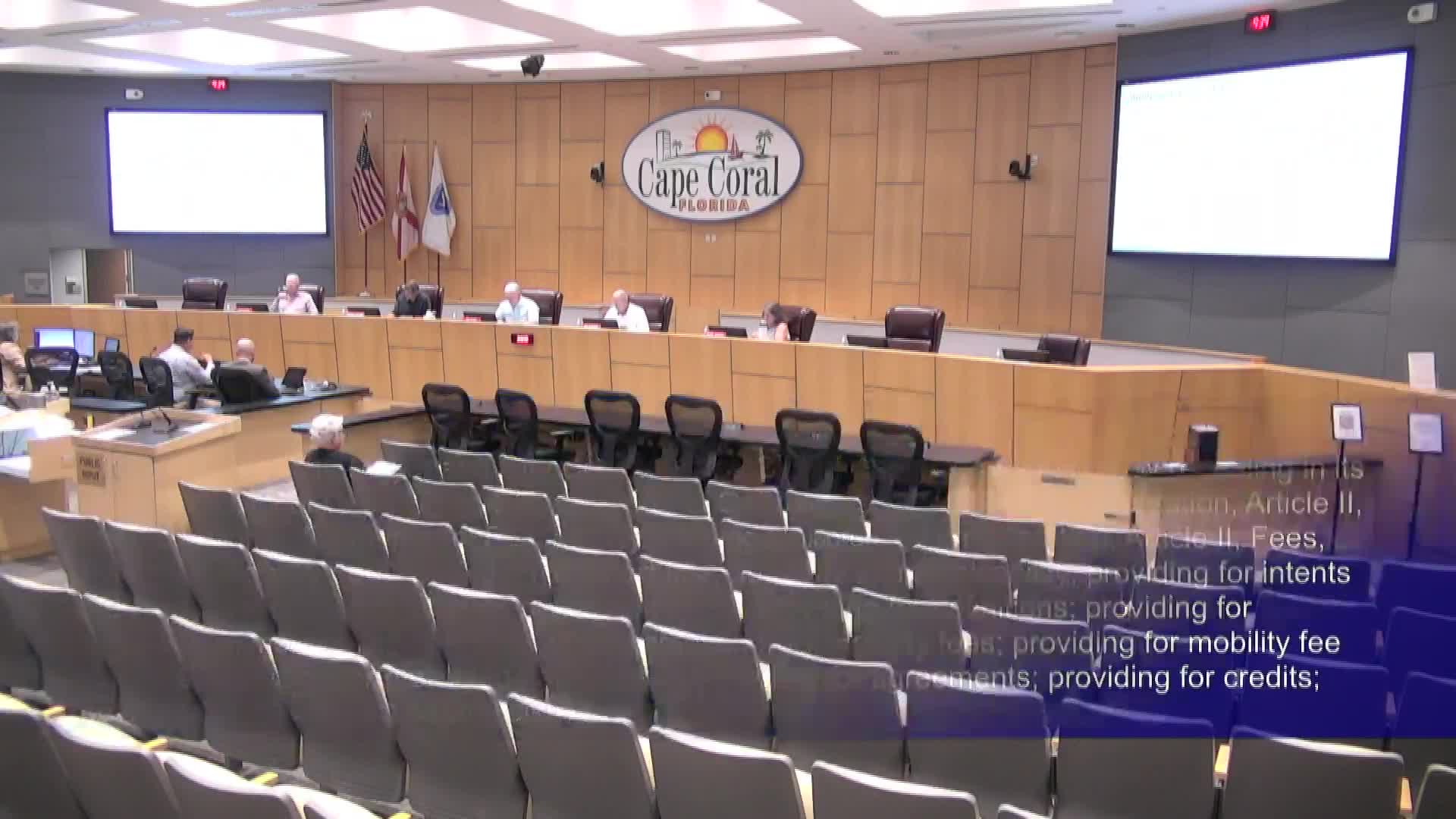
The Planning and Zoning Commission voted to recommend approval of Ordinance 42-25 on Aug. 6, a city‑initiated ordinance to repeal the existing road impact fee ordinance and replace it with a mobility plan and mobility fee. The motion passed 4‑1 following presentations from city transportation staff and two consultants and a commissioners’ discussion of fee levels and implementation options.
Laura Dodd, the city’s principal transportation planner, introduced the ordinance and explained that the proposal replaces the existing road impact fee with a mobility fee consistent with Florida Statute 163.318. Dodd said the new ordinance creates fee structure rules, assessment and benefit areas, credits, exemptions, an extraordinary‑circumstances study and appeals processes, and described public outreach including surveys, workshops, and advisory hearings conducted as part of the plan development.
David Farmer of Metro Forecasting Models presented the city’s recent growth analysis, telling commissioners that between his firm’s 2023 and 2025 updates the city added 9,700 housing units in an 18‑month period and that the city has roughly 40,000 platted lots remaining. Farmer said much of that growth has been concentrated north of Pine Island Road and argued the city will need more commercial land and transportation capacity to serve new residents. He noted recent permitting surges and rising construction costs and said his housing‑unit method forecast averages about 1,715 permits per year going forward, with a build‑out projection adding tens of thousands of residents over the next decades.
Jonathan Paul of New Urban Concepts summarized the proposed mobility plan and fee, explaining the plan’s components (road and intersection improvements, multimodal paths, transit planning and mobility programs), the concept of assessment areas (South Cape core, Central Cape along Pine Island, North Cape), and proposed benefit districts that would generally limit where fees can be spent to the area where they were collected. Paul noted that Florida law governing extraordinary circumstances has changed: after Oct. 1 the statute will require a unanimous vote by elected officials to claim extraordinary circumstances, and statute limits fee increases absent a documented extraordinary‑circumstances finding.
Dodd and Paul discussed rate structure and implementation detail in response to commissioner questions. Commissioners asked about ferry stops (staff said initial ferry service would be recreational and pilot in nature and might expand regionally later), roundabouts (staff said ICE analysis will determine appropriate treatments at design phase and Public Works noted recent construction and lifecycle cost data showing long‑term operational savings for roundabouts), and rate calculations for nonresidential square footage. Public Works provided a recent comparison showing some multi‑lane roundabouts and signalized intersections had comparable initial cost estimates but lower long‑term maintenance costs for roundabouts.
Staff noted the city’s existing road impact fee was last updated in 2006 (the transcript records the 2006 rate at about $3,347 per single‑family dwelling) and that statute allows increases up to 50% without an extraordinary‑circumstances finding (with phased implementation). The ordinance package includes an extraordinary‑circumstances study and staff asked the commission to find the ordinance consistent with the comprehensive plan; staff recommended approval. Paul and Dodd said adoption options include implementing 100% of the calculated fee, phasing in increases, or adopting a discount/phase‑in schedule recommended to council.
Commissioner Santore expressed support for addressing growth and funding needs; Commissioner Senator voted nay in the final roll call. Commissioner Severson moved to recommend approval; Commissioner Martin seconded. Roll call: Apking — aye; Martin — aye; Senator — nay; Severson — aye; Lemieux — aye. The motion carried, 4‑1.
The ordinance package is scheduled for additional council briefings and readings: staff noted a council workshop Aug. 13, first reading Aug. 20 and second reading Sept. 3; an adopted fee would take effect 90 days after adoption (staff indicated a potential effective date of Jan. 1, 2026, if adopted on the calendar presented). Council will decide fee levels and whether to accept the extraordinary‑circumstances finding or to phase/discount rates.
Laura Dodd, the city’s principal transportation planner, introduced the ordinance and explained that the proposal replaces the existing road impact fee with a mobility fee consistent with Florida Statute 163.318. Dodd said the new ordinance creates fee structure rules, assessment and benefit areas, credits, exemptions, an extraordinary‑circumstances study and appeals processes, and described public outreach including surveys, workshops, and advisory hearings conducted as part of the plan development.
David Farmer of Metro Forecasting Models presented the city’s recent growth analysis, telling commissioners that between his firm’s 2023 and 2025 updates the city added 9,700 housing units in an 18‑month period and that the city has roughly 40,000 platted lots remaining. Farmer said much of that growth has been concentrated north of Pine Island Road and argued the city will need more commercial land and transportation capacity to serve new residents. He noted recent permitting surges and rising construction costs and said his housing‑unit method forecast averages about 1,715 permits per year going forward, with a build‑out projection adding tens of thousands of residents over the next decades.
Jonathan Paul of New Urban Concepts summarized the proposed mobility plan and fee, explaining the plan’s components (road and intersection improvements, multimodal paths, transit planning and mobility programs), the concept of assessment areas (South Cape core, Central Cape along Pine Island, North Cape), and proposed benefit districts that would generally limit where fees can be spent to the area where they were collected. Paul noted that Florida law governing extraordinary circumstances has changed: after Oct. 1 the statute will require a unanimous vote by elected officials to claim extraordinary circumstances, and statute limits fee increases absent a documented extraordinary‑circumstances finding.
Dodd and Paul discussed rate structure and implementation detail in response to commissioner questions. Commissioners asked about ferry stops (staff said initial ferry service would be recreational and pilot in nature and might expand regionally later), roundabouts (staff said ICE analysis will determine appropriate treatments at design phase and Public Works noted recent construction and lifecycle cost data showing long‑term operational savings for roundabouts), and rate calculations for nonresidential square footage. Public Works provided a recent comparison showing some multi‑lane roundabouts and signalized intersections had comparable initial cost estimates but lower long‑term maintenance costs for roundabouts.
Staff noted the city’s existing road impact fee was last updated in 2006 (the transcript records the 2006 rate at about $3,347 per single‑family dwelling) and that statute allows increases up to 50% without an extraordinary‑circumstances finding (with phased implementation). The ordinance package includes an extraordinary‑circumstances study and staff asked the commission to find the ordinance consistent with the comprehensive plan; staff recommended approval. Paul and Dodd said adoption options include implementing 100% of the calculated fee, phasing in increases, or adopting a discount/phase‑in schedule recommended to council.
Commissioner Santore expressed support for addressing growth and funding needs; Commissioner Senator voted nay in the final roll call. Commissioner Severson moved to recommend approval; Commissioner Martin seconded. Roll call: Apking — aye; Martin — aye; Senator — nay; Severson — aye; Lemieux — aye. The motion carried, 4‑1.
The ordinance package is scheduled for additional council briefings and readings: staff noted a council workshop Aug. 13, first reading Aug. 20 and second reading Sept. 3; an adopted fee would take effect 90 days after adoption (staff indicated a potential effective date of Jan. 1, 2026, if adopted on the calendar presented). Council will decide fee levels and whether to accept the extraordinary‑circumstances finding or to phase/discount rates.
View the Full Meeting & All Its Details
This article offers just a summary. Unlock complete video, transcripts, and insights as a Founder Member.
✓
Watch full, unedited meeting videos
✓
Search every word spoken in unlimited transcripts
✓
AI summaries & real-time alerts (all government levels)
✓
Permanent access to expanding government content
30-day money-back guarantee
