Reno planning commission backs ADU ordinance, recommends attached-unit size match detached standards
August 07, 2025 | City Council Meetings , Reno, Washoe County, Nevada
This article was created by AI summarizing key points discussed. AI makes mistakes, so for full details and context, please refer to the video of the full meeting. Please report any errors so we can fix them. Report an error »
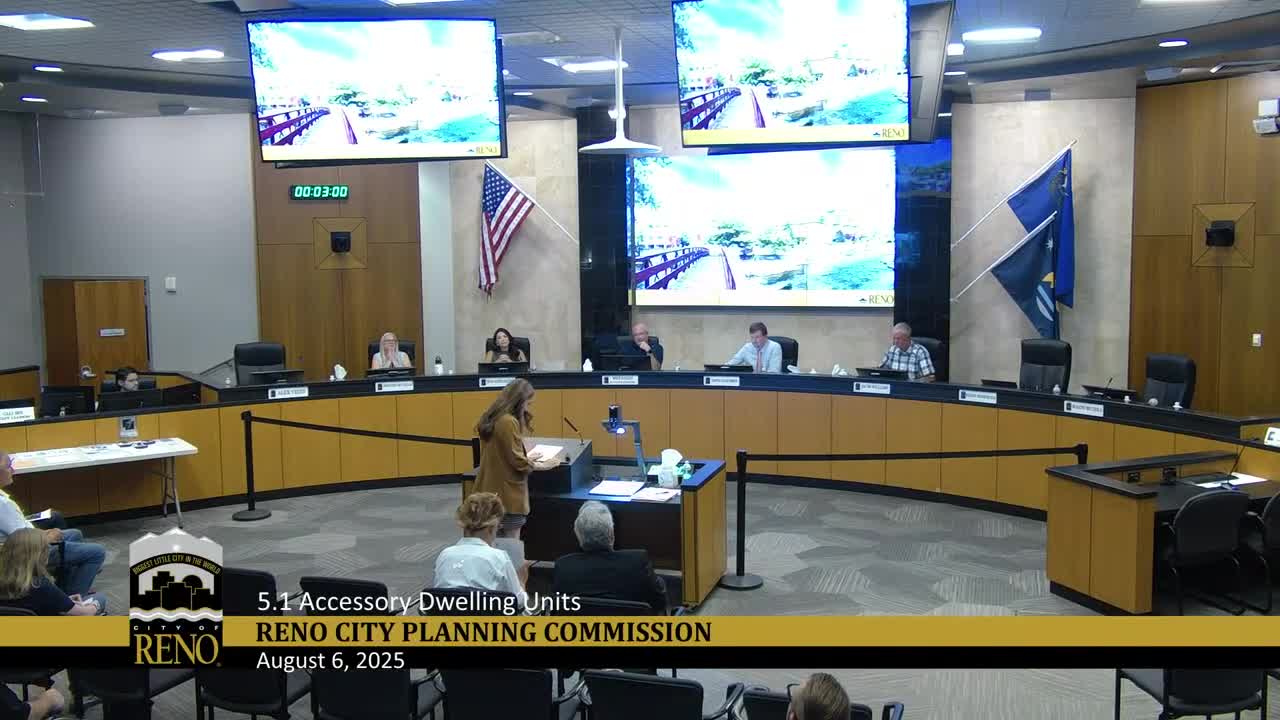
The Reno Planning Commission on Aug. 6 recommended that City Council adopt a citywide accessory dwelling unit ordinance (case TXT24-00002), voting unanimously to forward staff’s draft with one amendment: attached ADUs should be sized under the same detached-accessory-structure limits as detached ADUs.
The recommendation comes after a multi-year outreach process staff described as among the city’s most extensive. Grace Mackinnon, senior management analyst, told the commission the draft responds to prior Planning Commission and City Council input and must comply with state law changes in Assembly Bill 396.
“AB 396 requires that we cannot prohibit separate kitchen facilities for the ADU. We cannot require any more than one parking space per ADU. We cannot require any side or rear setback larger than that of the primary structure, and we cannot require any improvement or repair to a public street unless necessary,” Mackinnon said. She told commissioners the draft was shaped to remain as permissive as state law allows while addressing neighborhood concerns.
Why it matters: the ordinance will set the rules for where and how homeowners may add secondary housing on residential lots, affecting infill capacity, neighborhood character, parking demand and short-term rental use across Reno. Staff said adoption by City Council is anticipated this fall to meet state-mandated timelines for local ADU regulations.
Key provisions and debate
Staff summarized the principal elements of the draft: a 5,000-square-foot minimum lot size (reduced from a prior 9,000-square-foot proposal), a limit of one ADU per parcel, a requirement that each ADU have one off-street parking space, adoption of existing guest-house design standards for compatibility, and a prohibition on renting an ADU as transient lodging shorter than the ordinance’s transient definition.
Mackinnon noted the city’s definition of transient lodging is 28 days or less and said the draft “is regulating to the maximum extent possible” under AB 396 on short-term rental length. She also said the draft does not include an owner-occupancy requirement and that existing unpermitted ADUs would be handled like other nonconforming structures through building-permit review and possible retroactive permitting.
Public commenters offered a range of viewpoints. Several residents with older or small lots asked for flexibility so unusually small historic houses could be reconfigured without expensive special permits; Connie Silvera asked for “some leeway” for a 1930s-era tiny house on her lot and suggested a review option for atypical parcels. Professionals and long-term residents urged flexibility on parking and short-term-rental restrictions: planner Greg Evangelatos and neighborhood resident Doug Erwin supported ADUs for reinvestment and aging-in-place but cautioned that a universal parking standard and an across‑the‑board prohibition on short-term ADU rentals could discourage new units.
Legal and implementation constraints
Staff repeatedly cited AB 396 as limiting the city’s options. Besides the provisions Mackinnon listed, the law prevents municipalities from imposing unrelated conditions that would effectively bar ADU use; staff said they negotiated with the bill’s authors to preserve the ability to require one parking space per ADU and to keep design compatibility standards where permissible.
Commissioners asked several implementation questions: how the city would treat CC&Rs (private covenants), how retroactive permitting would work for existing unpermitted units, and whether the 5,000-square-foot lot-size threshold should differ for attached versus detached units. Mackinnon and city staff said private CC&Rs remain enforceable by private parties and that the city cannot enforce private restrictions; retroactive permitting would be handled by the building department primarily for life-safety compliance.
Vote and motion
Commissioner Williams moved the recommendation; his motion included the specific addition that attached ADU size limits mirror the detached accessory structure standards. Commissioner Wri seconded. The commission voted unanimously to recommend approval and forward the draft ordinance and the attached-size clarification to City Council.
What’s next
Per staff, the draft will be transmitted to City Council for a formal public hearing and potential adoption. Staff said they will monitor the ordinance’s performance after adoption and may return with amendments if implementation issues arise.
Evidence span: the Planning Commission’s discussion and public testimony on TXT24-00002 occurred during the public-hearing portion of the Aug. 6 meeting; staff began the presentation and timeline at the start of the ADU item and commissioners closed deliberations with the motion to forward the ordinance to council.
Ending
The commission’s recommendation does not adopt any change into law; it sends a formal recommendation to City Council with an explicit size-standard amendment for attached ADUs. City Council will have the final decision on the ordinance and any additional modifications.
The recommendation comes after a multi-year outreach process staff described as among the city’s most extensive. Grace Mackinnon, senior management analyst, told the commission the draft responds to prior Planning Commission and City Council input and must comply with state law changes in Assembly Bill 396.
“AB 396 requires that we cannot prohibit separate kitchen facilities for the ADU. We cannot require any more than one parking space per ADU. We cannot require any side or rear setback larger than that of the primary structure, and we cannot require any improvement or repair to a public street unless necessary,” Mackinnon said. She told commissioners the draft was shaped to remain as permissive as state law allows while addressing neighborhood concerns.
Why it matters: the ordinance will set the rules for where and how homeowners may add secondary housing on residential lots, affecting infill capacity, neighborhood character, parking demand and short-term rental use across Reno. Staff said adoption by City Council is anticipated this fall to meet state-mandated timelines for local ADU regulations.
Key provisions and debate
Staff summarized the principal elements of the draft: a 5,000-square-foot minimum lot size (reduced from a prior 9,000-square-foot proposal), a limit of one ADU per parcel, a requirement that each ADU have one off-street parking space, adoption of existing guest-house design standards for compatibility, and a prohibition on renting an ADU as transient lodging shorter than the ordinance’s transient definition.
Mackinnon noted the city’s definition of transient lodging is 28 days or less and said the draft “is regulating to the maximum extent possible” under AB 396 on short-term rental length. She also said the draft does not include an owner-occupancy requirement and that existing unpermitted ADUs would be handled like other nonconforming structures through building-permit review and possible retroactive permitting.
Public commenters offered a range of viewpoints. Several residents with older or small lots asked for flexibility so unusually small historic houses could be reconfigured without expensive special permits; Connie Silvera asked for “some leeway” for a 1930s-era tiny house on her lot and suggested a review option for atypical parcels. Professionals and long-term residents urged flexibility on parking and short-term-rental restrictions: planner Greg Evangelatos and neighborhood resident Doug Erwin supported ADUs for reinvestment and aging-in-place but cautioned that a universal parking standard and an across‑the‑board prohibition on short-term ADU rentals could discourage new units.
Legal and implementation constraints
Staff repeatedly cited AB 396 as limiting the city’s options. Besides the provisions Mackinnon listed, the law prevents municipalities from imposing unrelated conditions that would effectively bar ADU use; staff said they negotiated with the bill’s authors to preserve the ability to require one parking space per ADU and to keep design compatibility standards where permissible.
Commissioners asked several implementation questions: how the city would treat CC&Rs (private covenants), how retroactive permitting would work for existing unpermitted units, and whether the 5,000-square-foot lot-size threshold should differ for attached versus detached units. Mackinnon and city staff said private CC&Rs remain enforceable by private parties and that the city cannot enforce private restrictions; retroactive permitting would be handled by the building department primarily for life-safety compliance.
Vote and motion
Commissioner Williams moved the recommendation; his motion included the specific addition that attached ADU size limits mirror the detached accessory structure standards. Commissioner Wri seconded. The commission voted unanimously to recommend approval and forward the draft ordinance and the attached-size clarification to City Council.
What’s next
Per staff, the draft will be transmitted to City Council for a formal public hearing and potential adoption. Staff said they will monitor the ordinance’s performance after adoption and may return with amendments if implementation issues arise.
Evidence span: the Planning Commission’s discussion and public testimony on TXT24-00002 occurred during the public-hearing portion of the Aug. 6 meeting; staff began the presentation and timeline at the start of the ADU item and commissioners closed deliberations with the motion to forward the ordinance to council.
Ending
The commission’s recommendation does not adopt any change into law; it sends a formal recommendation to City Council with an explicit size-standard amendment for attached ADUs. City Council will have the final decision on the ordinance and any additional modifications.
View the Full Meeting & All Its Details
This article offers just a summary. Unlock complete video, transcripts, and insights as a Founder Member.
✓
Watch full, unedited meeting videos
✓
Search every word spoken in unlimited transcripts
✓
AI summaries & real-time alerts (all government levels)
✓
Permanent access to expanding government content
30-day money-back guarantee
