City planners hold Preston Hollow Village open-space plan after neighbors dispute fulfillment of PD 750 requirements
September 04, 2025 | Dallas, Dallas County, Texas
This article was created by AI summarizing key points discussed. AI makes mistakes, so for full details and context, please refer to the video of the full meeting. Please report any errors so we can fix them. Report an error »
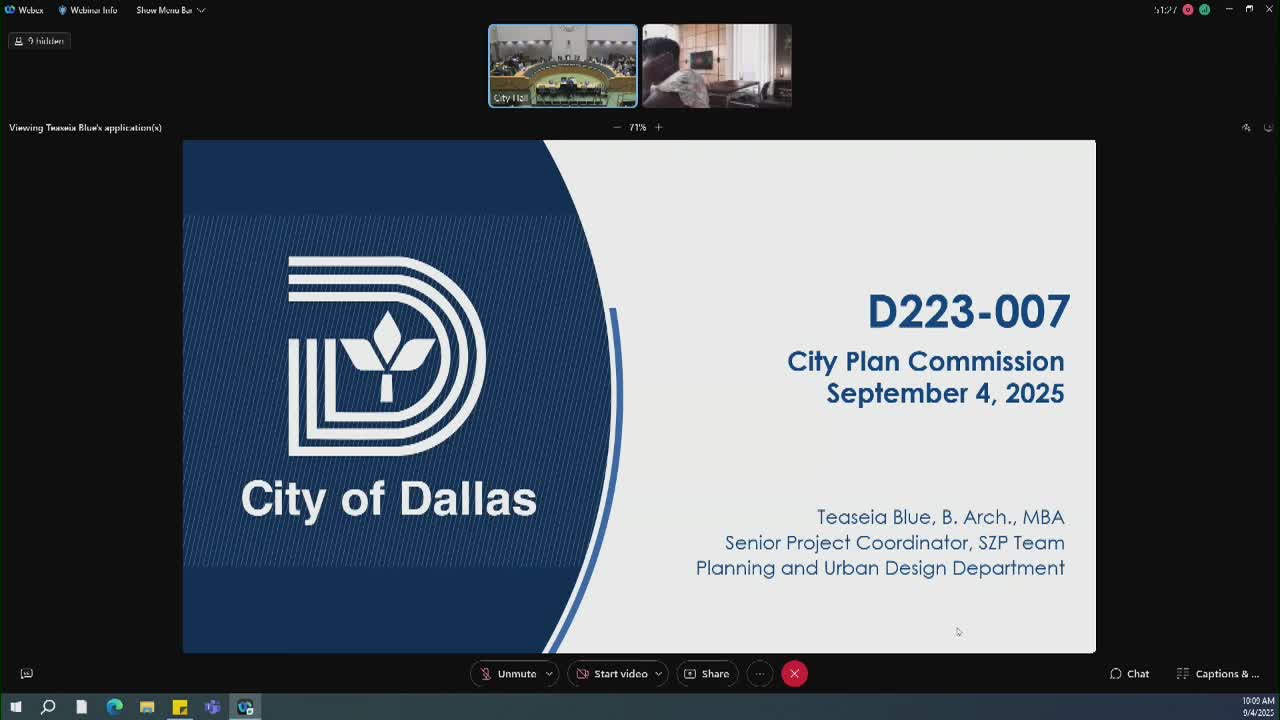
The Dallas City Planning Commission on Thursday held a development-and-landscape plan for the Preston Hollow Village portion of Plan Development District (PD) No. 750 under advisement after neighbors and the developer disagreed about whether the PD’s large-open-space requirements have been satisfied.
Staff presented a formal development plan for portions of Subdistrict C (tracks C, D and F) at the northwest corner of North Central Expressway and Walnut Hill Lane. The application covers roughly 6.323 acres in Council District 11 and would formalize construction of a roughly 3-acre large open space, pedestrian connections and streetscape elements. Planning staff recommended approval of the plan but commissioners opted to hold the case to allow further negotiation with neighborhood representatives.
The dispute centers on language in PD 750 requiring a minimum of 3 acres of required landscape area to be provided and maintained within the large open space and completed within two years of issuance of certificates of occupancy for a minimum of 500 dwelling units. Staff planner Sharon Blue told the commission that the PD’s “final location of large open space must be shown on a development plan,” and that the district’s controlling language allows some adjustment of the open-space footprint when the development plan is filed. Blue said the applicant’s proposed layout shows the required landscape area and streetscape, and that staff’s analysis finds it meets the PD standards.
Applicant representatives said parts of the large open space already exist and that the submitted development-and-landscape plan completes the PD’s open-space obligation. Suzanne Kedron, who described herself as the applicant’s representative, told commissioners: “This area complies with the PD as part of the large open space by providing three water features, tree plantings, hardscape areas, pedestrian lighting, benches [and] an open amphitheater area.” She asked the commission to approve the plan.
Neighbors and members of the PD’s long-standing neighborhood task force said the developer had previously promised a contiguous, triangular park and had failed to construct the required amenities on schedule. Edward Haines, a founding member of the task force, told the commission that the PD required the open space to be completed after the developer reached the 500-dwelling-unit milestone, which staff records show occurred in 2019, and that the large open space “was never developed.” Haines asked the commission to deny the application so the developer would be required to fulfill the original PD commitments.
Commissioners pressed staff on specific measurements and the effect of small shifts in the open-space footprint. At the hearing, commissioners and staff discussed numbers the neighborhood submitted and staff’s conversion of plan square footage into acreage: the applicant’s documents and commissioners’ calculations produced a set of figures frequently cited during the hearing — a roughly 2.46-acre green area plus an approximately 0.37-acre street footprint yields about 2.81 acres, and the parties disputed whether the long skinny hardscape area to the south (roughly 0.60 acres, according to one commissioners’ calculation) should count toward the PD-required 3 acres. Staff said PD language allows some flexibility: “It could have moved east, west,” Blue said, adding staff concluded the proposed plan met the PD standards.
Neighbors also raised concerns about notice. Commissioner Sims asked staff whether the PD or city code requires mailed notice for a development plan. Blue responded the PD required the applicant to notify a list of neighborhood associations before filing the application, but that the city’s development-plan process does not carry the same public-notice requirements as rezoning decisions. Applicant counsel provided certified notices they said had been mailed in 2023 in accordance with the PD conditions.
Given lingering disagreement and the public objections, the commission voted to hold the item under advisement. Commissioner Steve Sims moved for the hold; Commissioner Hampton seconded, and the motion passed. The commission asked staff and the parties to continue negotiations and return with revised materials at the next meeting (the case was held to the meeting on Sept. 18).
What happens next: staff and the applicant will continue discussions with the neighborhood task force. The commission’s hold gives both sides time to reconcile measurements and the scope of the large open space, and to confirm whether elements that the neighborhood considers hardscape should count toward the PD’s 3-acre requirement.
Why it matters: PD 750 is a long-standing, multi-parcel development that included negotiated community commitments. Whether the developer’s current plan satisfies the PD language affects both the quality and quantity of publicly accessible green space being delivered for the surrounding neighborhoods and establishes how much flexibility staff and the commission will allow when concept plans are refined into final development plans.
Speakers at the meeting included applicant representatives, planning staff and multiple neighborhood leaders; the commission heard several public comments and requested additional clarification from staff before deciding to hold the case for further negotiation.
Staff presented a formal development plan for portions of Subdistrict C (tracks C, D and F) at the northwest corner of North Central Expressway and Walnut Hill Lane. The application covers roughly 6.323 acres in Council District 11 and would formalize construction of a roughly 3-acre large open space, pedestrian connections and streetscape elements. Planning staff recommended approval of the plan but commissioners opted to hold the case to allow further negotiation with neighborhood representatives.
The dispute centers on language in PD 750 requiring a minimum of 3 acres of required landscape area to be provided and maintained within the large open space and completed within two years of issuance of certificates of occupancy for a minimum of 500 dwelling units. Staff planner Sharon Blue told the commission that the PD’s “final location of large open space must be shown on a development plan,” and that the district’s controlling language allows some adjustment of the open-space footprint when the development plan is filed. Blue said the applicant’s proposed layout shows the required landscape area and streetscape, and that staff’s analysis finds it meets the PD standards.
Applicant representatives said parts of the large open space already exist and that the submitted development-and-landscape plan completes the PD’s open-space obligation. Suzanne Kedron, who described herself as the applicant’s representative, told commissioners: “This area complies with the PD as part of the large open space by providing three water features, tree plantings, hardscape areas, pedestrian lighting, benches [and] an open amphitheater area.” She asked the commission to approve the plan.
Neighbors and members of the PD’s long-standing neighborhood task force said the developer had previously promised a contiguous, triangular park and had failed to construct the required amenities on schedule. Edward Haines, a founding member of the task force, told the commission that the PD required the open space to be completed after the developer reached the 500-dwelling-unit milestone, which staff records show occurred in 2019, and that the large open space “was never developed.” Haines asked the commission to deny the application so the developer would be required to fulfill the original PD commitments.
Commissioners pressed staff on specific measurements and the effect of small shifts in the open-space footprint. At the hearing, commissioners and staff discussed numbers the neighborhood submitted and staff’s conversion of plan square footage into acreage: the applicant’s documents and commissioners’ calculations produced a set of figures frequently cited during the hearing — a roughly 2.46-acre green area plus an approximately 0.37-acre street footprint yields about 2.81 acres, and the parties disputed whether the long skinny hardscape area to the south (roughly 0.60 acres, according to one commissioners’ calculation) should count toward the PD-required 3 acres. Staff said PD language allows some flexibility: “It could have moved east, west,” Blue said, adding staff concluded the proposed plan met the PD standards.
Neighbors also raised concerns about notice. Commissioner Sims asked staff whether the PD or city code requires mailed notice for a development plan. Blue responded the PD required the applicant to notify a list of neighborhood associations before filing the application, but that the city’s development-plan process does not carry the same public-notice requirements as rezoning decisions. Applicant counsel provided certified notices they said had been mailed in 2023 in accordance with the PD conditions.
Given lingering disagreement and the public objections, the commission voted to hold the item under advisement. Commissioner Steve Sims moved for the hold; Commissioner Hampton seconded, and the motion passed. The commission asked staff and the parties to continue negotiations and return with revised materials at the next meeting (the case was held to the meeting on Sept. 18).
What happens next: staff and the applicant will continue discussions with the neighborhood task force. The commission’s hold gives both sides time to reconcile measurements and the scope of the large open space, and to confirm whether elements that the neighborhood considers hardscape should count toward the PD’s 3-acre requirement.
Why it matters: PD 750 is a long-standing, multi-parcel development that included negotiated community commitments. Whether the developer’s current plan satisfies the PD language affects both the quality and quantity of publicly accessible green space being delivered for the surrounding neighborhoods and establishes how much flexibility staff and the commission will allow when concept plans are refined into final development plans.
Speakers at the meeting included applicant representatives, planning staff and multiple neighborhood leaders; the commission heard several public comments and requested additional clarification from staff before deciding to hold the case for further negotiation.
View the Full Meeting & All Its Details
This article offers just a summary. Unlock complete video, transcripts, and insights as a Founder Member.
✓
Watch full, unedited meeting videos
✓
Search every word spoken in unlimited transcripts
✓
AI summaries & real-time alerts (all government levels)
✓
Permanent access to expanding government content
30-day money-back guarantee
