Planning commission backs 5-year renewal for Buckner Boulevard store's alcohol permit; commissioners debate SUP policy
September 04, 2025 | Dallas, Dallas County, Texas
This article was created by AI summarizing key points discussed. AI makes mistakes, so for full details and context, please refer to the video of the full meeting. Please report any errors so we can fix them. Report an error »
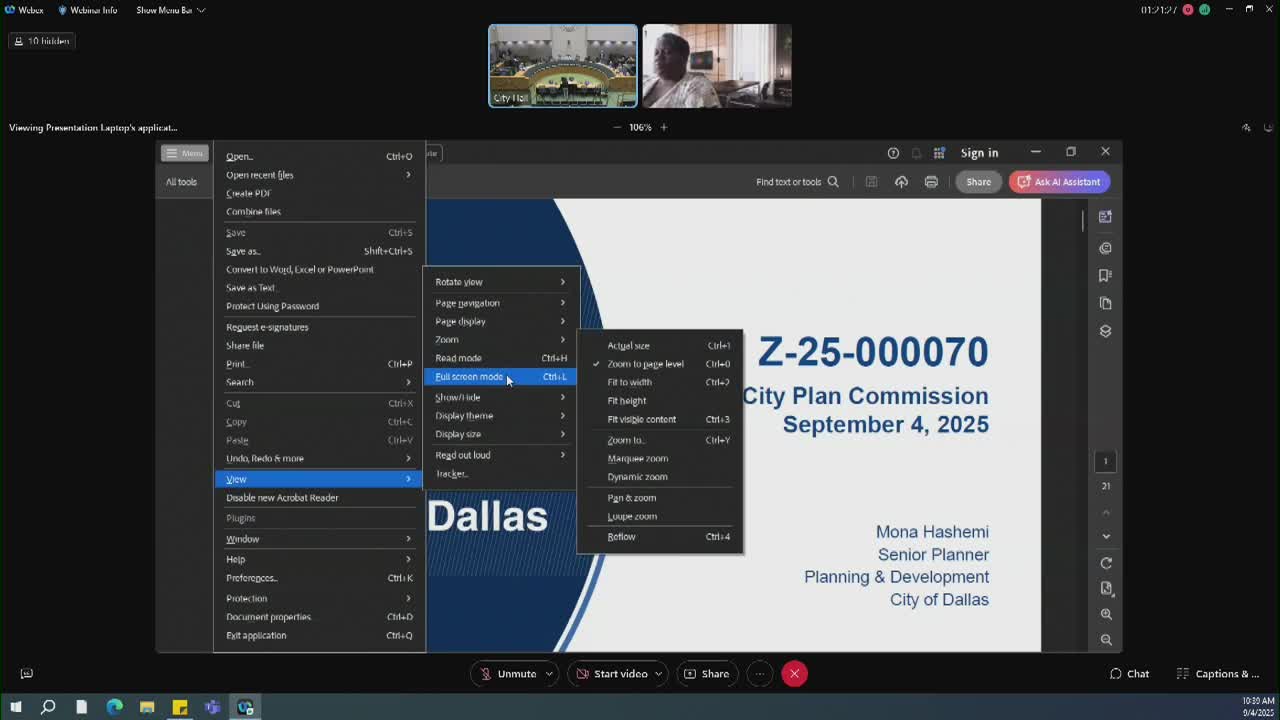
The Dallas City Planning Commission voted to recommend approval of a specific-use permit renewal that authorizes the sale of alcoholic beverages at a retail store on Buckner Boulevard, approving the applicant’s request for a five-year renewal with automatic five-year renewals thereafter.
Staff told the commission that the store — located at the northwest corner of South Buckner Boulevard and Scion Road within Subarea 7 of Planned Development District 366 — had a history of time-limited renewals because of prior permit conditions and a fire. Planner Mona Hashemi and other staff said the store had met the city’s site, permitting and safety requirements after remodeling and that conditions linked to earlier noncompliance had been cleared. Planning staff recommended approval without an expiration date, subject to the standard conditions.
Andrew Ruhick, counsel for the applicant, explained the recent timeline: the SUP previously had been approved only for one year because the building was inoperable following an arson fire; the store has since been repaired and reopened. Ruhick asked the commission to authorize a five-year term with automatic renewals. “We are respectfully requesting today approval for a five-year renewal with five-year automatic renewals,” he told commissioners.
Commissioners used the item to pursue a broader debate about whether SUPs — particularly for alcohol sales — should be time-limited, how the city enforces conditions and whether zoning is the right tool for managing repeat permit violations. Several commissioners asked planning and legal staff to identify alternative enforcement approaches that do not rely on periodic public hearings.
Chief Planner Michael Pepe and planning staff said some conditions (for example, site layout, hours of operation and building code compliance) are best handled in land-use reviews, while other concerns — nuisance calls, criminal activity or repeated permit violations — may be better pursued through enforcement by other city offices or state regulatory agencies. Several commissioners expressed concern that extended, repeated hearings to reauthorize SUPs place the enforcement burden on neighborhoods and neighborhood groups.
After discussion, the commission closed the public hearing and voted to follow staff’s recommendation and grant the applicant’s request for a five-year term with automatic five-year renewals, subject to the conditions on the staff report. The record does not contain a full roll-call tally in the transcript; the motion was put and the chair’s motion to approve passed. The applicant will appear before the City Council with the commission’s recommendation.
Why this matters: The case prompted a policy-level discussion about how the city should regulate uses such as alcohol sales that are tied to broader public-safety and nuisance concerns. Some commissioners urged code amendments and better administrative tools so the city need not repeatedly use SUP time limits as the primary enforcement mechanism.
Speakers at the item included the applicant’s counsel and planning staff; no public opposition was recorded at the commission hearing.
Staff told the commission that the store — located at the northwest corner of South Buckner Boulevard and Scion Road within Subarea 7 of Planned Development District 366 — had a history of time-limited renewals because of prior permit conditions and a fire. Planner Mona Hashemi and other staff said the store had met the city’s site, permitting and safety requirements after remodeling and that conditions linked to earlier noncompliance had been cleared. Planning staff recommended approval without an expiration date, subject to the standard conditions.
Andrew Ruhick, counsel for the applicant, explained the recent timeline: the SUP previously had been approved only for one year because the building was inoperable following an arson fire; the store has since been repaired and reopened. Ruhick asked the commission to authorize a five-year term with automatic renewals. “We are respectfully requesting today approval for a five-year renewal with five-year automatic renewals,” he told commissioners.
Commissioners used the item to pursue a broader debate about whether SUPs — particularly for alcohol sales — should be time-limited, how the city enforces conditions and whether zoning is the right tool for managing repeat permit violations. Several commissioners asked planning and legal staff to identify alternative enforcement approaches that do not rely on periodic public hearings.
Chief Planner Michael Pepe and planning staff said some conditions (for example, site layout, hours of operation and building code compliance) are best handled in land-use reviews, while other concerns — nuisance calls, criminal activity or repeated permit violations — may be better pursued through enforcement by other city offices or state regulatory agencies. Several commissioners expressed concern that extended, repeated hearings to reauthorize SUPs place the enforcement burden on neighborhoods and neighborhood groups.
After discussion, the commission closed the public hearing and voted to follow staff’s recommendation and grant the applicant’s request for a five-year term with automatic five-year renewals, subject to the conditions on the staff report. The record does not contain a full roll-call tally in the transcript; the motion was put and the chair’s motion to approve passed. The applicant will appear before the City Council with the commission’s recommendation.
Why this matters: The case prompted a policy-level discussion about how the city should regulate uses such as alcohol sales that are tied to broader public-safety and nuisance concerns. Some commissioners urged code amendments and better administrative tools so the city need not repeatedly use SUP time limits as the primary enforcement mechanism.
Speakers at the item included the applicant’s counsel and planning staff; no public opposition was recorded at the commission hearing.
View the Full Meeting & All Its Details
This article offers just a summary. Unlock complete video, transcripts, and insights as a Founder Member.
✓
Watch full, unedited meeting videos
✓
Search every word spoken in unlimited transcripts
✓
AI summaries & real-time alerts (all government levels)
✓
Permanent access to expanding government content
30-day money-back guarantee
