Board discusses state marker production, local marker applications and county signage rules
September 04, 2025 | Clay County, Florida
This article was created by AI summarizing key points discussed. AI makes mistakes, so for full details and context, please refer to the video of the full meeting. Please report any errors so we can fix them. Report an error »
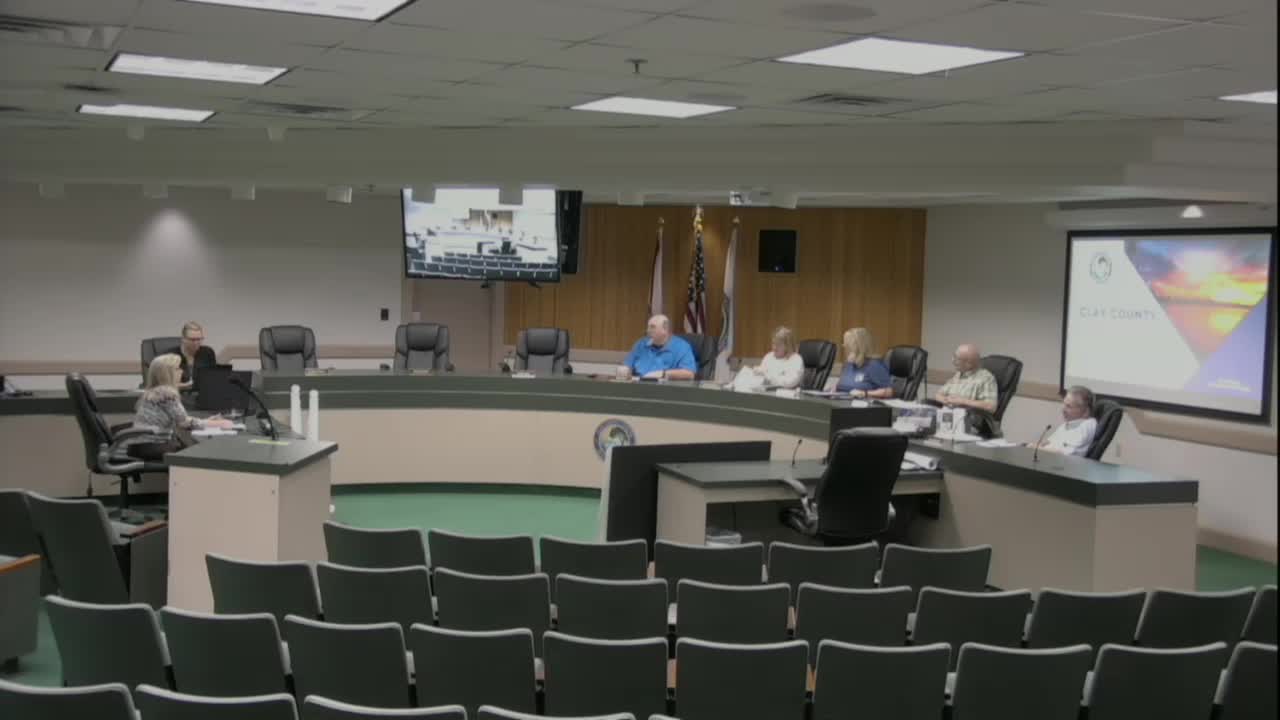
Board members discussed multiple historic-marker and county-signage matters, including state production timelines, local application assignments, design mock-ups and requirements for placement.
Beth reported that the state council approved the Brandyfield marker on Aug. 19 and that production was expected to take about seven to eight months. She said staff estimated the St. Mary’s marker work might be scheduled in early spring but added that production timing is a backlog-driven estimate from state staff. The board discussed the 4-11 (Fort Number 11) marker: Beth said it was unclear whether an application had been formally submitted after Deirdre’s resignation and that the board needed to identify a local applicant and a site; the Keystone heritage committee or the City of Keystone could serve as applicants if they agree.
Tom (last name not provided) has identified approximate coordinates for the 4-11 site from artifacts and historical maps but said confirming an exact historical footprint will require additional archaeology or artifact evidence and possibly field work in cooler weather.
The Middleburg Museum marker text is being revised to emphasize that part of the site was a WPA-authorized project in the 1930s; proponents found contemporary newspaper articles that helped refine the timeline and will finalize the text at a follow-up meeting. Board members agreed they could submit revised text to state staff but cautioned that placement in the state queue depends on production backlog.
On county signage, the board reviewed a mock-up the county had prepared after a state design was chosen; the county’s sign would be blue with a gold border and incorporate the county seal at the top with narrative text below. State reviewers requested a design consistent with state markers; the board discussed adding a sponsorship credit line at the bottom for the state, county commission and the historic board.
Board staff said they are converting the state application into a county PDF form and were drafting county-specific guidelines to determine eligible sign topics (archaeological, historical, architectural or cultural). The board discussed placement rules: signs cannot be in the right of way, require safe pull-off areas where drivers can park and read the text, require property-owner permission if off county property, and may need FDOT approval if placed along a state road (for example, U.S. 17).
Members noted at least one state marker (Fort San Francisco de Pupo on the St. Johns River) had been removed or lost during roadway or construction projects in the past; a member suggested engineering staff contact the relevant project manager to determine whether the missing marker was accounted for in pre-construction planning.
No formal votes on marker text, county policy or sign fabrication funding were recorded in the transcript; the items were discussed and staff were assigned to prepare application templates and guideline drafts for future action.
Beth reported that the state council approved the Brandyfield marker on Aug. 19 and that production was expected to take about seven to eight months. She said staff estimated the St. Mary’s marker work might be scheduled in early spring but added that production timing is a backlog-driven estimate from state staff. The board discussed the 4-11 (Fort Number 11) marker: Beth said it was unclear whether an application had been formally submitted after Deirdre’s resignation and that the board needed to identify a local applicant and a site; the Keystone heritage committee or the City of Keystone could serve as applicants if they agree.
Tom (last name not provided) has identified approximate coordinates for the 4-11 site from artifacts and historical maps but said confirming an exact historical footprint will require additional archaeology or artifact evidence and possibly field work in cooler weather.
The Middleburg Museum marker text is being revised to emphasize that part of the site was a WPA-authorized project in the 1930s; proponents found contemporary newspaper articles that helped refine the timeline and will finalize the text at a follow-up meeting. Board members agreed they could submit revised text to state staff but cautioned that placement in the state queue depends on production backlog.
On county signage, the board reviewed a mock-up the county had prepared after a state design was chosen; the county’s sign would be blue with a gold border and incorporate the county seal at the top with narrative text below. State reviewers requested a design consistent with state markers; the board discussed adding a sponsorship credit line at the bottom for the state, county commission and the historic board.
Board staff said they are converting the state application into a county PDF form and were drafting county-specific guidelines to determine eligible sign topics (archaeological, historical, architectural or cultural). The board discussed placement rules: signs cannot be in the right of way, require safe pull-off areas where drivers can park and read the text, require property-owner permission if off county property, and may need FDOT approval if placed along a state road (for example, U.S. 17).
Members noted at least one state marker (Fort San Francisco de Pupo on the St. Johns River) had been removed or lost during roadway or construction projects in the past; a member suggested engineering staff contact the relevant project manager to determine whether the missing marker was accounted for in pre-construction planning.
No formal votes on marker text, county policy or sign fabrication funding were recorded in the transcript; the items were discussed and staff were assigned to prepare application templates and guideline drafts for future action.
View the Full Meeting & All Its Details
This article offers just a summary. Unlock complete video, transcripts, and insights as a Founder Member.
✓
Watch full, unedited meeting videos
✓
Search every word spoken in unlimited transcripts
✓
AI summaries & real-time alerts (all government levels)
✓
Permanent access to expanding government content
30-day money-back guarantee
