Hearing examiner hears testimony on Green Line Subdivision in Spokane Valley; decision to be issued
October 23, 2025 | Spokane Valley, Spokane County, Washington
This article was created by AI summarizing key points discussed. AI makes mistakes, so for full details and context, please refer to the video of the full meeting. Please report any errors so we can fix them. Report an error »
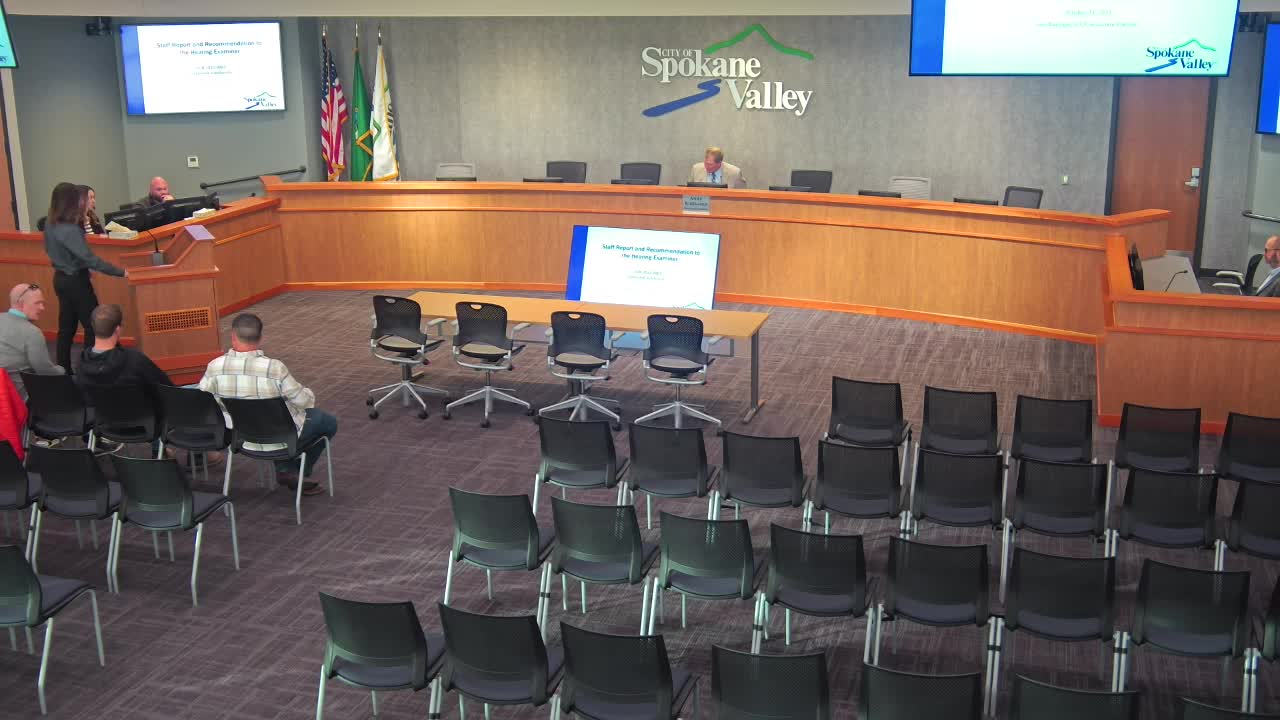
The Spokane Valley hearing examiner heard testimony Oct. 23 on SUB2025‑0003, the “Green Line Subdivision,” a proposal to subdivide 1.4 acres on Valleyway Avenue into 26 lots for attached single‑family townhomes (3‑ and 4‑unit structures where each unit would sit on its own lot). Hearing Examiner Andy Kotkamp said a written decision will be issued within 10 working days.
Levi Basener, associate planner for the City of Spokane Valley, told the examiner that staff reviewed the application under the State Environmental Policy Act (SEPA), RCW 58.17 (plats), the Spokane Valley Comprehensive Plan and Spokane Valley Municipal Code Titles 19 (zoning), 20 (subdivision), 21 (environmental) and 22 (design/development standards). Basener said staff concluded the proposal meets applicable standards and recommended approval with conditions, including required public‑improvement work on Valleyway Avenue, stormwater and utility installation, demolition of the existing house and outbuildings, and SEPA mitigation measures tied to cultural resources.
Basener summarized the application timeline and public notice: the application was submitted July 9 and deemed complete July 17; notices were mailed to properties within 400 feet and a notice posted on the site in early October; a Mitigated Determination of Nonsignificance (MDNS) under SEPA was issued Sept. 12, 2025. Basener said agencies that commented include Spokane County Wastewater Division (sewer), Vera Water and Power (water; certificate of water availability provided), Spokane Valley Fire District No. 1 (fire), and others referenced in the staff report. He noted the nearest public park is the Appleway Trail about a half mile south and that the site is in Central Valley School District (Progress Elementary, North Pines Middle School and Central Valley High School).
Staff described zoning and density: the site is designated Corridor Mixed Use (CMU) in the comprehensive plan and zoned CMU. Basener said density/dimensional standards the city applies to single‑family development in the CMU zone result in a 2,000 square‑foot minimum lot size and a 22 units‑per‑acre maximum when applied to single‑family standards; the proposed subdivision’s lots range from just over 2,000 square feet to just over 3,000 square feet and the net density on the site would be 19 dwelling units per acre. Street and access details presented by staff include two new private streets (to be named Pioneer Lane and Olive Lane), required frontage improvements on Valleyway Avenue (curb, gutter, sidewalk, stormwater), and a design deviation allowing lots to be accessed from private streets.
The staff report noted one written comment from Pioneer School, a private school northwest of the site. The school’s comment raised concern that the project proposes no playground or on‑site open space and said children from nearby multifamily developments have trespassed onto the school’s playground. Basener told the examiner that municipal code does not require parks or on‑site open space for subdivisions in the underlying zoning, so staff did not add open space as a required mitigation.
Applicant Matt Kelly (testifying as an authorized agent for the applicant/property owner) said the project is an allowed use in CMU and that if the same buildings and access were developed as a single lot the governing agencies likely would not have required a cultural resources survey. Kelly asked that, instead of a full cultural resource survey, the city accept only an inadvertent discovery plan. "We're excited about this project," Kelly said, adding that the subdivision approach creates individual lots for ownership rather than a single rental community.
Basener responded that the cultural resource survey requirement stems from the site’s SEPA MDNS and associated mitigation measures. He noted the MDNS was issued Sept. 12 and was not appealed, so the mitigation measures included in the MDNS remain in effect and have been incorporated into the conditions of approval.
Hearing Examiner Kotkamp admitted exhibits 1–16 as referenced in the staff report, admitted Exhibit 17 (the staff report), and admitted Exhibit 18 (the staff PowerPoint). No members of the public were present to testify at the hearing. Kotkamp closed the public record and said he would prepare a written decision within 10 working days.
Next steps: the examiner’s written decision will be issued in the record; the decision will indicate approval, denial or modification of the recommended conditions. Any appeal from the final decision would need to be filed as a land use petition within 21 days of the decision’s issuance, as the examiner noted at the hearing.
Levi Basener, associate planner for the City of Spokane Valley, told the examiner that staff reviewed the application under the State Environmental Policy Act (SEPA), RCW 58.17 (plats), the Spokane Valley Comprehensive Plan and Spokane Valley Municipal Code Titles 19 (zoning), 20 (subdivision), 21 (environmental) and 22 (design/development standards). Basener said staff concluded the proposal meets applicable standards and recommended approval with conditions, including required public‑improvement work on Valleyway Avenue, stormwater and utility installation, demolition of the existing house and outbuildings, and SEPA mitigation measures tied to cultural resources.
Basener summarized the application timeline and public notice: the application was submitted July 9 and deemed complete July 17; notices were mailed to properties within 400 feet and a notice posted on the site in early October; a Mitigated Determination of Nonsignificance (MDNS) under SEPA was issued Sept. 12, 2025. Basener said agencies that commented include Spokane County Wastewater Division (sewer), Vera Water and Power (water; certificate of water availability provided), Spokane Valley Fire District No. 1 (fire), and others referenced in the staff report. He noted the nearest public park is the Appleway Trail about a half mile south and that the site is in Central Valley School District (Progress Elementary, North Pines Middle School and Central Valley High School).
Staff described zoning and density: the site is designated Corridor Mixed Use (CMU) in the comprehensive plan and zoned CMU. Basener said density/dimensional standards the city applies to single‑family development in the CMU zone result in a 2,000 square‑foot minimum lot size and a 22 units‑per‑acre maximum when applied to single‑family standards; the proposed subdivision’s lots range from just over 2,000 square feet to just over 3,000 square feet and the net density on the site would be 19 dwelling units per acre. Street and access details presented by staff include two new private streets (to be named Pioneer Lane and Olive Lane), required frontage improvements on Valleyway Avenue (curb, gutter, sidewalk, stormwater), and a design deviation allowing lots to be accessed from private streets.
The staff report noted one written comment from Pioneer School, a private school northwest of the site. The school’s comment raised concern that the project proposes no playground or on‑site open space and said children from nearby multifamily developments have trespassed onto the school’s playground. Basener told the examiner that municipal code does not require parks or on‑site open space for subdivisions in the underlying zoning, so staff did not add open space as a required mitigation.
Applicant Matt Kelly (testifying as an authorized agent for the applicant/property owner) said the project is an allowed use in CMU and that if the same buildings and access were developed as a single lot the governing agencies likely would not have required a cultural resources survey. Kelly asked that, instead of a full cultural resource survey, the city accept only an inadvertent discovery plan. "We're excited about this project," Kelly said, adding that the subdivision approach creates individual lots for ownership rather than a single rental community.
Basener responded that the cultural resource survey requirement stems from the site’s SEPA MDNS and associated mitigation measures. He noted the MDNS was issued Sept. 12 and was not appealed, so the mitigation measures included in the MDNS remain in effect and have been incorporated into the conditions of approval.
Hearing Examiner Kotkamp admitted exhibits 1–16 as referenced in the staff report, admitted Exhibit 17 (the staff report), and admitted Exhibit 18 (the staff PowerPoint). No members of the public were present to testify at the hearing. Kotkamp closed the public record and said he would prepare a written decision within 10 working days.
Next steps: the examiner’s written decision will be issued in the record; the decision will indicate approval, denial or modification of the recommended conditions. Any appeal from the final decision would need to be filed as a land use petition within 21 days of the decision’s issuance, as the examiner noted at the hearing.
Don't Miss a Word: See the Full Meeting!
Go beyond summaries. Unlock every video, transcript, and key insight with a Founder Membership.
✓
Get instant access to full meeting videos
✓
Search and clip any phrase from complete transcripts
✓
Receive AI-powered summaries & custom alerts
✓
Enjoy lifetime, unrestricted access to government data
30-day money-back guarantee
