MCPS presents four options for Twinbrook Elementary; Rockville council signals support for full rebuild and asks about funding for community gym
October 06, 2025 | Rockville City, Montgomery County, Maryland
This article was created by AI summarizing key points discussed. AI makes mistakes, so for full details and context, please refer to the video of the full meeting. Please report any errors so we can fix them. Report an error »
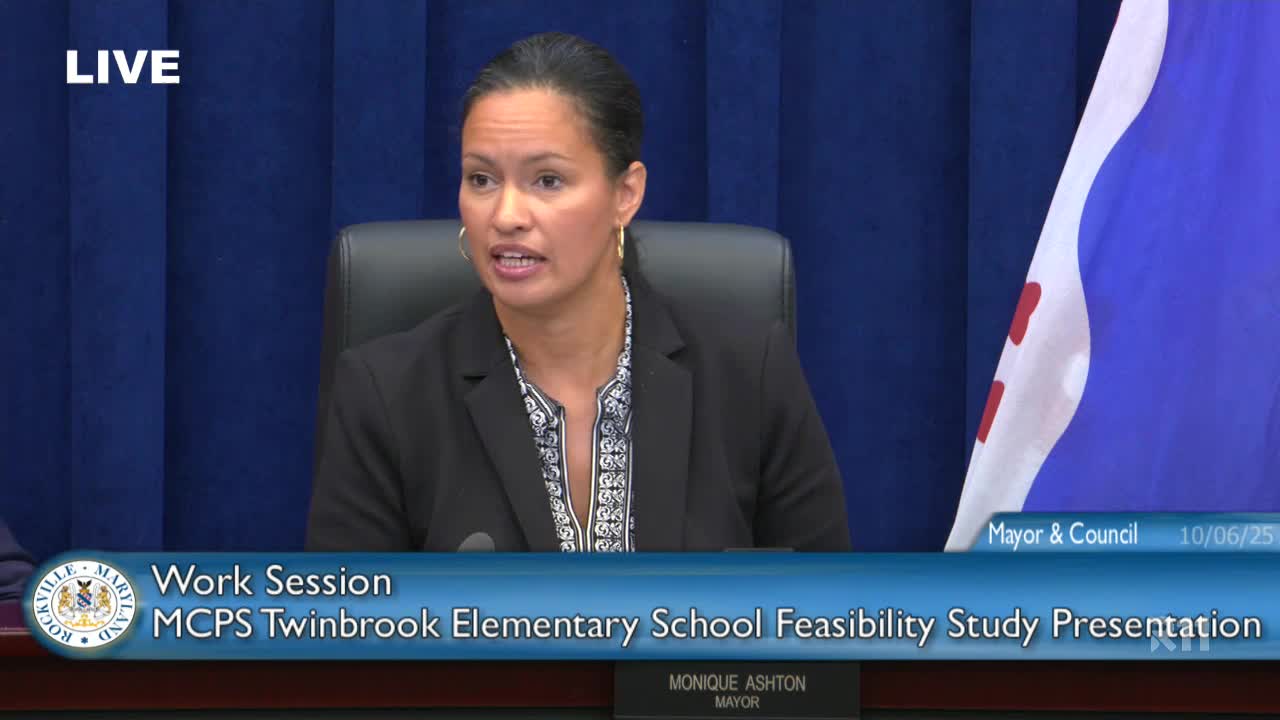
Montgomery County Public Schools presented a feasibility study for Twinbrook Elementary School to the Rockville Mayor and Council on Oct. 6. The study evaluated four options: renovation of the existing building (Option 1); less-than-50% demolition and new construction (Option 2); more-than-50% demolition and new construction (Option 3); and full demolition and replacement with a new building (Option 4).
The feasibility phase analyzed existing conditions, community priorities, circulation and access, and the educational specifications used by MCPS to size classrooms and core spaces. MCPS and its architect presented pros and cons for each option, estimated relative costs and offered construction-timeline estimates; staff said full design and construction timelines are preliminary and will be refined if the project moves forward.
Community participants and school staff told MCPS they prioritize preserving open play fields (soccer and softball), keeping after-school and weekend access for sports and community events, and improving playground visibility for supervisors. The current building’s awkward orientation and limited daylight in interior spaces were repeatedly cited as constraints. The school community also raised traffic and safety concerns on Wainwright Avenue and asked staff to reduce conflict between car drop-off, bus circulation and after-school uses.
MCPS’s options, as presented:
- Option 1 (Renewal): Renovate the existing building and systems, add accessibility improvements and a new elevator for the two‑story portion. Pros: lower cost and retention of the existing community-sized gym; cons: limited ability to meet modern educational specifications and daylighting requirements.
- Option 2 (<50% demolition): Partial demolition and new construction to improve circulation and program adjacencies while keeping significant existing fabric. Pros: better program alignment than Option 1 and improved site circulation; cons: still constrained in some key program areas and increases cost relative to Option 1.
- Option 3 (>50% demolition): Larger demolition and a two‑story wing to reduce site footprint while increasing indoor program capacity. Pros: improved educational spaces and circulation; cons: major construction impacts and cost increases.
- Option 4 (Full replacement): Demolish the existing school and construct a new two‑story facility with consolidated circulation, clearer entries, and fields and play areas visible from street frontages. Pros: meets the education specification, improves sustainability and accessibility, and best addresses playground visibility; cons: the highest upfront construction cost. Architects estimated multi‑month design phases followed by roughly 24 months of construction for major options; staff cautioned timelines are estimates.
Council members and community advocates voiced strong interest in Option 4 — a complete replacement — though they did not adopt a formal council position at the meeting. Several council members said they favored the full rebuild because it best addresses long-standing functional problems, accessibility and future needs. The mayor and multiple council members also asked whether the city could help pay for an upgraded community‑sized gym, which the neighborhood said is a heavily used venue for sports and gatherings. Council members cited prior city contributions to other local school gym projects and asked staff to explore possible sources of city support; one council member mentioned a prior local contribution to Bayard Rustin as a precedent and asked staff to confirm the amount.
MCPS noted that Linkages to Learning and other wraparound services are considered alternates in the county’s educational specification and that dedicated space for those programs can be included in design if funding and site plans permit. The presenters also said core building spaces in the feasibility analysis were sized to accommodate up to about 640 students and that MCPS could consider design flexibility to support up to about 740 students if warranted.
Timing and next steps: MCPS and the school system are completing the capital improvement plan (CIP) schedule; staff said the City’s CIP publication was scheduled for Oct. 13 and MCPS will receive the feasibility report for inclusion in its CIP deliberations. The MCPS school‑board timeline included public hearings and a November decision point noted by presenters; councilmembers were invited to the county CIP hearings and asked staff to include Twinbrook advocacy in testimony to the county and state partners.
Speakers quoted or summarized in this article appear in the speaker list below.
The feasibility phase analyzed existing conditions, community priorities, circulation and access, and the educational specifications used by MCPS to size classrooms and core spaces. MCPS and its architect presented pros and cons for each option, estimated relative costs and offered construction-timeline estimates; staff said full design and construction timelines are preliminary and will be refined if the project moves forward.
Community participants and school staff told MCPS they prioritize preserving open play fields (soccer and softball), keeping after-school and weekend access for sports and community events, and improving playground visibility for supervisors. The current building’s awkward orientation and limited daylight in interior spaces were repeatedly cited as constraints. The school community also raised traffic and safety concerns on Wainwright Avenue and asked staff to reduce conflict between car drop-off, bus circulation and after-school uses.
MCPS’s options, as presented:
- Option 1 (Renewal): Renovate the existing building and systems, add accessibility improvements and a new elevator for the two‑story portion. Pros: lower cost and retention of the existing community-sized gym; cons: limited ability to meet modern educational specifications and daylighting requirements.
- Option 2 (<50% demolition): Partial demolition and new construction to improve circulation and program adjacencies while keeping significant existing fabric. Pros: better program alignment than Option 1 and improved site circulation; cons: still constrained in some key program areas and increases cost relative to Option 1.
- Option 3 (>50% demolition): Larger demolition and a two‑story wing to reduce site footprint while increasing indoor program capacity. Pros: improved educational spaces and circulation; cons: major construction impacts and cost increases.
- Option 4 (Full replacement): Demolish the existing school and construct a new two‑story facility with consolidated circulation, clearer entries, and fields and play areas visible from street frontages. Pros: meets the education specification, improves sustainability and accessibility, and best addresses playground visibility; cons: the highest upfront construction cost. Architects estimated multi‑month design phases followed by roughly 24 months of construction for major options; staff cautioned timelines are estimates.
Council members and community advocates voiced strong interest in Option 4 — a complete replacement — though they did not adopt a formal council position at the meeting. Several council members said they favored the full rebuild because it best addresses long-standing functional problems, accessibility and future needs. The mayor and multiple council members also asked whether the city could help pay for an upgraded community‑sized gym, which the neighborhood said is a heavily used venue for sports and gatherings. Council members cited prior city contributions to other local school gym projects and asked staff to explore possible sources of city support; one council member mentioned a prior local contribution to Bayard Rustin as a precedent and asked staff to confirm the amount.
MCPS noted that Linkages to Learning and other wraparound services are considered alternates in the county’s educational specification and that dedicated space for those programs can be included in design if funding and site plans permit. The presenters also said core building spaces in the feasibility analysis were sized to accommodate up to about 640 students and that MCPS could consider design flexibility to support up to about 740 students if warranted.
Timing and next steps: MCPS and the school system are completing the capital improvement plan (CIP) schedule; staff said the City’s CIP publication was scheduled for Oct. 13 and MCPS will receive the feasibility report for inclusion in its CIP deliberations. The MCPS school‑board timeline included public hearings and a November decision point noted by presenters; councilmembers were invited to the county CIP hearings and asked staff to include Twinbrook advocacy in testimony to the county and state partners.
Speakers quoted or summarized in this article appear in the speaker list below.
View the Full Meeting & All Its Details
This article offers just a summary. Unlock complete video, transcripts, and insights as a Founder Member.
✓
Watch full, unedited meeting videos
✓
Search every word spoken in unlimited transcripts
✓
AI summaries & real-time alerts (all government levels)
✓
Permanent access to expanding government content
30-day money-back guarantee
