Forecast: Arkansas prison population rising; parole returns and longer sentences drive growth
August 11, 2025 | 2025 Legislative Meetings, Arkansas
This article was created by AI summarizing key points discussed. AI makes mistakes, so for full details and context, please refer to the video of the full meeting. Please report any errors so we can fix them. Report an error »
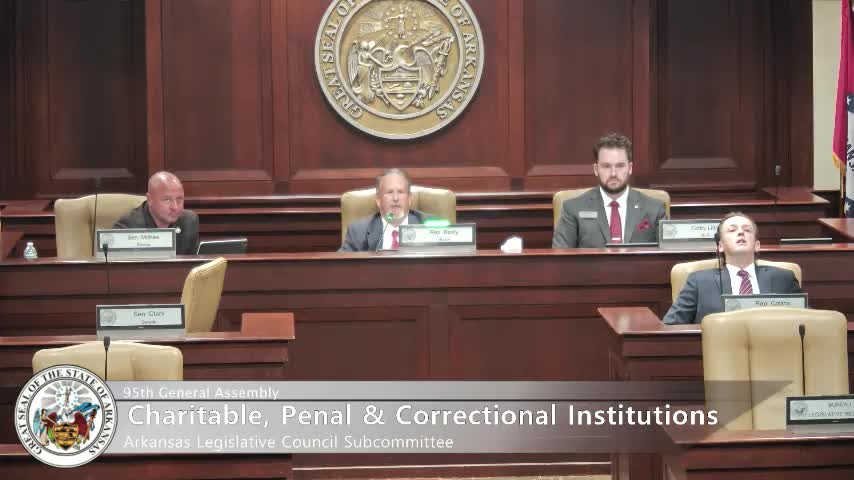
A consultant who prepares Arkansas prison forecasts told a legislative committee the state's corrections population has been growing and that policy and sentence changes are the primary drivers.
Wendy Ware, senior vice president at CGL (formerly JFA Associates), presented long-term trends and forecasts, explaining that prison population equals the number of admissions multiplied by average length of stay. She said admissions have risen since 2020 and that, across a longer span, admissions grew about 2% per year. Since 2020, Ware said, the state has seen a sharper rise: roughly 5.5% annual increases in recent years.
Ware highlighted several policy drivers. Parole violators admitted with new charges now make up roughly half of statewide admissions; she attributed that increase to a 2013 "zero-tolerance" policy for parole violators. Prisoners who must serve 70% of their sentence have also increased as a share of the population, rising from about 17% in 2014 to about 23% in 2023.
The forecast incorporated recent law changes. Ware said the Protect Arkansas Act (referenced in the hearing) is expected to increase long-term bed needs; its full effect will appear gradually and is likely to add significant bed demand in the middle 2030s as today’s long-term sentences age and accumulate. She also said the elimination of earlier emergency-release mechanisms (EPA releases) increased the population in the near term.
Ware and committee counsel reiterated that the forecast is not a capacity plan but a projections tool: "we tell you how many beds you're going to need," she said, rather than fitting forecasts to existing capacity. She noted that release-practice changes are a major factor: a higher share of inmates are being held beyond their transfer-eligibility date, and Ware said 2023 data show the average delay was about ten months with roughly 83% of individuals detained beyond the earliest eligibility.
Why it matters: The forecast affects planning for new bed capacity and long-term budget requests. Ware said that without policy or sentencing changes, projected growth and the added effects of the Protect Arkansas Act will raise bed needs and costs.
What comes next: The consultant will finalize reports and make underlying datasets available to staff; lawmakers asked for additional detail on technical violators, probation cohorts and community corrections capacity.
Wendy Ware, senior vice president at CGL (formerly JFA Associates), presented long-term trends and forecasts, explaining that prison population equals the number of admissions multiplied by average length of stay. She said admissions have risen since 2020 and that, across a longer span, admissions grew about 2% per year. Since 2020, Ware said, the state has seen a sharper rise: roughly 5.5% annual increases in recent years.
Ware highlighted several policy drivers. Parole violators admitted with new charges now make up roughly half of statewide admissions; she attributed that increase to a 2013 "zero-tolerance" policy for parole violators. Prisoners who must serve 70% of their sentence have also increased as a share of the population, rising from about 17% in 2014 to about 23% in 2023.
The forecast incorporated recent law changes. Ware said the Protect Arkansas Act (referenced in the hearing) is expected to increase long-term bed needs; its full effect will appear gradually and is likely to add significant bed demand in the middle 2030s as today’s long-term sentences age and accumulate. She also said the elimination of earlier emergency-release mechanisms (EPA releases) increased the population in the near term.
Ware and committee counsel reiterated that the forecast is not a capacity plan but a projections tool: "we tell you how many beds you're going to need," she said, rather than fitting forecasts to existing capacity. She noted that release-practice changes are a major factor: a higher share of inmates are being held beyond their transfer-eligibility date, and Ware said 2023 data show the average delay was about ten months with roughly 83% of individuals detained beyond the earliest eligibility.
Why it matters: The forecast affects planning for new bed capacity and long-term budget requests. Ware said that without policy or sentencing changes, projected growth and the added effects of the Protect Arkansas Act will raise bed needs and costs.
What comes next: The consultant will finalize reports and make underlying datasets available to staff; lawmakers asked for additional detail on technical violators, probation cohorts and community corrections capacity.
View the Full Meeting & All Its Details
This article offers just a summary. Unlock complete video, transcripts, and insights as a Founder Member.
✓
Watch full, unedited meeting videos
✓
Search every word spoken in unlimited transcripts
✓
AI summaries & real-time alerts (all government levels)
✓
Permanent access to expanding government content
30-day money-back guarantee
