LATC urges flexible, science‑based approach to proposed ‘Zone 0’ defensible‑space rules
October 22, 2025 | Landscape Architects Technical Committee, Other State Agencies, Executive, California
This article was created by AI summarizing key points discussed. AI makes mistakes, so for full details and context, please refer to the video of the full meeting. Please report any errors so we can fix them. Report an error »
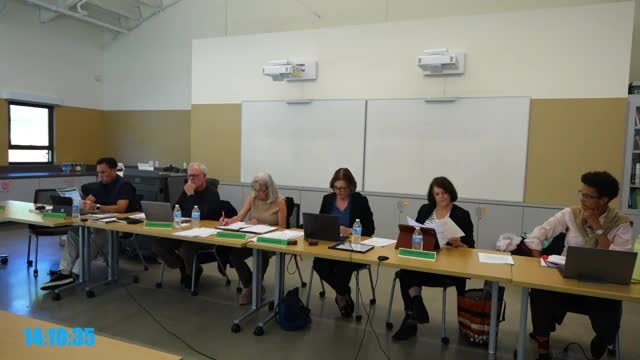
The Landscape Architects Technical Committee discussed draft statewide rules for a five‑foot “Zone 0” defensible space around buildings and urged a flexible approach that preserves some living plantings while restricting combustible materials.
Committee members reviewed four draft policy options that range from a near‑total ban on planted materials in the 0–5‑foot strip around a structure to more permissive approaches that allow potted or low‑growing plants if maintained and kept free of dead leaves, needles and combustible mulches. The LATC emphasized that a rule that removes all vegetation risks negative public‑health and local climate effects while delivering unclear benefits in extreme ember‑driven fires.
“Some plants have helped cool ember showers and protected structures in past fires,” Vice Chair Patricia Trapp said during the discussion. Committee members pointed to recorded cases where well‑maintained vegetation reduced firebrand impacts and urged regulators to avoid one‑size‑fits‑all prescriptions that do not account for local climate, parcel size and urban fabric.
Why it matters: the draft regulation would apply statewide in State Responsibility Areas and to properties in local responsibility areas that the state designates as Very High Fire Hazard Severity Zones. Where adopted, the rule would phase in building and landscape requirements over several years, affecting homeowners, landlords, landscape contractors and municipal planners.
Key points discussed
- Four options: (1) only small potted plants; (2) potted plants plus very low planted groundcover under a 4‑inch threshold; (3) low plantings allowed if spaced and kept below an 18‑inch height and not directly in front of windows/vents; (4) more permissive allowance for planted materials but explicit ban on fallen leaves, needles, weeds and combustible mulches. LATC members generally favored an approach closest to option 3 or a worded variant of option 4 that preserves planted material but requires active maintenance and spacing to reduce ember transmission.
- Trees: the draft includes alternative formulations for tree canopy near roofs and chimneys. The committee supported limits on branches over roofs and chimneys but urged clearer, practically enforceable measures (for instance, trimming to keep canopy away from the roofline) and recognition of local tree‑protection ordinances.
- Fences and outbuildings: draft language would require fences and gates attached to the building (or within the five‑foot zone) to be noncombustible. Members asked the Board of Forestry to clarify whether treated wood or specific ASTM/NFPA‑listed treatments would qualify.
- Local discretion and equivalency: the LATC supported language allowing authorities having jurisdiction to approve alternate methods that deliver the same level of fire safety, so long as alternatives are demonstrably effective for local conditions.
Committee recommendation and next steps
The LATC agreed to submit comments urging a flexible, scientifically informed standard that: (a) restricts combustible debris (fallen leaves, needles, dead/dying plants and combustible mulches) in Zone 0; (b) allows living, irrigated and maintained plants where they are appropriately spaced and do not create direct flame paths to building openings; (c) clarifies tree‑canopy setbacks and provides a path for local agencies to adopt alternative, evidence‑based compliance approaches; and (d) asks the Board of Forestry to work with landscape subject‑matter experts to develop a list (or negative list) of plant materials that demonstrably increase ember ignitability.
Committee members planned to attend the Board of Forestry public rule session this Thursday and provide the LATC’s written comments supporting a performance‑based, locally adaptable approach.
Ending: LATC members said they will follow the rulemaking closely and offered LATC staff and volunteer subject‑matter experts to help craft practical guidance that balances ember risk with urban heat, equity and ecosystem considerations.
Committee members reviewed four draft policy options that range from a near‑total ban on planted materials in the 0–5‑foot strip around a structure to more permissive approaches that allow potted or low‑growing plants if maintained and kept free of dead leaves, needles and combustible mulches. The LATC emphasized that a rule that removes all vegetation risks negative public‑health and local climate effects while delivering unclear benefits in extreme ember‑driven fires.
“Some plants have helped cool ember showers and protected structures in past fires,” Vice Chair Patricia Trapp said during the discussion. Committee members pointed to recorded cases where well‑maintained vegetation reduced firebrand impacts and urged regulators to avoid one‑size‑fits‑all prescriptions that do not account for local climate, parcel size and urban fabric.
Why it matters: the draft regulation would apply statewide in State Responsibility Areas and to properties in local responsibility areas that the state designates as Very High Fire Hazard Severity Zones. Where adopted, the rule would phase in building and landscape requirements over several years, affecting homeowners, landlords, landscape contractors and municipal planners.
Key points discussed
- Four options: (1) only small potted plants; (2) potted plants plus very low planted groundcover under a 4‑inch threshold; (3) low plantings allowed if spaced and kept below an 18‑inch height and not directly in front of windows/vents; (4) more permissive allowance for planted materials but explicit ban on fallen leaves, needles, weeds and combustible mulches. LATC members generally favored an approach closest to option 3 or a worded variant of option 4 that preserves planted material but requires active maintenance and spacing to reduce ember transmission.
- Trees: the draft includes alternative formulations for tree canopy near roofs and chimneys. The committee supported limits on branches over roofs and chimneys but urged clearer, practically enforceable measures (for instance, trimming to keep canopy away from the roofline) and recognition of local tree‑protection ordinances.
- Fences and outbuildings: draft language would require fences and gates attached to the building (or within the five‑foot zone) to be noncombustible. Members asked the Board of Forestry to clarify whether treated wood or specific ASTM/NFPA‑listed treatments would qualify.
- Local discretion and equivalency: the LATC supported language allowing authorities having jurisdiction to approve alternate methods that deliver the same level of fire safety, so long as alternatives are demonstrably effective for local conditions.
Committee recommendation and next steps
The LATC agreed to submit comments urging a flexible, scientifically informed standard that: (a) restricts combustible debris (fallen leaves, needles, dead/dying plants and combustible mulches) in Zone 0; (b) allows living, irrigated and maintained plants where they are appropriately spaced and do not create direct flame paths to building openings; (c) clarifies tree‑canopy setbacks and provides a path for local agencies to adopt alternative, evidence‑based compliance approaches; and (d) asks the Board of Forestry to work with landscape subject‑matter experts to develop a list (or negative list) of plant materials that demonstrably increase ember ignitability.
Committee members planned to attend the Board of Forestry public rule session this Thursday and provide the LATC’s written comments supporting a performance‑based, locally adaptable approach.
Ending: LATC members said they will follow the rulemaking closely and offered LATC staff and volunteer subject‑matter experts to help craft practical guidance that balances ember risk with urban heat, equity and ecosystem considerations.
View the Full Meeting & All Its Details
This article offers just a summary. Unlock complete video, transcripts, and insights as a Founder Member.
✓
Watch full, unedited meeting videos
✓
Search every word spoken in unlimited transcripts
✓
AI summaries & real-time alerts (all government levels)
✓
Permanent access to expanding government content
30-day money-back guarantee
