Farmington board hears First Amendment briefing; members dispute chair’s public post and a board communication
October 22, 2025 | Farmington School District, School Districts, Connecticut
This article was created by AI summarizing key points discussed. AI makes mistakes, so for full details and context, please refer to the video of the full meeting. Please report any errors so we can fix them. Report an error »
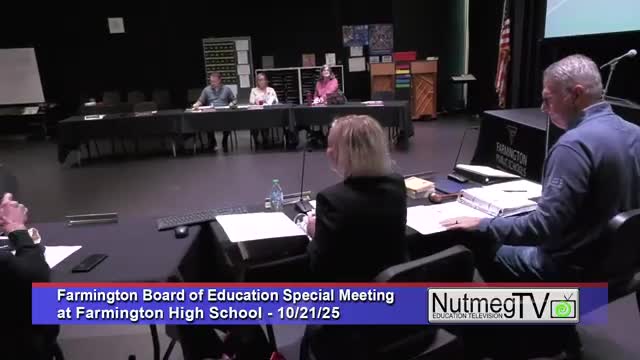
Farmington — At a special meeting Oct. 21, the Farmington Board of Education received a legal briefing on First Amendment limits and the board’s bylaws, and several members pressed for clarity after a controversial Facebook post by Board Chair Bill Becker and a subsequent communication distributed “on behalf of the board.”
Attorney Tom Mooney gave the board a timed presentation on how free-speech rules differ for students, public employees and elected board members, reviewing U.S. Supreme Court precedents including Tinker v. Des Moines and more recent social-media rulings. "It can hardly be argued that students or teachers shed their constitutional rights at the schoolhouse gate," Mooney said, summarizing the Tinker standard for regulating student speech.
The briefing led into a sustained discussion by board members about whether a letter circulated to parents and the community had been sent properly and whether individual members’ online posts — including one by Chair Bill Becker — required board accountability. "My name is Clyde Stack because I did not agree with that communication nor do I have any discussion," Board member Clyde Stack said. Stack also said his home was defaced and that the Farmington police were investigating a threat he connected to rhetoric from other board members.
Mooney told the board there is no mechanism under Connecticut law for the board to remove an elected member from office; a board may, however, remove a board officer (for example, a chair or vice chair) if it has an appropriate policy and follows it. He cited a Connecticut Supreme Court decision in a Winchester board dispute that reinstated an officer after the board failed to follow its own removal procedures. "If you have a policy you have to follow it," Mooney said.
Board members reviewed Farmington bylaws during the discussion. One bylaw cited during the meeting, Bylaw 9015 (Transaction of Business), reads in part that "individual members shall make no commitments for the board or issue orders for the board except when executing an assignment delegated by the board," a point several members invoked when objecting to the communication that was signed "on behalf of the board." The board’s existing policy language also identifies the chair as the board spokesperson, and Vice Chair Andrea Sabinski was identified as the alternate in the chair’s absence; the bylaw number for that provision was cited in the meeting as Bylaw 912.
Several members asked how agenda items are set and how special meetings are requested. Mooney and other participants explained that, under state law and the board’s bylaws, three board members may call a special meeting if the chair will not, and the special meeting’s agenda must reflect the request. Members said eight requests prompted the Oct. 21 special meeting; the group discussed the difference between regular and special meetings and noted that, under Connecticut’s Freedom of Information Law, boards must limit discussion at special meetings to posted agenda items.
Board members debated whether the chair’s role as spokesperson includes responsibility to consult other board leaders or the superintendent before sending communications that purport to represent the full board. Superintendent Kathy (first name given in the meeting) said that during her 16 years she has understood the chair to be the board’s spokesperson and that any change to that practice should be made in the bylaws.
No formal action or vote was taken at the Oct. 21 session. Several board members suggested referring the model policy on removal of officers and related bylaw language to the policy committee for further review; Mooney described the materials he provided as a model for the board to consider, not a directive. "Whether you wish to consider and or adopt this draft policy is a judgment for you," Mooney said.
The meeting closed with an agreement to follow up on outstanding questions about the specific communication at issue and on possible policy next steps; the board chair adjourned the special meeting.
Ending: The discussion left open whether the board will pursue formal changes to bylaws or adopt a model officer-removal policy. Board members said they expect the policy committee and leadership to clarify the board’s process for communications, spokesperson roles and any accountability measures before bringing any recommendation back to a public meeting.
Attorney Tom Mooney gave the board a timed presentation on how free-speech rules differ for students, public employees and elected board members, reviewing U.S. Supreme Court precedents including Tinker v. Des Moines and more recent social-media rulings. "It can hardly be argued that students or teachers shed their constitutional rights at the schoolhouse gate," Mooney said, summarizing the Tinker standard for regulating student speech.
The briefing led into a sustained discussion by board members about whether a letter circulated to parents and the community had been sent properly and whether individual members’ online posts — including one by Chair Bill Becker — required board accountability. "My name is Clyde Stack because I did not agree with that communication nor do I have any discussion," Board member Clyde Stack said. Stack also said his home was defaced and that the Farmington police were investigating a threat he connected to rhetoric from other board members.
Mooney told the board there is no mechanism under Connecticut law for the board to remove an elected member from office; a board may, however, remove a board officer (for example, a chair or vice chair) if it has an appropriate policy and follows it. He cited a Connecticut Supreme Court decision in a Winchester board dispute that reinstated an officer after the board failed to follow its own removal procedures. "If you have a policy you have to follow it," Mooney said.
Board members reviewed Farmington bylaws during the discussion. One bylaw cited during the meeting, Bylaw 9015 (Transaction of Business), reads in part that "individual members shall make no commitments for the board or issue orders for the board except when executing an assignment delegated by the board," a point several members invoked when objecting to the communication that was signed "on behalf of the board." The board’s existing policy language also identifies the chair as the board spokesperson, and Vice Chair Andrea Sabinski was identified as the alternate in the chair’s absence; the bylaw number for that provision was cited in the meeting as Bylaw 912.
Several members asked how agenda items are set and how special meetings are requested. Mooney and other participants explained that, under state law and the board’s bylaws, three board members may call a special meeting if the chair will not, and the special meeting’s agenda must reflect the request. Members said eight requests prompted the Oct. 21 special meeting; the group discussed the difference between regular and special meetings and noted that, under Connecticut’s Freedom of Information Law, boards must limit discussion at special meetings to posted agenda items.
Board members debated whether the chair’s role as spokesperson includes responsibility to consult other board leaders or the superintendent before sending communications that purport to represent the full board. Superintendent Kathy (first name given in the meeting) said that during her 16 years she has understood the chair to be the board’s spokesperson and that any change to that practice should be made in the bylaws.
No formal action or vote was taken at the Oct. 21 session. Several board members suggested referring the model policy on removal of officers and related bylaw language to the policy committee for further review; Mooney described the materials he provided as a model for the board to consider, not a directive. "Whether you wish to consider and or adopt this draft policy is a judgment for you," Mooney said.
The meeting closed with an agreement to follow up on outstanding questions about the specific communication at issue and on possible policy next steps; the board chair adjourned the special meeting.
Ending: The discussion left open whether the board will pursue formal changes to bylaws or adopt a model officer-removal policy. Board members said they expect the policy committee and leadership to clarify the board’s process for communications, spokesperson roles and any accountability measures before bringing any recommendation back to a public meeting.
View the Full Meeting & All Its Details
This article offers just a summary. Unlock complete video, transcripts, and insights as a Founder Member.
✓
Watch full, unedited meeting videos
✓
Search every word spoken in unlimited transcripts
✓
AI summaries & real-time alerts (all government levels)
✓
Permanent access to expanding government content
30-day money-back guarantee
