Punta Gorda moves to modernize Chapter 17 of its utilities code, adding cross‑connection, enforcement and conservation rules
October 22, 2025 | Punta Gorda City, Charlotte County, Florida
This article was created by AI summarizing key points discussed. AI makes mistakes, so for full details and context, please refer to the video of the full meeting. Please report any errors so we can fix them. Report an error »
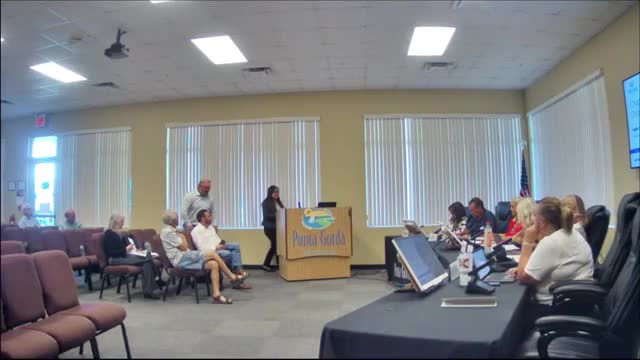
City staff and consultants presented a draft, rewritten Chapter 17 public utilities ordinance at a joint Punta Gorda City Council and Utility Advisory Board session, proposing a comprehensive reorganization of water, wastewater and billing rules.
Nicole Cohen of Corolla Engineers told the assembled council members and Utility Advisory Board that the rewrite is intended to “modernize the ordinance,” clarify responsibilities for customers, developers and the utility department, and strengthen enforcement tools and conservation and emergency‑management provisions.
The draft groups the ordinance into 10 articles and about 90 sections, Cohen said, adding sections for cross‑connection and backflow prevention, pretreatment and fats‑oils‑and‑grease control, metering and high‑consumption review, administrative remedies, and more detailed water conservation and drought‑response stages.
Derek Marie, chair of the Utility Advisory Board, praised the draft for readability: “I read the new Chapter 17. It's fantastic. Very readable,” he said, noting the draft uses a 100‑foot mandatory connection threshold consistently for mandatory connections when existing mains are within that distance.
The draft leaves many monetary amounts — including some permit and administrative fees and the impact fees discussed elsewhere on the agenda — to be adopted by resolution rather than hard‑coding every amount into the ordinance. A commenter in the meeting recommended that routine fees be adopted and updated by annual resolution so that the city can adjust fees during budget cycles without repeated code amendments. Finance Director Kristen Semillon said staff supports that approach and noted the current draft already references rates and impact fees being set “by resolution.”
Other topics discussed during the presentation and public discussion included:
- Cross‑connection and backflow control: The draft explicitly adds a program to protect public health and safety and aligns the ordinance with regulatory requirements.
- Metering and billing: The draft includes procedures for meter installation, testing and appeals, high‑consumption reviews, and lien procedures; staff said they are working to ensure the lien process protects the city’s ability to recover unpaid charges when properties are sold.
- Water conservation and emergencies: The draft specifies year‑round irrigation restrictions, triggers for drought‑response phases and enforcement authority for violations.
- Developer obligations and system extensions: The draft clarifies when connections are mandatory (the 100‑foot rule), when developers must construct off‑site improvements, and adds authority for capacity reservation agreements and inspection/acceptance processes.
Councilmembers and UAB members also discussed incentives and surcharges for certain economic development areas (referred to in the draft as ECAP). Several members suggested removing specific incentive percentages and ECAP references from the ordinance and handling discretionary incentives through separate policy or resolution language so the city retains flexibility.
Cohen said the city’s ordinance structure was reworked to make future additions easier and to make definitions and user types more explicit. Staff said they will incorporate feedback, finalize cross references and links (the city is transitioning to an online code platform), and return the next draft for the formal ordinance adoption process (two readings). No ordinance vote occurred at the workshop.
Council and staff agreed to continue refining the draft and to bring a final ordinance package back for public hearings and council readings.
Nicole Cohen of Corolla Engineers told the assembled council members and Utility Advisory Board that the rewrite is intended to “modernize the ordinance,” clarify responsibilities for customers, developers and the utility department, and strengthen enforcement tools and conservation and emergency‑management provisions.
The draft groups the ordinance into 10 articles and about 90 sections, Cohen said, adding sections for cross‑connection and backflow prevention, pretreatment and fats‑oils‑and‑grease control, metering and high‑consumption review, administrative remedies, and more detailed water conservation and drought‑response stages.
Derek Marie, chair of the Utility Advisory Board, praised the draft for readability: “I read the new Chapter 17. It's fantastic. Very readable,” he said, noting the draft uses a 100‑foot mandatory connection threshold consistently for mandatory connections when existing mains are within that distance.
The draft leaves many monetary amounts — including some permit and administrative fees and the impact fees discussed elsewhere on the agenda — to be adopted by resolution rather than hard‑coding every amount into the ordinance. A commenter in the meeting recommended that routine fees be adopted and updated by annual resolution so that the city can adjust fees during budget cycles without repeated code amendments. Finance Director Kristen Semillon said staff supports that approach and noted the current draft already references rates and impact fees being set “by resolution.”
Other topics discussed during the presentation and public discussion included:
- Cross‑connection and backflow control: The draft explicitly adds a program to protect public health and safety and aligns the ordinance with regulatory requirements.
- Metering and billing: The draft includes procedures for meter installation, testing and appeals, high‑consumption reviews, and lien procedures; staff said they are working to ensure the lien process protects the city’s ability to recover unpaid charges when properties are sold.
- Water conservation and emergencies: The draft specifies year‑round irrigation restrictions, triggers for drought‑response phases and enforcement authority for violations.
- Developer obligations and system extensions: The draft clarifies when connections are mandatory (the 100‑foot rule), when developers must construct off‑site improvements, and adds authority for capacity reservation agreements and inspection/acceptance processes.
Councilmembers and UAB members also discussed incentives and surcharges for certain economic development areas (referred to in the draft as ECAP). Several members suggested removing specific incentive percentages and ECAP references from the ordinance and handling discretionary incentives through separate policy or resolution language so the city retains flexibility.
Cohen said the city’s ordinance structure was reworked to make future additions easier and to make definitions and user types more explicit. Staff said they will incorporate feedback, finalize cross references and links (the city is transitioning to an online code platform), and return the next draft for the formal ordinance adoption process (two readings). No ordinance vote occurred at the workshop.
Council and staff agreed to continue refining the draft and to bring a final ordinance package back for public hearings and council readings.
View the Full Meeting & All Its Details
This article offers just a summary. Unlock complete video, transcripts, and insights as a Founder Member.
✓
Watch full, unedited meeting videos
✓
Search every word spoken in unlimited transcripts
✓
AI summaries & real-time alerts (all government levels)
✓
Permanent access to expanding government content
30-day money-back guarantee
