Punta Gorda proposes project‑evaluation form to flag utility capacity impacts from county‑area development
October 22, 2025 | Punta Gorda City, Charlotte County, Florida
This article was created by AI summarizing key points discussed. AI makes mistakes, so for full details and context, please refer to the video of the full meeting. Please report any errors so we can fix them. Report an error »
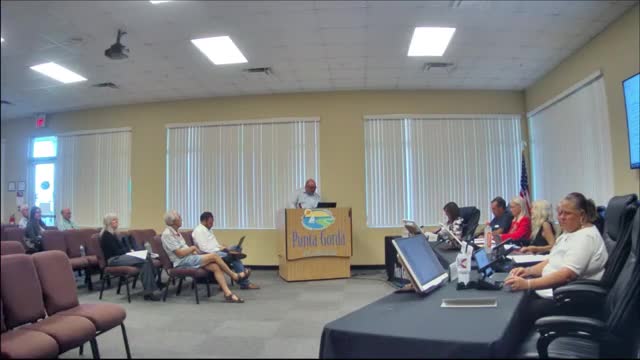
City utilities staff presented a proposed project evaluation form intended to make permit reviews and city‑council notification more systematic for development proposals inside Punta Gorda’s utility service area but outside city limits.
Tom Spencer, Punta Gorda utilities director, and Steve Adams, the city’s utility engineering manager, described the form as a checklist and data capture tool staff will use during utility plan review. The form collects project name and location, engineering firm, classification (residential/commercial), whether a site is inside ECAP, and the modelled water and wastewater demand. Spencer said the form is intended to show whether a proposed project would exceed available peak‑day, peak‑hour or peak‑hour fire‑flow capacity.
Spencer said projects that materially affect capacity would be flagged and brought to the Utility Advisory Board for recommendation and to council for consideration. He told the meeting that, for some projects, staff would ask developers to pay for an updated hydraulic model or water‑plan analysis performed by the city’s consultant and that the developer would pay those study costs.
City attorney counsel and others discussed creating a two‑tier review: routine "minor" projects that meet the current water‑supply plan and can be handled administratively, and "major" projects that require additional review and a developer‑funded analysis. City Attorney Rooney recommended a clear major/minor threshold tied to capacity metrics and possible dollar thresholds so council receives projects that are large enough to affect network planning or city finances. "You maybe create a cost recovery ordinance where you say, if you're in this major category, we want you to go to Corolla and to do a water‑plan analysis because you're probably increasing your capacity demands on the city so much that we wanna see how it impacts the entire system," Rooney said.
Utility Advisory Board Chair Derek Marie asked for a mechanism to ensure commissioners and council receive adequate notice when land‑use changes have utility implications. Several councilmembers and board members suggested developing clear triggers: thresholds measured in ERUs (equivalent residential units), percent of reserve capacity consumed, or a simple dollar‑value threshold tied to projected impact‑fee or connection‑fee revenue.
Staff said they will refine the form, work with the UAB to recommend thresholds, and bring the revised form back to the UAB before presenting it to council for formal adoption. Spencer closed the discussion by saying he will return with the UAB recommendation and a proposed approval path.
Tom Spencer, Punta Gorda utilities director, and Steve Adams, the city’s utility engineering manager, described the form as a checklist and data capture tool staff will use during utility plan review. The form collects project name and location, engineering firm, classification (residential/commercial), whether a site is inside ECAP, and the modelled water and wastewater demand. Spencer said the form is intended to show whether a proposed project would exceed available peak‑day, peak‑hour or peak‑hour fire‑flow capacity.
Spencer said projects that materially affect capacity would be flagged and brought to the Utility Advisory Board for recommendation and to council for consideration. He told the meeting that, for some projects, staff would ask developers to pay for an updated hydraulic model or water‑plan analysis performed by the city’s consultant and that the developer would pay those study costs.
City attorney counsel and others discussed creating a two‑tier review: routine "minor" projects that meet the current water‑supply plan and can be handled administratively, and "major" projects that require additional review and a developer‑funded analysis. City Attorney Rooney recommended a clear major/minor threshold tied to capacity metrics and possible dollar thresholds so council receives projects that are large enough to affect network planning or city finances. "You maybe create a cost recovery ordinance where you say, if you're in this major category, we want you to go to Corolla and to do a water‑plan analysis because you're probably increasing your capacity demands on the city so much that we wanna see how it impacts the entire system," Rooney said.
Utility Advisory Board Chair Derek Marie asked for a mechanism to ensure commissioners and council receive adequate notice when land‑use changes have utility implications. Several councilmembers and board members suggested developing clear triggers: thresholds measured in ERUs (equivalent residential units), percent of reserve capacity consumed, or a simple dollar‑value threshold tied to projected impact‑fee or connection‑fee revenue.
Staff said they will refine the form, work with the UAB to recommend thresholds, and bring the revised form back to the UAB before presenting it to council for formal adoption. Spencer closed the discussion by saying he will return with the UAB recommendation and a proposed approval path.
View the Full Meeting & All Its Details
This article offers just a summary. Unlock complete video, transcripts, and insights as a Founder Member.
✓
Watch full, unedited meeting videos
✓
Search every word spoken in unlimited transcripts
✓
AI summaries & real-time alerts (all government levels)
✓
Permanent access to expanding government content
30-day money-back guarantee
