Residents raise transparency and curriculum concerns; committee moves to executive session on open-meeting complaint
October 01, 2025 | Burlington Public Schools, School Boards, Massachusetts
This article was created by AI summarizing key points discussed. AI makes mistakes, so for full details and context, please refer to the video of the full meeting. Please report any errors so we can fix them. Report an error »
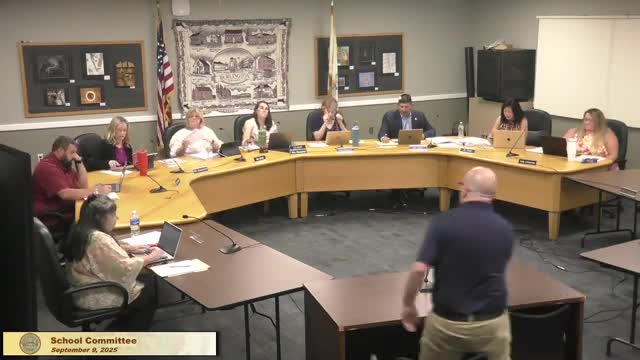
Public commenters at a Burlington Public Schools School Committee meeting on Sept. 21 urged the committee to be more transparent about a recent change to the superintendent’s compensation, raised concerns about staff social-media posts and classroom content, and pressed the committee to explain whether it had followed the state’s open-meeting requirements.
Adam Cenese, a Town Line Road resident and parent who said he is also a town meeting member, told the committee, “I filed the open meeting law complaint,” and asked, “Are you going to come back and vote on anything else later in the evening?” Cenese said he had filed the complaint after what he described as an unanticipated pay change that did not appear on a posted agenda and asked whether the budget presented at town meeting had accounted for any raise.
Why it matters: Commenters framed the issues as questions of public trust and process for a district with major capital work under way. The committee responded by moving into an executive session to acknowledge and discuss the open-meeting law complaint; the committee later returned to public session only for adjournment.
Other speakers tied process concerns to workplace and classroom issues. Willie Mecha, who identified himself as a student, described a series of district controversies and said they made him feel “unsafe,” citing what he called a federal investigation into the Youth Risk Behavior Survey and a separate allegation that a teacher told students “men are not necessary in society.” Mecha also said that some school committee social-media posts, including imagery he characterized as showing bullet holes, had contributed to that feeling.
Resident Adrian Semione urged the committee to do more around student wellness after students in the district reportedly saw a violent video involving a public figure. He also raised questions about the district’s use of social-emotional learning materials, saying, “From what I can see from the budget, we spent $40,000 on the Wayfinder social emotional learning curriculum,” and asking the committee to distinguish between what the state requires and what it recommends. Semione cited 603 CMR 26 and said his reading was that it requires schools to encourage respect for human and civil rights but does not require “celebrat[ion]” of specific identities.
The chair declined to discuss the pending open-meeting-law matter during public comment, saying the committee would not comment on the complaint at that time. The agenda later listed an executive-session item: “pursuant to MGL Chapter 30A, 21A(1) to address the open meeting law complaint. Acknowledge receipt of open meeting law complaint from Adam Sonesi dated 09/15/2025.” Committee members took the motion to enter executive session by roll call; the meeting later returned to public session solely for adjournment.
What the meeting did not resolve: The public comment period raised specific requests — for the committee to explain whether a superintendent raise had been reasonably anticipated in the budget and to identify exactly which lines were adjusted if money was reallocated — but the transcript records those as questions asked during public comment rather than as responses from the committee. Committee members directed requesters to follow up by email for answers, and the chair explicitly declined to discuss the pending complaint in public comment.
Context and next steps: The public record cited during comments included a reference to a complaint dated Sept. 15, 2025; the committee’s executive-session agenda item identified that complaint for acknowledgement and discussion. The transcript shows the committee entered executive session; it returned to public session only for adjournment. No public vote or formal action on the substance of the complaint is recorded in the public portion of the meeting.
Ending: Commenters at the meeting asked the committee to supply clearer budget detail and public documentation of personnel decisions; the transcript shows the committee acknowledged the complaint in executive session and closed the public meeting thereafter.
Adam Cenese, a Town Line Road resident and parent who said he is also a town meeting member, told the committee, “I filed the open meeting law complaint,” and asked, “Are you going to come back and vote on anything else later in the evening?” Cenese said he had filed the complaint after what he described as an unanticipated pay change that did not appear on a posted agenda and asked whether the budget presented at town meeting had accounted for any raise.
Why it matters: Commenters framed the issues as questions of public trust and process for a district with major capital work under way. The committee responded by moving into an executive session to acknowledge and discuss the open-meeting law complaint; the committee later returned to public session only for adjournment.
Other speakers tied process concerns to workplace and classroom issues. Willie Mecha, who identified himself as a student, described a series of district controversies and said they made him feel “unsafe,” citing what he called a federal investigation into the Youth Risk Behavior Survey and a separate allegation that a teacher told students “men are not necessary in society.” Mecha also said that some school committee social-media posts, including imagery he characterized as showing bullet holes, had contributed to that feeling.
Resident Adrian Semione urged the committee to do more around student wellness after students in the district reportedly saw a violent video involving a public figure. He also raised questions about the district’s use of social-emotional learning materials, saying, “From what I can see from the budget, we spent $40,000 on the Wayfinder social emotional learning curriculum,” and asking the committee to distinguish between what the state requires and what it recommends. Semione cited 603 CMR 26 and said his reading was that it requires schools to encourage respect for human and civil rights but does not require “celebrat[ion]” of specific identities.
The chair declined to discuss the pending open-meeting-law matter during public comment, saying the committee would not comment on the complaint at that time. The agenda later listed an executive-session item: “pursuant to MGL Chapter 30A, 21A(1) to address the open meeting law complaint. Acknowledge receipt of open meeting law complaint from Adam Sonesi dated 09/15/2025.” Committee members took the motion to enter executive session by roll call; the meeting later returned to public session solely for adjournment.
What the meeting did not resolve: The public comment period raised specific requests — for the committee to explain whether a superintendent raise had been reasonably anticipated in the budget and to identify exactly which lines were adjusted if money was reallocated — but the transcript records those as questions asked during public comment rather than as responses from the committee. Committee members directed requesters to follow up by email for answers, and the chair explicitly declined to discuss the pending complaint in public comment.
Context and next steps: The public record cited during comments included a reference to a complaint dated Sept. 15, 2025; the committee’s executive-session agenda item identified that complaint for acknowledgement and discussion. The transcript shows the committee entered executive session; it returned to public session only for adjournment. No public vote or formal action on the substance of the complaint is recorded in the public portion of the meeting.
Ending: Commenters at the meeting asked the committee to supply clearer budget detail and public documentation of personnel decisions; the transcript shows the committee acknowledged the complaint in executive session and closed the public meeting thereafter.
View the Full Meeting & All Its Details
This article offers just a summary. Unlock complete video, transcripts, and insights as a Founder Member.
✓
Watch full, unedited meeting videos
✓
Search every word spoken in unlimited transcripts
✓
AI summaries & real-time alerts (all government levels)
✓
Permanent access to expanding government content
30-day money-back guarantee
