Attorney Steven Scofield briefs commission on Brown Act and Public Records Act
October 01, 2025 | Plumas County, California
This article was created by AI summarizing key points discussed. AI makes mistakes, so for full details and context, please refer to the video of the full meeting. Please report any errors so we can fix them. Report an error »
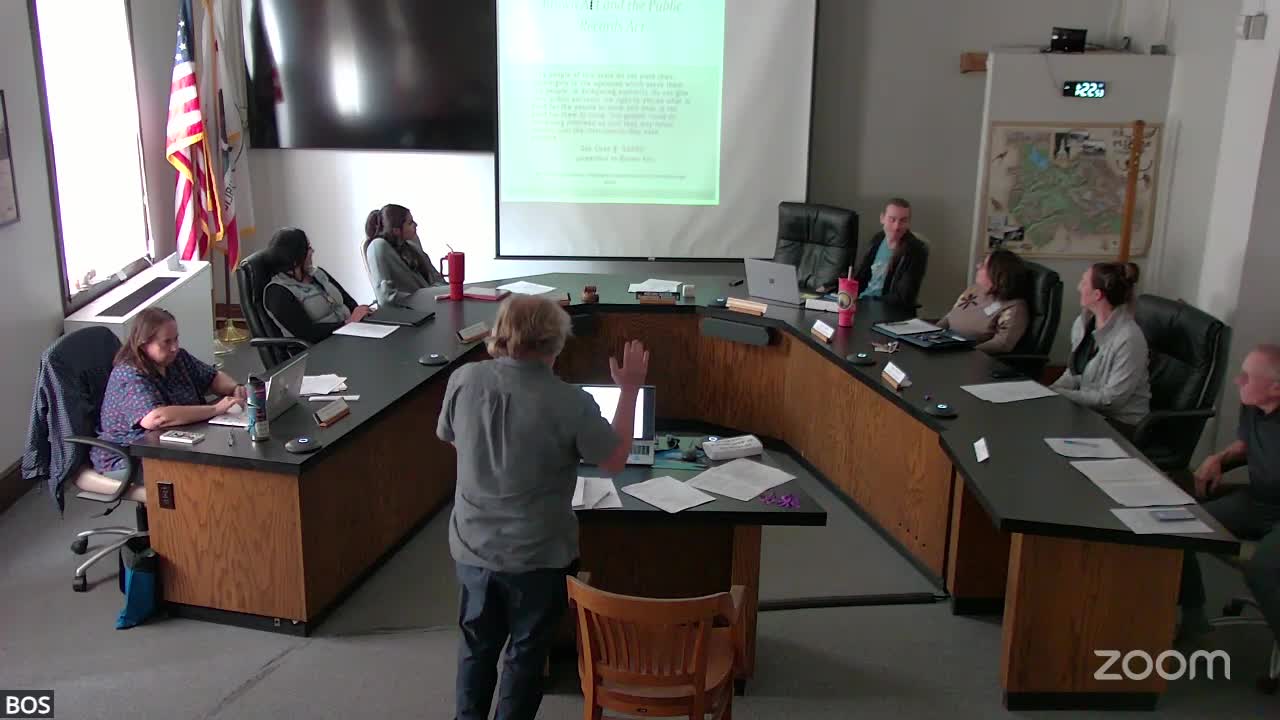
Steven Scofield, who identified himself as an attorney and presenter, gave commissioners an extended briefing on the Brown Act and the Public Records Act, describing core transparency principles and practical compliance steps.
Scofield opened with the Brown Act's preamble, which was read aloud to the commission: "The people of this state do not yield their sovereignty to the agencies which serve them. The people, in delegating authority, do not give their public servants the right to decide what is good for the people to know and what is not good for them to know. The people insist on remaining informed so that they may retain control over the instruments they have created." He used the quotation to frame why open meetings and public records rules exist.
Key points presented:
- Definition of a meeting: A meeting generally occurs when a majority of a legislative body gathers to discuss matters within its jurisdiction; subsidiary bodies and advisory committees can also fall under the rules when they deliberate on agency business.
- Serial meetings: Scofield warned about "daisy chain" and "hub-and-spoke" communications where individual one-on-one contacts or forwarded emails can build a quorum's consensus outside public view. He gave a hypothetical about commissioners informally discussing acquisition of a specific property and said such discussions risk Brown Act violations.
- Teleconferencing and remote participation: The presenter explained that remote participation creates additional posting and access obligations; remote locations must be publicly noticed and accessible for the public to attend and speak. If members participate remotely without making the remote location a public site, they may not be counted toward a quorum or vote.
- Agendas and special meetings: Regular meeting agendas must be posted 72 hours in advance with brief descriptive language; special meetings require 24-hour notice and must be narrowly focused. Adding items after posting is limited and typically requires a two-thirds vote or an emergency justification.
- Public comment and enforcement: Agencies must allow public comment on agenda items and a general comment period. Reasonable time, place and manner rules apply; violations can lead to civil remedies (injunctions, declaratory relief) and, in narrow circumstances, criminal misdemeanor charges when there is intent to deprive the public of information.
- Public Records Act: "Writing" is broadly defined (emails, metadata, photos, recordings, texts) and records are presumed public unless a statutory exemption applies. Agencies generally have 10 days to respond to requests and may seek limited extensions; reasonable search efforts are required and personal devices used for public business can be subject to disclosure.
Scofield recommended practical safeguards: limit off-agenda deliberations, involve county counsel when complex legal advice is needed, and keep transparency principles in mind when communicating outside meetings. The presentation closed with a reminder that the statutes are detailed and nuanced and county counsel is the resource for compliance questions.
No formal action was taken on the presentation; it was an informational briefing.
Scofield opened with the Brown Act's preamble, which was read aloud to the commission: "The people of this state do not yield their sovereignty to the agencies which serve them. The people, in delegating authority, do not give their public servants the right to decide what is good for the people to know and what is not good for them to know. The people insist on remaining informed so that they may retain control over the instruments they have created." He used the quotation to frame why open meetings and public records rules exist.
Key points presented:
- Definition of a meeting: A meeting generally occurs when a majority of a legislative body gathers to discuss matters within its jurisdiction; subsidiary bodies and advisory committees can also fall under the rules when they deliberate on agency business.
- Serial meetings: Scofield warned about "daisy chain" and "hub-and-spoke" communications where individual one-on-one contacts or forwarded emails can build a quorum's consensus outside public view. He gave a hypothetical about commissioners informally discussing acquisition of a specific property and said such discussions risk Brown Act violations.
- Teleconferencing and remote participation: The presenter explained that remote participation creates additional posting and access obligations; remote locations must be publicly noticed and accessible for the public to attend and speak. If members participate remotely without making the remote location a public site, they may not be counted toward a quorum or vote.
- Agendas and special meetings: Regular meeting agendas must be posted 72 hours in advance with brief descriptive language; special meetings require 24-hour notice and must be narrowly focused. Adding items after posting is limited and typically requires a two-thirds vote or an emergency justification.
- Public comment and enforcement: Agencies must allow public comment on agenda items and a general comment period. Reasonable time, place and manner rules apply; violations can lead to civil remedies (injunctions, declaratory relief) and, in narrow circumstances, criminal misdemeanor charges when there is intent to deprive the public of information.
- Public Records Act: "Writing" is broadly defined (emails, metadata, photos, recordings, texts) and records are presumed public unless a statutory exemption applies. Agencies generally have 10 days to respond to requests and may seek limited extensions; reasonable search efforts are required and personal devices used for public business can be subject to disclosure.
Scofield recommended practical safeguards: limit off-agenda deliberations, involve county counsel when complex legal advice is needed, and keep transparency principles in mind when communicating outside meetings. The presentation closed with a reminder that the statutes are detailed and nuanced and county counsel is the resource for compliance questions.
No formal action was taken on the presentation; it was an informational briefing.
View the Full Meeting & All Its Details
This article offers just a summary. Unlock complete video, transcripts, and insights as a Founder Member.
✓
Watch full, unedited meeting videos
✓
Search every word spoken in unlimited transcripts
✓
AI summaries & real-time alerts (all government levels)
✓
Permanent access to expanding government content
30-day money-back guarantee
