West Palm Beach adopts tentative FY2026 budget and keeps millage rate flat at 8.1308 mills
September 10, 2025 | West Palm Beach, Palm Beach County, Florida
This article was created by AI summarizing key points discussed. AI makes mistakes, so for full details and context, please refer to the video of the full meeting. Please report any errors so we can fix them. Report an error »
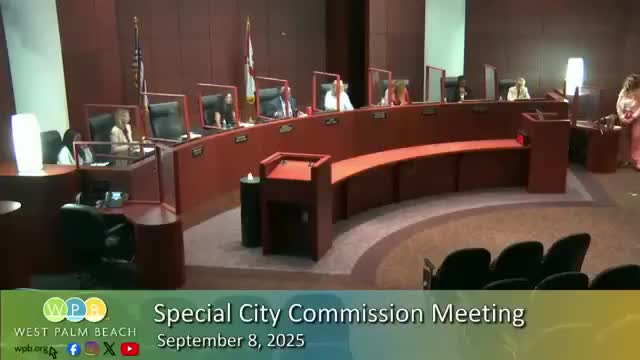
The West Palm Beach City Commission on Sept. 8 held a public hearing and unanimously adopted a tentative fiscal year 2026 budget and a tentative ad valorem millage rate that remains flat at 8.1308 mills.
Bridget Souffrant, the city’s chief financial officer, presented the proposed tentative general fund operating budget and related citywide figures. “Tonight, we bring you the final numbers for the proposed fiscal year 2026 budget,” Souffrant said, noting the tentative general fund operating budget is balanced at $283,563,050 and that the overall citywide balanced budget excluding the Community Redevelopment Agency (CRA) and ECR is $780,541,591. She told the commission the city’s taxable value rose 9.4% to $25,400,000,000, and holding the millage flat would yield about $11.5 million in new tax revenue.
The nut of the commission’s discussion centered on how growth and baseline contractual obligations shape the ability to reduce the millage. City Administrator Johnson explained why city leadership recommended maintaining the current millage rather than pursuing another reduction: “If we did not have mission critical needs, our base increases in the budget [are] below what the revenue is. We could just take that and do a millage reduction. But that’s not the reality of what we are facing right now.” She said increased public safety staffing and other workload-driven positions mean the city needs to allocate revenue to operations rather than cut the rate.
Commissioners asked questions about public engagement and compensation. Commissioner Fox asked how residents’ priorities are incorporated and raised the question he said he’s heard from constituents: “How come we’re not able to turn some of that back to residents?” Administrators described two community budget meetings (one in person, one on Zoom), digital outreach using the city’s BERT engagement tool, and written follow-ups for commissioner-submitted priorities. Johnson and staff said much of the year-over-year increase in spending is contractual or mission-critical (roughly two-thirds of an identified $19.5 million increase, per staff), and that recent pay adjustments were intended to keep the city competitive and address recruitment and retention.
Souffrant outlined major revenue and expenditure drivers: property taxes accounted for about 52.6% of general fund revenue; charges for services and intergovernmental revenue were the next largest categories. On the expense side, personnel services and benefits comprised about 67% of general fund expenditures. The tentative budget includes 49 net new full-time equivalents (FTEs) across the general fund, including additions in fire (11 new positions proposed in the general fund plus others funded in the fire assessment fee fund) and police (33 new positions added to the department with a net FTE change of 12.7 after a budgetary reallocation of code enforcement). The fire assessment fee fund tentative budget was presented as $10,154,577 to cover personnel, materials and one-time capital items and reserves.
Other details noted by staff: an overall increase of $715,246 in the general fund compared with the July draft (driven by revised utility taxes and final state intergovernmental revenue); a $1,500,000 increase to police vehicle capital outlay (part of a $3,700,000 police vehicle program tied to collective bargaining); continued funding of the IT replacement plan at $1,200,000; and a contingency funding increase to meet the policy of budgeting 1% of general fund revenue.
Two resolutions were moved and adopted by voice vote. Commissioner Fox moved to approve the millage-resolution and the motion was seconded; the commission voted unanimously to adopt a tentative ad valorem millage rate of 8.1308 mills (total tentative millage 8.1888 mills when including a 0.058 mills debt service levy). Commissioner Fox then moved to adopt the tentative FY2026 budget (Resolution No. 211-25F as stated in the hearing); the motion was seconded and carried unanimously.
The commission set a final public hearing to adopt the budget and millage rate for Sept. 24; the budget will take effect Oct. 1 if adopted at the final hearing.
Votes at a glance
- Resolution No. 210-25F (tentative ad valorem millage – general operating 8.1308 mills; debt service 0.058 mills; total 8.1888 mills): Moved by Commissioner Fox; second not specified on the record; outcome: approved unanimously. Present: President Lambert; Commissioners Fox, Ward and Warren (voted yes).
- Resolution No. 211-25F (tentative FY2026 budget – general fund balanced at $283,563,050; citywide excluding CRA/ECR $780,541,591): Moved by Commissioner Fox; second not specified on the record; outcome: approved unanimously. Present: President Lambert; Commissioners Fox, Ward and Warren (voted yes).
Ending
Staff said the commission will hold a final public hearing on Sept. 24 to consider final adoption of the millage and budget; that decision will determine whether the tentative figures become the adopted FY2026 budget and rates on Oct. 1.
Bridget Souffrant, the city’s chief financial officer, presented the proposed tentative general fund operating budget and related citywide figures. “Tonight, we bring you the final numbers for the proposed fiscal year 2026 budget,” Souffrant said, noting the tentative general fund operating budget is balanced at $283,563,050 and that the overall citywide balanced budget excluding the Community Redevelopment Agency (CRA) and ECR is $780,541,591. She told the commission the city’s taxable value rose 9.4% to $25,400,000,000, and holding the millage flat would yield about $11.5 million in new tax revenue.
The nut of the commission’s discussion centered on how growth and baseline contractual obligations shape the ability to reduce the millage. City Administrator Johnson explained why city leadership recommended maintaining the current millage rather than pursuing another reduction: “If we did not have mission critical needs, our base increases in the budget [are] below what the revenue is. We could just take that and do a millage reduction. But that’s not the reality of what we are facing right now.” She said increased public safety staffing and other workload-driven positions mean the city needs to allocate revenue to operations rather than cut the rate.
Commissioners asked questions about public engagement and compensation. Commissioner Fox asked how residents’ priorities are incorporated and raised the question he said he’s heard from constituents: “How come we’re not able to turn some of that back to residents?” Administrators described two community budget meetings (one in person, one on Zoom), digital outreach using the city’s BERT engagement tool, and written follow-ups for commissioner-submitted priorities. Johnson and staff said much of the year-over-year increase in spending is contractual or mission-critical (roughly two-thirds of an identified $19.5 million increase, per staff), and that recent pay adjustments were intended to keep the city competitive and address recruitment and retention.
Souffrant outlined major revenue and expenditure drivers: property taxes accounted for about 52.6% of general fund revenue; charges for services and intergovernmental revenue were the next largest categories. On the expense side, personnel services and benefits comprised about 67% of general fund expenditures. The tentative budget includes 49 net new full-time equivalents (FTEs) across the general fund, including additions in fire (11 new positions proposed in the general fund plus others funded in the fire assessment fee fund) and police (33 new positions added to the department with a net FTE change of 12.7 after a budgetary reallocation of code enforcement). The fire assessment fee fund tentative budget was presented as $10,154,577 to cover personnel, materials and one-time capital items and reserves.
Other details noted by staff: an overall increase of $715,246 in the general fund compared with the July draft (driven by revised utility taxes and final state intergovernmental revenue); a $1,500,000 increase to police vehicle capital outlay (part of a $3,700,000 police vehicle program tied to collective bargaining); continued funding of the IT replacement plan at $1,200,000; and a contingency funding increase to meet the policy of budgeting 1% of general fund revenue.
Two resolutions were moved and adopted by voice vote. Commissioner Fox moved to approve the millage-resolution and the motion was seconded; the commission voted unanimously to adopt a tentative ad valorem millage rate of 8.1308 mills (total tentative millage 8.1888 mills when including a 0.058 mills debt service levy). Commissioner Fox then moved to adopt the tentative FY2026 budget (Resolution No. 211-25F as stated in the hearing); the motion was seconded and carried unanimously.
The commission set a final public hearing to adopt the budget and millage rate for Sept. 24; the budget will take effect Oct. 1 if adopted at the final hearing.
Votes at a glance
- Resolution No. 210-25F (tentative ad valorem millage – general operating 8.1308 mills; debt service 0.058 mills; total 8.1888 mills): Moved by Commissioner Fox; second not specified on the record; outcome: approved unanimously. Present: President Lambert; Commissioners Fox, Ward and Warren (voted yes).
- Resolution No. 211-25F (tentative FY2026 budget – general fund balanced at $283,563,050; citywide excluding CRA/ECR $780,541,591): Moved by Commissioner Fox; second not specified on the record; outcome: approved unanimously. Present: President Lambert; Commissioners Fox, Ward and Warren (voted yes).
Ending
Staff said the commission will hold a final public hearing on Sept. 24 to consider final adoption of the millage and budget; that decision will determine whether the tentative figures become the adopted FY2026 budget and rates on Oct. 1.
View the Full Meeting & All Its Details
This article offers just a summary. Unlock complete video, transcripts, and insights as a Founder Member.
✓
Watch full, unedited meeting videos
✓
Search every word spoken in unlimited transcripts
✓
AI summaries & real-time alerts (all government levels)
✓
Permanent access to expanding government content
30-day money-back guarantee
