Anacortes council candidates emphasize revenue sustainability, housing and customer service at forum
October 15, 2025 | Anacortes, Skagit County, Washington
This article was created by AI summarizing key points discussed. AI makes mistakes, so for full details and context, please refer to the video of the full meeting. Please report any errors so we can fix them. Report an error »
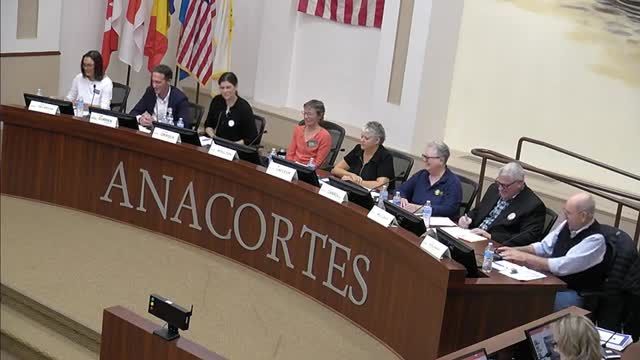
Anacortes City Council candidates speaking at the Anacortes Chamber of Commerce government affairs candidate forum highlighted revenue sustainability and housing as the city’s top near-term challenges, and urged improved responsiveness from city government.
At the forum, Luke Currier, a candidate for City Council position 4 and a former planning commissioner, said the city faces “revenue sustainability” problems and housing shortages. “Building permits are down a third since 2022,” Currier said, and he cited a council retreat projection that the city could face about a $2,000,000 resource cost increase in 2026 and employee benefit increases of roughly 8 percent. “If we want to keep funding public safety, infrastructure, parks, and essential services, we need to grow a revenue base. Not by increasing the tax burden on homeowners, but by strategically and steadily growing our local economy,” he said.
Why it matters: candidates tied revenue and housing directly to workforce and public-safety capacity, saying fewer local workers make it harder to staff emergency services, schools and small businesses.
Candidates offered overlapping and sometimes divergent approaches. Incumbent Councilmember Carolyn Moulton pointed to steps the council has already taken to encourage affordable units — for example, waiving certain hookup charges for accessory dwelling units and supporting projects by the Anacortes Family Center. “We have a housing action plan that we unanimously adopted,” Moulton said, adding that many recommendations will be considered as the city updates development regulations.
Courtney Orrock, running for position 6 and a library trustee, pressed for operational fixes that are not strictly land-use measures: stronger standards for responding to residents and clearer expectations for staff and council-level communications. “There needs to be a standard operating procedure to address communication from citizens,” Orrock said. She suggested formal response timelines, even if the substantive answer must be withheld for legal or staffing reasons.
Teresa Dela Rosa, a candidate for position 4 who described personal experience with housing instability, stressed location and family needs for affordable housing and encouraged conversation about options such as land leases and using vacant properties near schools for family housing.
On supply-side housing measures, multiple candidates endorsed incremental, community-scale steps: expanding ADUs, allowing duplexes/triplexes in appropriate areas, exploring pre-approved plans to speed permitting, and targeted density downtown to support businesses while preserving neighborhood character. Currier also proposed pairing fee waivers and density bonuses with deed restrictions to lock in affordability for selected projects.
Funding and tradeoffs: Moulton warned against diverting lodging tax (LTAC) money away from events that currently generate tourism revenue, noting the city raises about $600,000 a year in lodging tax that funds events and nonprofit support. Several candidates said projects such as the MJB waterfront redevelopment (discussed separately at the forum) could be a long-term economic engine if developed with ecological protections and active public access.
Candidates also urged streamlined permitting, better multi‑year operating forecasts, and closer partnerships with existing local housing developers and nonprofit providers such as the Anacortes Family Center and the Anacortes Housing Authority.
The forum provided little in the way of firm policy commitments — no formal proposals were adopted — but it underscored areas council candidates say they will prioritize if elected: stabilizing city finances by encouraging compatible economic growth, increasing housing supply in ways that maintain local character, and improving responsiveness to residents.
A next step for the city will be the pending comprehensive-plan-related regulatory changes and public hearings; candidates repeatedly encouraged residents to participate in those processes.
At the forum, Luke Currier, a candidate for City Council position 4 and a former planning commissioner, said the city faces “revenue sustainability” problems and housing shortages. “Building permits are down a third since 2022,” Currier said, and he cited a council retreat projection that the city could face about a $2,000,000 resource cost increase in 2026 and employee benefit increases of roughly 8 percent. “If we want to keep funding public safety, infrastructure, parks, and essential services, we need to grow a revenue base. Not by increasing the tax burden on homeowners, but by strategically and steadily growing our local economy,” he said.
Why it matters: candidates tied revenue and housing directly to workforce and public-safety capacity, saying fewer local workers make it harder to staff emergency services, schools and small businesses.
Candidates offered overlapping and sometimes divergent approaches. Incumbent Councilmember Carolyn Moulton pointed to steps the council has already taken to encourage affordable units — for example, waiving certain hookup charges for accessory dwelling units and supporting projects by the Anacortes Family Center. “We have a housing action plan that we unanimously adopted,” Moulton said, adding that many recommendations will be considered as the city updates development regulations.
Courtney Orrock, running for position 6 and a library trustee, pressed for operational fixes that are not strictly land-use measures: stronger standards for responding to residents and clearer expectations for staff and council-level communications. “There needs to be a standard operating procedure to address communication from citizens,” Orrock said. She suggested formal response timelines, even if the substantive answer must be withheld for legal or staffing reasons.
Teresa Dela Rosa, a candidate for position 4 who described personal experience with housing instability, stressed location and family needs for affordable housing and encouraged conversation about options such as land leases and using vacant properties near schools for family housing.
On supply-side housing measures, multiple candidates endorsed incremental, community-scale steps: expanding ADUs, allowing duplexes/triplexes in appropriate areas, exploring pre-approved plans to speed permitting, and targeted density downtown to support businesses while preserving neighborhood character. Currier also proposed pairing fee waivers and density bonuses with deed restrictions to lock in affordability for selected projects.
Funding and tradeoffs: Moulton warned against diverting lodging tax (LTAC) money away from events that currently generate tourism revenue, noting the city raises about $600,000 a year in lodging tax that funds events and nonprofit support. Several candidates said projects such as the MJB waterfront redevelopment (discussed separately at the forum) could be a long-term economic engine if developed with ecological protections and active public access.
Candidates also urged streamlined permitting, better multi‑year operating forecasts, and closer partnerships with existing local housing developers and nonprofit providers such as the Anacortes Family Center and the Anacortes Housing Authority.
The forum provided little in the way of firm policy commitments — no formal proposals were adopted — but it underscored areas council candidates say they will prioritize if elected: stabilizing city finances by encouraging compatible economic growth, increasing housing supply in ways that maintain local character, and improving responsiveness to residents.
A next step for the city will be the pending comprehensive-plan-related regulatory changes and public hearings; candidates repeatedly encouraged residents to participate in those processes.
View the Full Meeting & All Its Details
This article offers just a summary. Unlock complete video, transcripts, and insights as a Founder Member.
✓
Watch full, unedited meeting videos
✓
Search every word spoken in unlimited transcripts
✓
AI summaries & real-time alerts (all government levels)
✓
Permanent access to expanding government content
30-day money-back guarantee
