House panel advances bill to ban specified synthetic food dyes from public school meals with two-year delay
January 14, 2025 | 2025 Legislature VA, Virginia
This article was created by AI summarizing key points discussed. AI makes mistakes, so for full details and context, please refer to the video of the full meeting. Please report any errors so we can fix them. Report an error »
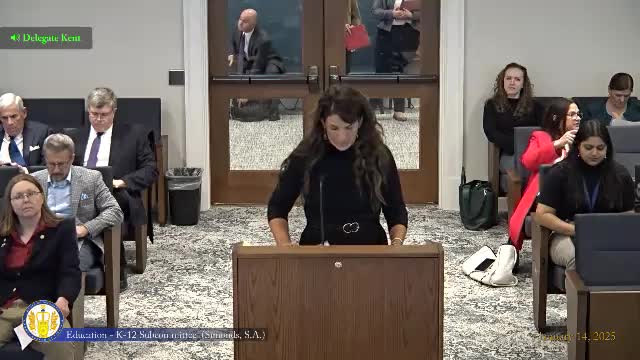
Delegate Kathy Kent presented House Bill 1910 on behalf of the bill’s sponsor, saying the measure would prohibit certain synthetic color additives from school meals and snacks served during instructional time.
The bill names seven commonly used dyes and would bar foods containing them from being offered in Virginia public elementary and secondary schools. "Synthetic dyes have been linked to hyperactivity, emotional meltdowns, ADHD," Kent said while asking for committee support.
Supporters in person and online described anecdotal and scientific reasons for the change. Max Crittendon said school meals directly affect children’s ability to concentrate. Lisa Lefferts, identified as a science consultant and former senior scientist at the Center for Science in the Public Interest, summarized published evidence and told the subcommittee that clinical trials and multiple lines of research show synthetic dyes can worsen neurobehavioral outcomes for some children. Scott Faber, a law professor at Georgetown University Law Center and representative of the Environmental Working Group, told the committee his analysis found only a small share of school-tray items contain the listed dyes and said the FDA has not comprehensively reviewed those additives for decades.
Arlington Public Schools’ Steven Mark registered qualified opposition, saying the division’s concern was potential cost and procurement impacts if vendors cannot supply like-for-like products without the dyes and warning the bill could create an unfunded mandate unless additional funding is provided.
During debate the subcommittee adopted an amendment to delay the bill’s effective date for two years to give school divisions time to adjust procurement. Delegate Russell proposed the two-year delayed effective date; the committee accepted the amendment as offered. After the amendment was made, the subcommittee voted to report HB 1910 as amended; the clerk recorded the final vote as 8 to 0 in favor.
What’s next: The bill as amended was reported out of the K-12 Education Subcommittee 8-0 and will proceed through the legislative process with the two-year delayed effective date attached.
The bill names seven commonly used dyes and would bar foods containing them from being offered in Virginia public elementary and secondary schools. "Synthetic dyes have been linked to hyperactivity, emotional meltdowns, ADHD," Kent said while asking for committee support.
Supporters in person and online described anecdotal and scientific reasons for the change. Max Crittendon said school meals directly affect children’s ability to concentrate. Lisa Lefferts, identified as a science consultant and former senior scientist at the Center for Science in the Public Interest, summarized published evidence and told the subcommittee that clinical trials and multiple lines of research show synthetic dyes can worsen neurobehavioral outcomes for some children. Scott Faber, a law professor at Georgetown University Law Center and representative of the Environmental Working Group, told the committee his analysis found only a small share of school-tray items contain the listed dyes and said the FDA has not comprehensively reviewed those additives for decades.
Arlington Public Schools’ Steven Mark registered qualified opposition, saying the division’s concern was potential cost and procurement impacts if vendors cannot supply like-for-like products without the dyes and warning the bill could create an unfunded mandate unless additional funding is provided.
During debate the subcommittee adopted an amendment to delay the bill’s effective date for two years to give school divisions time to adjust procurement. Delegate Russell proposed the two-year delayed effective date; the committee accepted the amendment as offered. After the amendment was made, the subcommittee voted to report HB 1910 as amended; the clerk recorded the final vote as 8 to 0 in favor.
What’s next: The bill as amended was reported out of the K-12 Education Subcommittee 8-0 and will proceed through the legislative process with the two-year delayed effective date attached.
View the Full Meeting & All Its Details
This article offers just a summary. Unlock complete video, transcripts, and insights as a Founder Member.
✓
Watch full, unedited meeting videos
✓
Search every word spoken in unlimited transcripts
✓
AI summaries & real-time alerts (all government levels)
✓
Permanent access to expanding government content
30-day money-back guarantee
