Glens Falls officials describe $1M emergency switchgear fix, $13–14M electrical upgrade at wastewater plant and broader water/sewer funding challenges
January 14, 2025 | Glens Falls City, Warren County, New York
This article was created by AI summarizing key points discussed. AI makes mistakes, so for full details and context, please refer to the video of the full meeting. Please report any errors so we can fix them. Report an error »
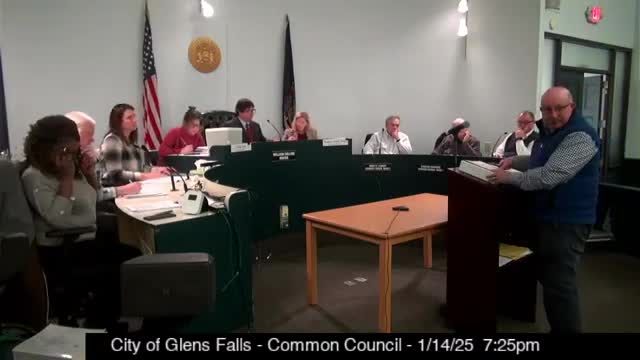
City water and sewer officials told the Common Council that a failure of the wastewater treatment plant’s main switchgear on Dec. 23 required an immediate short-term replacement estimated at roughly $1,000,000 and that a full electrical upgrade of the plant is expected to cost about $13 million to $14 million.
Bill Norton, water and sewer superintendent, said plant staff and a contractor determined the aging switchgear began smoking and failing when crews tried to transfer power to a backup feed. Norton said crews used existing on-site generators and outside contractor High Voltage Electric Services to restore power and that a currently available switch the contractor could install would likely restore reliable operation for “two to three years” while the city completes a full electrical upgrade design.
Norton told the council that the short-term replacement and generator work would cost in the “$1,000,000 range” and that the engineering design for a complete upgrade — including replacement of motor control centers (MCCs) originally installed in 1986 — has been procured and is about 90 percent complete. “Estimates are somewhere in the $13 to $14,000,000 range,” Norton said of the full upgrade, which would include new MCCs and bring electrical systems up to current code.
City Engineer Jeremy Schneibel said the electrical upgrade and other top water/sewer projects were placed on the city’s priority list in 2023 so the city could pursue grants and low-cost financing. Schneibel said the city has pursued multiple funding channels — the New York State Environmental Facilities Corporation (EFC), DEC grants, congressional directed spending, and other sources — and has had mixed success. He noted one federal earmark of $1 million toward water distribution upgrades and a $1 million DEC water-quality grant toward a Washington Street sewer separation project. Schneibel said the city’s applications for larger EFC grants for the electrical project had not scored well; he attributed part of that to changes in the EFC’s disadvantaged community scoring and the difficulty of framing the electrical upgrade as a water-quality project for grant reviewers.
Norton and Schneibel said staff are pursuing three funding paths for the immediate switchgear work: (1) an insurance claim (adjuster to inspect the damaged gear), (2) an appropriation from a city reconstruction fund already set aside for capital repairs, and (3) a council request if insurance does not cover the cost. Mayor and council members said the city expects to have final cost and insurance information in about a month and that the contractor hoped to install the short-term replacement in the first week of February.
Officials cautioned that replacing the obsolete equipment is not only expensive but also subject to long lead times for custom electrical panels; Schneibel said procurement and manufacturing turnaround for major panels has increased to multiple years in some cases. Norton said the temporary replacement could leave the plant operating on generators for an extended period if a permanent upgrade is delayed.
Why it matters: failure of key electrical equipment at a wastewater plant risks service interruptions and environmental impacts if the plant goes offline; the city’s water and sewer systems serve local residents and businesses and are tied into larger regional water-quality obligations.
What’s next: staff will meet with the insurer’s adjuster, finalize estimates and funding recommendations, and return the project and any appropriation requests to the Water and Sewer Commission and the Common Council for approval.
Bill Norton, water and sewer superintendent, said plant staff and a contractor determined the aging switchgear began smoking and failing when crews tried to transfer power to a backup feed. Norton said crews used existing on-site generators and outside contractor High Voltage Electric Services to restore power and that a currently available switch the contractor could install would likely restore reliable operation for “two to three years” while the city completes a full electrical upgrade design.
Norton told the council that the short-term replacement and generator work would cost in the “$1,000,000 range” and that the engineering design for a complete upgrade — including replacement of motor control centers (MCCs) originally installed in 1986 — has been procured and is about 90 percent complete. “Estimates are somewhere in the $13 to $14,000,000 range,” Norton said of the full upgrade, which would include new MCCs and bring electrical systems up to current code.
City Engineer Jeremy Schneibel said the electrical upgrade and other top water/sewer projects were placed on the city’s priority list in 2023 so the city could pursue grants and low-cost financing. Schneibel said the city has pursued multiple funding channels — the New York State Environmental Facilities Corporation (EFC), DEC grants, congressional directed spending, and other sources — and has had mixed success. He noted one federal earmark of $1 million toward water distribution upgrades and a $1 million DEC water-quality grant toward a Washington Street sewer separation project. Schneibel said the city’s applications for larger EFC grants for the electrical project had not scored well; he attributed part of that to changes in the EFC’s disadvantaged community scoring and the difficulty of framing the electrical upgrade as a water-quality project for grant reviewers.
Norton and Schneibel said staff are pursuing three funding paths for the immediate switchgear work: (1) an insurance claim (adjuster to inspect the damaged gear), (2) an appropriation from a city reconstruction fund already set aside for capital repairs, and (3) a council request if insurance does not cover the cost. Mayor and council members said the city expects to have final cost and insurance information in about a month and that the contractor hoped to install the short-term replacement in the first week of February.
Officials cautioned that replacing the obsolete equipment is not only expensive but also subject to long lead times for custom electrical panels; Schneibel said procurement and manufacturing turnaround for major panels has increased to multiple years in some cases. Norton said the temporary replacement could leave the plant operating on generators for an extended period if a permanent upgrade is delayed.
Why it matters: failure of key electrical equipment at a wastewater plant risks service interruptions and environmental impacts if the plant goes offline; the city’s water and sewer systems serve local residents and businesses and are tied into larger regional water-quality obligations.
What’s next: staff will meet with the insurer’s adjuster, finalize estimates and funding recommendations, and return the project and any appropriation requests to the Water and Sewer Commission and the Common Council for approval.
View the Full Meeting & All Its Details
This article offers just a summary. Unlock complete video, transcripts, and insights as a Founder Member.
✓
Watch full, unedited meeting videos
✓
Search every word spoken in unlimited transcripts
✓
AI summaries & real-time alerts (all government levels)
✓
Permanent access to expanding government content
30-day money-back guarantee
