Subcommittee narrows procurement bill to local governments, adopts amendments (HB 1789)
January 14, 2025 | 2025 Legislature VA, Virginia
This article was created by AI summarizing key points discussed. AI makes mistakes, so for full details and context, please refer to the video of the full meeting. Please report any errors so we can fix them. Report an error »
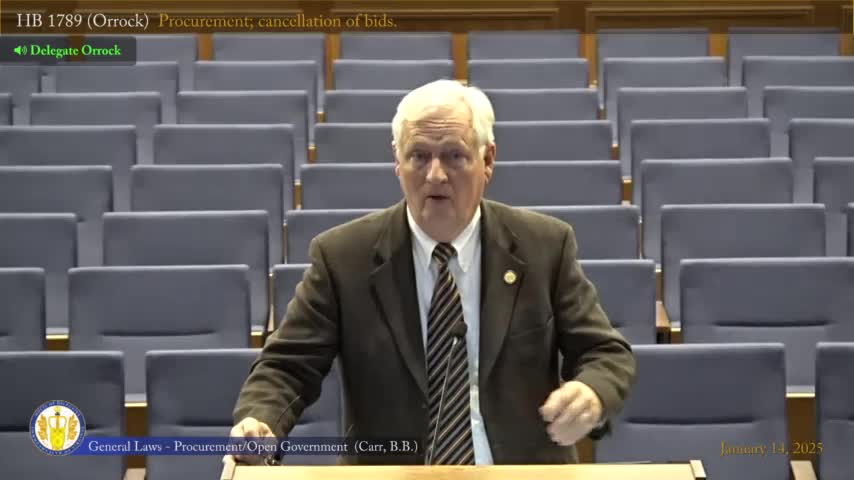
Delegate O'Rourke introduced amendments to HB 1789 and asked the subcommittee to take the bill "by for the day" so he could refine language with stakeholders. The principal change in the line amendments was to narrow references from “public body” to “local government,” limiting the bill’s scope to local jurisdictions.
O'Rourke described a scenario raised by local officials in which visible transportation funds drive up bid prices. He cited an example in which a contractor building a nearby Wawa reportedly charged roughly $1,000,000 for required turn lanes, while the lowest bid the county received for the same work exceeded $3,000,000. “This is just to try and bring in a circumstance whereby the language of this bill is once permissive to local government,” O'Rourke said, explaining the change would allow local governments to advertise a cap or expected private-sector cost as part of the solicitation and to reject bids that exceed that advertised cap.
The intent, the patron said, is to encourage lower bids so local governments can complete more projects within fixed budgets. Under the proposed approach, local governments could accept a bid that falls under the advertised cap or reject all bids and reopen the process if bids exceed the cap; the development and contracting communities would then know why a solicitation was rejected.
Committee counsel and members discussed the mechanics of the change and whether the language added substantive authority beyond existing procurement rules. One member noted that public bodies can already cancel solicitations for a range of articulated reasons; O'Rourke and others said the bill aims to create predictable criteria tied to advertised caps.
The subcommittee adopted two line amendments (to lines 15 and 17) and approved taking the bill "by for the day." The amendments were moved and seconded; the chair called for a voice vote and members responded, "Aye." The patron said he would work with stakeholders and, if no consensus is reached, the bill would remain by the committee.
Why it matters: supporters representing local government officials said the change would help curb bid escalation when local funds are advertised as available, potentially allowing more projects to be completed within local budgets. The subcommittee did not vote the bill out; the patron will seek language acceptable to stakeholders before returning.
O'Rourke described a scenario raised by local officials in which visible transportation funds drive up bid prices. He cited an example in which a contractor building a nearby Wawa reportedly charged roughly $1,000,000 for required turn lanes, while the lowest bid the county received for the same work exceeded $3,000,000. “This is just to try and bring in a circumstance whereby the language of this bill is once permissive to local government,” O'Rourke said, explaining the change would allow local governments to advertise a cap or expected private-sector cost as part of the solicitation and to reject bids that exceed that advertised cap.
The intent, the patron said, is to encourage lower bids so local governments can complete more projects within fixed budgets. Under the proposed approach, local governments could accept a bid that falls under the advertised cap or reject all bids and reopen the process if bids exceed the cap; the development and contracting communities would then know why a solicitation was rejected.
Committee counsel and members discussed the mechanics of the change and whether the language added substantive authority beyond existing procurement rules. One member noted that public bodies can already cancel solicitations for a range of articulated reasons; O'Rourke and others said the bill aims to create predictable criteria tied to advertised caps.
The subcommittee adopted two line amendments (to lines 15 and 17) and approved taking the bill "by for the day." The amendments were moved and seconded; the chair called for a voice vote and members responded, "Aye." The patron said he would work with stakeholders and, if no consensus is reached, the bill would remain by the committee.
Why it matters: supporters representing local government officials said the change would help curb bid escalation when local funds are advertised as available, potentially allowing more projects to be completed within local budgets. The subcommittee did not vote the bill out; the patron will seek language acceptable to stakeholders before returning.
View the Full Meeting & All Its Details
This article offers just a summary. Unlock complete video, transcripts, and insights as a Founder Member.
✓
Watch full, unedited meeting videos
✓
Search every word spoken in unlimited transcripts
✓
AI summaries & real-time alerts (all government levels)
✓
Permanent access to expanding government content
30-day money-back guarantee
