Noem delivers top‑10 State of the State and signals possible departure to federal post
January 14, 2025 | 2025 Legislative SD, South Dakota
This article was created by AI summarizing key points discussed. AI makes mistakes, so for full details and context, please refer to the video of the full meeting. Please report any errors so we can fix them. Report an error »
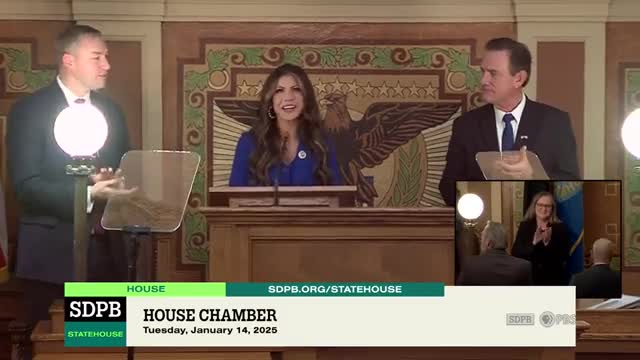
Gov. Kristi Noem delivered the State of the State address to a joint session of the South Dakota Legislature, praising the state’s economy, public safety and rural values while previewing policy priorities for the coming session and referencing a potential move to a federal post.
Noem opened by framing her remarks as a “top 10” list of reasons South Dakota is an example to the nation, and repeatedly noted that she may soon leave the governor’s office if confirmed for a federal appointment. “This may well be the last opportunity that I have to introduce the governor,” Lieutenant Governor Larry Rhoden said when introducing Noem. In the address, Noem told lawmakers she had been asked to serve in President‑elect Trump’s administration and called border security “nothing short of an invasion.” She said, in part, “Leadership has consequences.”
Why it matters: the address combined a political farewell with policy signals that the Republican majority in the Legislature has already said it will consider. Noem highlighted education changes, workforce and health initiatives, a large planned prison project, and emergency response investments—areas likely to shape budget and bill priorities this session.
Most prominent policy touches included a renewed push for education savings accounts (introduced, Noem said, in coordination with Representative Odenbach and Senate Majority Leader Jim Melhoff), health‑care measures such as expanded telehealth and regional mental‑health facilities, and a transfer of the Keep Farmers Farming program to the South Dakota Ag Foundation with a one‑year grant from the governor’s office of economic development. Noem also recounted the state’s response to recent floods, and presented awards to state and local emergency responders.
The speech was largely celebratory: Noem characterized the state’s unemployment rate as the lowest in the nation and credited state initiatives with adding more than 1,100 nurses to the workforce “across all nursing classifications.” She emphasized protections for firearms rights, state‑led law‑enforcement training for tribal officers, and investments in outdoor recreation and conservation.
Reaction from legislators in immediate post‑speech interviews showed the topic areas that are likely to receive early attention. Senate Majority Leader Jim Melhoff said he expects to work on the education savings account proposal; Representative Erin Healy, the incoming House minority leader, said her caucus opposes ESAs and expressed concern that new programs would reduce funds available for public schools.
Two routine motions concluded the joint session: the appointment of a committee to escort the governor to the rostrum (motion carried) and a motion to dissolve the joint meeting (motion carried).
Noem opened by framing her remarks as a “top 10” list of reasons South Dakota is an example to the nation, and repeatedly noted that she may soon leave the governor’s office if confirmed for a federal appointment. “This may well be the last opportunity that I have to introduce the governor,” Lieutenant Governor Larry Rhoden said when introducing Noem. In the address, Noem told lawmakers she had been asked to serve in President‑elect Trump’s administration and called border security “nothing short of an invasion.” She said, in part, “Leadership has consequences.”
Why it matters: the address combined a political farewell with policy signals that the Republican majority in the Legislature has already said it will consider. Noem highlighted education changes, workforce and health initiatives, a large planned prison project, and emergency response investments—areas likely to shape budget and bill priorities this session.
Most prominent policy touches included a renewed push for education savings accounts (introduced, Noem said, in coordination with Representative Odenbach and Senate Majority Leader Jim Melhoff), health‑care measures such as expanded telehealth and regional mental‑health facilities, and a transfer of the Keep Farmers Farming program to the South Dakota Ag Foundation with a one‑year grant from the governor’s office of economic development. Noem also recounted the state’s response to recent floods, and presented awards to state and local emergency responders.
The speech was largely celebratory: Noem characterized the state’s unemployment rate as the lowest in the nation and credited state initiatives with adding more than 1,100 nurses to the workforce “across all nursing classifications.” She emphasized protections for firearms rights, state‑led law‑enforcement training for tribal officers, and investments in outdoor recreation and conservation.
Reaction from legislators in immediate post‑speech interviews showed the topic areas that are likely to receive early attention. Senate Majority Leader Jim Melhoff said he expects to work on the education savings account proposal; Representative Erin Healy, the incoming House minority leader, said her caucus opposes ESAs and expressed concern that new programs would reduce funds available for public schools.
Two routine motions concluded the joint session: the appointment of a committee to escort the governor to the rostrum (motion carried) and a motion to dissolve the joint meeting (motion carried).
Don't Miss a Word: See the Full Meeting!
Go beyond summaries. Unlock every video, transcript, and key insight with a Founder Membership.
✓
Get instant access to full meeting videos
✓
Search and clip any phrase from complete transcripts
✓
Receive AI-powered summaries & custom alerts
✓
Enjoy lifetime, unrestricted access to government data
30-day money-back guarantee
